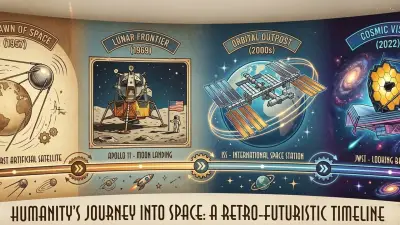
From Sputnik in 1957 to Starship in 2024, humanity has covered 67 years of space exploration. This is the complete timeline of our species' greatest adventure.
🚀 1957-1969: The Space Race
The Cold War ignited the greatest space race in history. On October 4, 1957, the Soviet Union launched Sputnik 1 — the first artificial satellite. Shortly after, Laika became the first animal in orbit. On April 12, 1961, Yuri Gagarin became the first human in space, and in 1963 Valentina Tereshkova became the first woman.
In 1965, Alexei Leonov performed the first spacewalk. And on July 20, 1969, Neil Armstrong and Buzz Aldrin set foot on the Moon with Apollo 11 — the moment that defined a generation.
🛸 1970-1990: Stations and the Shuttle
In 1971, the Soviet Union launched Salyut 1, the first space station. The USA followed with Skylab (1973). In 1975, the Apollo-Soyuz program marked the first international cooperation in space.
In 1981, the Space Shuttle era began — the first reusable spacecraft. In 1986, the Challenger tragedy shocked the world when the shuttle exploded 73 seconds after launch, killing all 7 crew members.
🔭 1990-2010: Telescopes and Rovers
In 1990, the Hubble Space Telescope was launched, transforming our understanding of the universe. In 1998, construction of the International Space Station (ISS) began — a symbol of international cooperation. On Mars, the Spirit, Opportunity, and later Curiosity rovers explored the surface. Cassini studied Saturn for 13 years. New Horizons flew past Pluto in 2015.
💫 2010-2020: Private Space
The 2010s marked the entry of the private sector. In 2004, SpaceShipOne became the first private spacecraft. SpaceX brought revolution with reusable Falcon 9 rockets. In 2019, the Event Horizon Telescope captured the first image of a black hole. In May 2020, Crew Dragon became the first commercial spacecraft to carry astronauts to the ISS.
🌟 2020-2026: A New Era
In December 2021, the James Webb Space Telescope (JWST) launched — the most powerful telescope ever built. In 2022, Artemis I completed the first orbit of the Moon with the SLS rocket. In 2024, SpaceX's Starship test flights demonstrated the future of reusable super-heavy rockets.
💡 Notable: Since November 2, 2000, there has been a continuous human presence in space — over 25 years without interruption. At any given moment, at least two people live and work aboard the ISS.
🔮 What Lies Ahead
NASA's Artemis program plans to return humans to the Moon, aiming for a permanent lunar base as a stepping stone to Mars. SpaceX is developing Starship with the goal of transporting humans to Mars. Private space stations are being planned to replace the ISS.
The robotic Voyager 1 and 2 spacecraft travel through interstellar space — beyond the boundaries of our solar system. From Sputnik to Starship, humanity continues to push the boundaries, making space increasingly accessible.