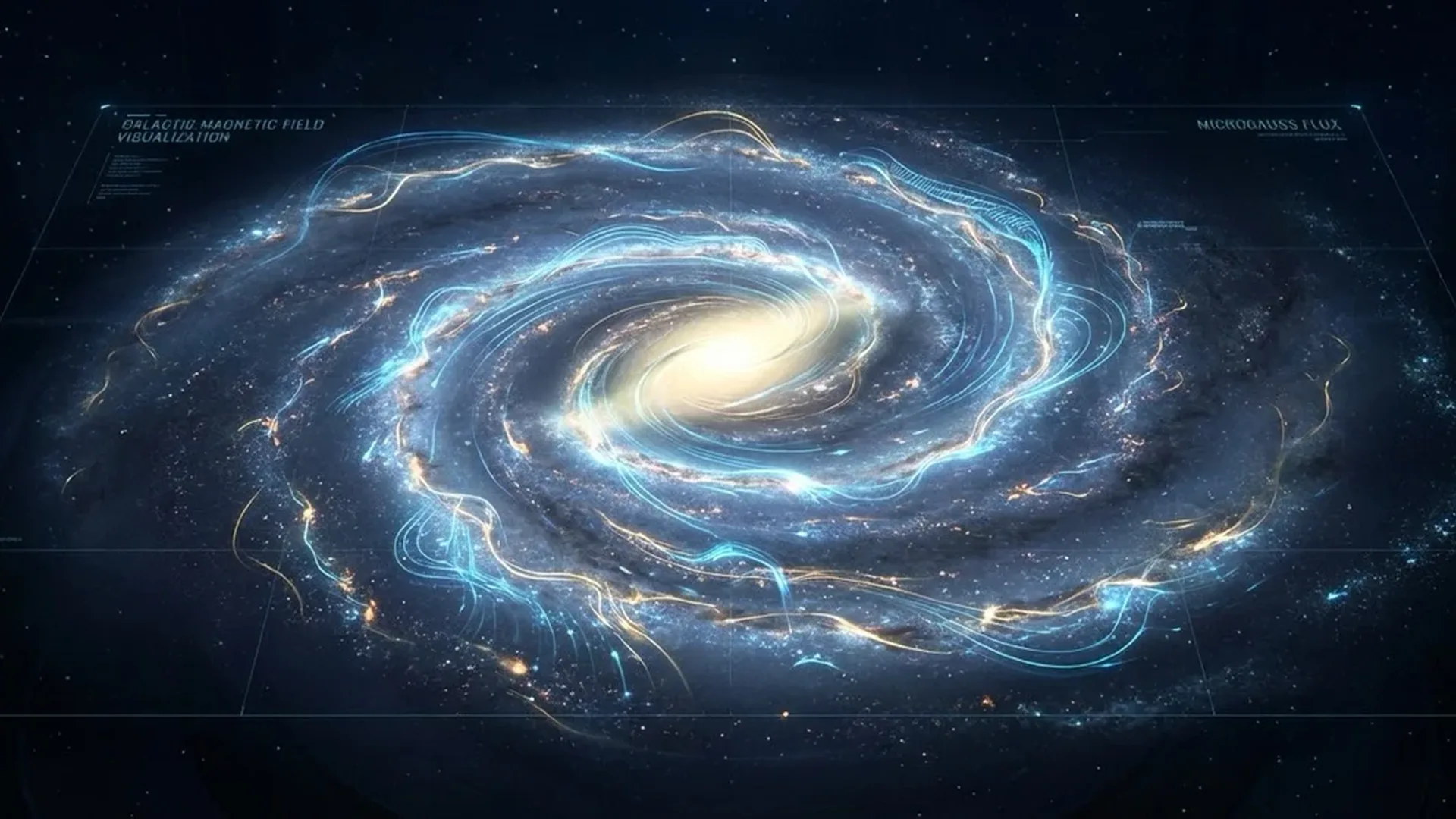
Astronomers at the University of Calgary have created the most detailed map ever made of the Milky Way's magnetic field — and hidden within it is something deeply unexpected: a diagonal magnetic reversal in the Sagittarius Arm that no model of our galaxy had predicted.
📖 Read more: Milky Way-Andromeda Collision: What Happens in 4.5B Years
Why the Galactic Magnetic Field Matters
The Milky Way is threaded throughout by an invisible magnetic field — billions of light-years of field lines that run through interstellar gas, dust, and plasma. This field is not a cosmetic detail. It plays fundamental roles in galactic structure and evolution:
- Preventing gravitational collapse: Without magnetic pressure, gas clouds and galactic arms would collapse faster under gravity
- Regulating star formation: Magnetic fields resist the compression that triggers new star birth — field geometry shapes where and when stars form
- Guiding cosmic rays: High-energy particles spiral along field lines, and the field's topology shapes their paths through the galaxy
- Shaping interstellar medium: Gas flows, turbulence, and shock waves all interact with the magnetic field
"Without a magnetic field, the galaxy would collapse in on itself due to gravity. We need to know what the Milky Way's magnetic field looks like today so we can create accurate models that predict how it will evolve."
— Dr. Jo-Anne Brown, PhD, Professor of Astronomy, University of CalgaryThe New Radio Telescope and GMIMS Survey
The research was conducted using a new radio telescope at the Dominion Radio Astrophysical Observatory (DRAO) in Penticton, British Columbia — a National Research Council Canada facility. The instrument was purpose-built to observe the entire northern sky at multiple radio frequencies simultaneously, enabling a comprehensive magnetic field survey across large sections of the Milky Way.
The data are part of the Global Magneto-Ionic Medium Survey (GMIMS), an international consortium designed to map the magnetic field of the entire Milky Way. Two new papers emerge from this work: one in The Astrophysical Journal (DOI: 10.3847/1538-4357/ae28d1) and one in the Astrophysical Journal Supplement Series (DOI: 10.3847/1538-4365/ae2471), published February 24, 2026.
Faraday Rotation: Reading the Field From Earth
The magnetic field itself is invisible. But astronomers can detect it using a clever technique called Faraday rotation: when radio waves from distant sources travel through a magnetized plasma (ionized gas with a magnetic field), the polarization of those radio waves twists slightly. The amount of twisting depends on the strength and direction of the field along the line of sight.
By measuring thousands of Faraday rotation signals across the sky at frequencies between 350 and 1030 MHz, the team was able to reconstruct a detailed three-dimensional picture of the magnetic field structure across the northern Milky Way.
"You can think of it like refraction. A straw in a glass of water appears bent because of the way light interacts with the water. Faraday rotation is a similar concept, but it's electrons and magnetic fields in space interacting with radio waves."
— Rebecca Booth, PhD Candidate, University of Calgary📖 Read more: nasa-13-billion-year-signal-fast-radio-burst
The Startling Discovery: A Diagonal Reversal
The Milky Way's overall magnetic field runs clockwise when viewed from above the galactic plane. But in the Sagittarius Arm — one of the major spiral arms of our galaxy — the field runs counterclockwise. This arm-scale reversal has been known for some time. What nobody knew was the geometry of the transition zone between them.
Dr. Anna Ordog, the lead author of the first paper, identified the data pattern that finally revealed the transition structure. When Dr. Brown first saw the result, her reaction was immediate and unscientific:
"One day Anna brought some data, and I said: 'O.M.G., the reversal's diagonal!'"
— Dr. Jo-Anne Brown, University of CalgaryThe reversal is not perpendicular to the galactic arm, as most models had assumed. It runs diagonally across the arm — a three-dimensional structure that Rebecca Booth was able to reconstruct into a full 3D model using the new dataset.
What Does a Diagonal Reversal Mean?
The diagonal geometry reveals that the physics generating and maintaining this magnetic reversal is more complex than previous models assumed. Understanding 3D field structure has direct implications:
- Galaxy evolution models: Simulations of how spiral arms form, develop, and change over billions of years must now account for diagonal field reversals
- Star formation predictions: Field geometry at the arm-reversal boundary affects where star formation is suppressed or enabled
- Dynamo theory: The galactic “dynamo” — the process that generates and maintains the galactic magnetic field — must explain why field reversals occur diagonally rather than radially
Open Data and New Models
Beyond the discovery itself, the team released a complete public dataset from the DRAO survey and a new model for the 3D evolution of the Milky Way's magnetic field. Both are freely available to the global astronomy community — enabling researchers worldwide to investigate further.
"The broad coverage really lets you get at the details of the magnetic field structure," noted Dr. Ordog. The combination of a new observational instrument, a global collaboration, and open data release makes this an unusually comprehensive contribution to galactic astronomy.
Summary
- New detailed map of the Milky Way's magnetic field — most comprehensive ever made of northern sky
- Overall Milky Way field: clockwise — but Sagittarius Arm: counterclockwise
- NEW: the transition between directions is diagonal (not perpendicular or radial)
- 3D model of the reversal built by Rebecca Booth (PhD candidate)
- Technique: Faraday rotation at 350-1030 MHz using DRAO radio telescope
- Part of GMIMS international survey; two ApJ papers published Feb 24, 2026
- Open dataset + new galactic magnetic field evolution model released publicly
- Lead team: Dr. Jo-Anne Brown + Dr. Anna Ordog + Rebecca Booth, University of Calgary