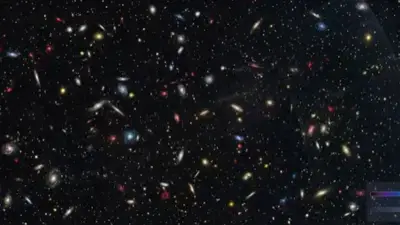
How far away is the Andromeda galaxy? 2.5 million light-years. How do we know? Astronomers don't have a single measuring tape — they've built a “cosmic distance ladder,” where each method calibrates the next. From the geometric technique of parallax for nearby stars, to Cepheid variable stars for other galaxies, to Type Ia supernovae for billions of light-years, each rung extends our reach a little further into the universe.
📐 The First Rung: Parallax
Parallax is the most direct method and works exactly like our stereoscopic vision. As Earth orbits the Sun, a nearby star appears to “shift” slightly against the background of more distant stars. By measuring this tiny angular shift — the parallax angle — the distance can be calculated.
The unit that comes from this technique is the parsec (1 parsec = 3.26 light-years). ESA's Gaia satellite has measured the distance and precise position of over 1.5 billion stars in the Milky Way using parallax. However, parallax is only reliable out to roughly 5,000–10,000 parsecs — for greater distances, other methods are needed.
⭐ Cepheid Variables: The Cosmic Metronomes
In the early 1900s, astronomer Henrietta Swan Leavitt discovered something remarkable: Cepheid variable stars pulsate in brightness at a rate directly related to their intrinsic luminosity. By measuring the pulsation period, astronomers can calculate the star's true brightness. Comparing that to how bright it appears from Earth gives the distance.
In 1925, Edwin Hubble used Cepheid variables to prove that the Andromeda “nebula” was actually a separate galaxy far beyond our own — the first direct proof that the universe contains billions of galaxies. Today, the James Webb Space Telescope (JWST) observes Cepheids in galaxies hundreds of millions of light-years away.
💥 Type Ia Supernovae: The Standard Candles of Cosmology
Type Ia supernovae always explode releasing the same amount of energy — they occur when a white dwarf accretes enough mass from a companion and exceeds the Chandrasekhar limit (1.44 solar masses). Because their peak luminosity is always the same, they function as "standard candles" visible billions of light-years away. The 1998 discovery that distant Type Ia supernovae were dimmer than expected led to the discovery of dark energy and the Nobel Prize in Physics 2011.
🔭 The Distance Ladder: A Chain of Methods
Astronomers don't rely on a single method — they build a chain of techniques (the cosmic distance ladder). Starting from parallax for nearby stars, they move to Cepheids for other galaxies, then to Type Ia supernovae for cosmological distances, and finally to redshift for the most distant galaxies. The formula z (redshift) = v/c gives recession velocity, and combined with Hubble's Law (v = H₀ × d), it yields distance.
This chain extends to the theoretical limit of the observable universe. Each link must be precisely calibrated against the previous one.
"Measuring cosmic distance is like building a ladder without knowing how many rungs are needed — every step is constructed from the one before it."
— NASA Science, Cosmic Scale of Distances🌌 JWST and the New Era of Distance Measurement
The James Webb Space Telescope (launched December 2021) is revolutionizing cosmic distance measurement. With its infrared sensitivity, it observes Cepheid variables in galaxies that the Hubble Space Telescope couldn't resolve — out to 130 million light-years and beyond. The new JWST data confirm the “local” Hubble constant measurements (~73 km/s/Mpc), deepening the so-called "Hubble Tension" — the disagreement with the CMB-derived value (~67 km/s/Mpc). This discrepancy may signal new physics beyond the standard cosmological model.