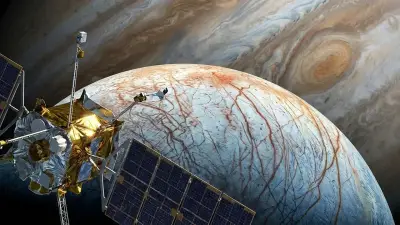
Europa Clipper is NASA's most ambitious mission to the outer solar system — searching for signs of life beneath the ice of Jupiter's moon Europa. Launched on October 14, 2024, the spacecraft will travel 1.8 billion miles (2.9 billion km) to reach the Jupiter system in April 2030. There, it will conduct 49 close flybys over Europa's frozen surface, using 9 science instruments to answer one of humanity's most fundamental questions: could conditions suitable for life exist beneath the ice?
🌊 An Ocean Beneath the Ice
Europa, one of Jupiter's 95 known moons, hides something extraordinary beneath its frozen shell: a global saltwater ocean. This subsurface ocean contains more water than all of Earth's oceans combined — a fact that makes Europa one of the most promising worlds in the search for extraterrestrial life in our solar system.
Europa's ice shell is estimated to be 10 to 25 kilometers thick. Below it, the liquid ocean remains in a fluid state thanks to tidal heating — the immense gravitational forces that Jupiter exerts as the moon orbits around it. This continuous deformation of Europa's interior generates enough energy to keep the ocean liquid, despite the extremely low surface temperatures that reach -160°C.
A study published in January 2026, based on data from NASA's Galileo mission, revealed evidence of ammonia at Europa — a molecule that could serve as a nutrient for microorganisms and further strengthens the case for potential habitability of this hidden ocean.
🔬 The Science Instruments
Europa Clipper carries nine science instruments, each designed to examine a different aspect of the moon. During each of the 49 close flybys, all instruments will operate simultaneously — a pioneering approach never before used on a planetary mission. This coordination means that every pass over Europa will yield a complete dataset. Additionally, the spacecraft's telecommunications system will be used for a gravity experiment, measuring the tiny orbital variations caused by Europa's mass.
📡 REASON — Ice-Penetrating Radar
Uses radio waves to penetrate Europa's ice shell and map its internal structure. Successfully tested during the Mars flyby. It will reveal how thick the ice is and whether subsurface water pockets exist within the shell.
🔴 MISE — Infrared Spectrometer
Analyzes the surface composition in infrared wavelengths, identifying salts, organic molecules, and other chemical signatures. It will reveal what materials from the ocean reach the surface through cracks and geological structures in the ice.
🌡️ E-THEMIS — Thermal Imaging
Detects warm regions on the surface that may indicate recent geological activity or locations where warm water rises close to the surface. Critical for identifying potential energy sources for biological processes.
💨 MASPEX — Atmosphere and Particle Analyzer
A high-resolution mass spectrometer that will analyze gases and particles around Europa. If Europa ejects water vapor or ocean materials, MASPEX will detect them and analyze their chemistry in real time.
🚀 The Journey to Jupiter
Europa Clipper launched on October 14, 2024, aboard a SpaceX Falcon Heavy rocket from Kennedy Space Center in Florida. The journey to Jupiter will take approximately 5.5 years — a path of 2.9 billion kilometers (1.8 billion miles) that includes gravity assists from both Mars and Earth, allowing the spacecraft to gain the necessary speed without excessive fuel consumption.
During its flyby of Mars in March 2025, the mission successfully tested the REASON radar instrument — confirming that it can operate under real planetary conditions. Along the way, the spacecraft also observed the interstellar comet 3I/ATLAS, adding unexpected scientific data to the mission.
After arriving at the Jupiter system in April 2030, Europa Clipper will enter orbit around Jupiter — not around Europa. This strategy was designed to minimize exposure to Jupiter's harsh radiation environment, which would destroy the spacecraft's electronics in a short time. On each orbit, the spacecraft will enter the radiation zone only for a few hours, performing a close flyby over Europa before retreating to a safe distance.
💌 Messages to Space: Europa Clipper carries a special vault plate engraved with 2.6 million names from people around the world, along with poems dedicated to exploration. It is a symbol of connection between humanity and science — a message that will travel to one of the most mysterious places in our solar system.
🧬 Searching for Life
Europa Clipper's mission is not searching directly for life — it's searching for the conditions that could support it. Scientists call this “habitability,” and its key ingredients are three: water, chemistry, and energy.
Europa appears to have all three. The global saltwater ocean provides the first ingredient in abundance. Chemical evidence on the surface — salts, potentially organic molecules, and the recent detection of ammonia — suggest that the ocean interacts chemically with the rocky seafloor, a process that on Earth sustains entire ecosystems around hydrothermal vents. Finally, tidal heating from Jupiter provides a steady and inexhaustible source of energy that could sustain biological processes.
Scientific evidence suggests that the ingredients for life may exist on Europa right now. If Europa Clipper confirms that the ocean is habitable, it will mark a milestone in astrobiology — paving the way for future missions that may search for life itself in the depths of this alien ocean.
🔭 What We Will Learn
Europa Clipper will map nearly the entire surface of Europa in high resolution, reveal the three-dimensional structure of the ice shell, analyze the composition of the thin atmosphere, and measure the depth and salinity of the ocean. It is the first mission designed specifically for the detailed study of this moon — a step beyond the brief observations made by Voyager and Galileo.
The significance of this mission extends far beyond Europa. NASA's Cassini mission revealed that Enceladus, a moon of Saturn, has a similar subsurface ocean with hydrothermal vents. Europa Clipper's findings will help us understand whether these “ocean worlds” — moons with hidden water beneath ice — are the rule or the exception in our solar system.
If Europa proves to be habitable, science will need to fundamentally reassess where we search for life. It will no longer suffice to look only within the “habitable zone” around a star — life could be hiding beneath ice, far from any light, on countless worlds across the galaxy. Europa Clipper may not find life itself, but it will tell us whether it's worth looking — and that alone will change the way we see the universe.