Look at the night sky. Every star, every galaxy, every nebula you see represents just 5% of the universe. Another 27% is something invisible, something that neither emits nor absorbs light, yet holds galaxies together: dark matter. After nearly a century of searching, it remains the greatest enigma of astrophysics.
👻 What Is Dark Matter
Dark matter makes up approximately 27% of the universe — more than five times the amount of ordinary matter (5%). It does not emit, absorb, or reflect light — it is literally invisible. The only evidence of its existence is its gravitational effect on visible objects. It constitutes approximately 85% of all matter in the universe.
🔬 How We Know It Exists
The story begins in 1933, when Swiss astronomer Fritz Zwicky studied the Coma galaxy cluster and found that the galaxies were moving too fast to be held together by visible mass alone. He proposed the existence of “dark matter” (dunkle Materie).
Confirmation came in the 1970s, when American astronomer Vera Rubin studied galaxy rotation curves. Stars at the edges of galaxies were moving just as fast as those near the center — impossible without additional invisible mass. Gravitational lensing, where light bends around invisible mass, confirms the distribution of dark matter throughout the universe.
💥 Bullet Cluster — The Strongest Evidence
The Bullet Cluster (1E 0657-56) is considered the strongest evidence for the existence of dark matter. It consists of two galaxy clusters that collided. The hot gas (ordinary matter) was slowed by friction, but the bulk of the mass (dark matter) passed through unimpeded, proving that mass and visible matter are separated. This is impossible to explain without dark matter.
🧪 Hunting the Invisible
Despite decades of effort, no experiment has directly detected dark matter. The most significant attempts include:
- LUX-ZEPLIN (LZ): The world's most sensitive detector, with 10 tonnes of liquid xenon in an underground laboratory in South Dakota.
- XENONnT: At Gran Sasso in Italy, searching for rare WIMP interactions with xenon.
- ADMX: Specialized in detecting axions, hypothetical particles of extremely low mass.
- LHC (CERN): The Large Hadron Collider attempts to produce dark matter particles in high-energy collisions.
💡 WIMPs or Axions? The two leading dark matter candidates: WIMPs (Weakly Interacting Massive Particles) are heavy but interact minimally with matter. Axions are extremely light and could form a “cloud” around galaxies. Neither has been detected yet.
🌐 The Cosmic Web
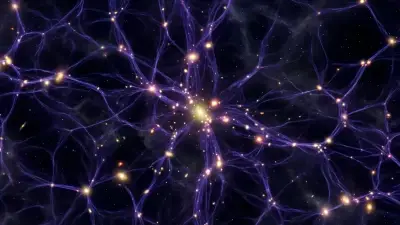
Simulations like the Millennium Simulation and IllustrisTNG show that dark matter forms an immense cosmic web — vast filaments of dark matter connecting galaxy clusters, with voids between them. Galaxies form at the nodes of this web, where dark matter is densest. This structure is the “skeletal system” of the universe.
❓ Alternative Theories
Some scientists propose that dark matter is not needed — perhaps gravity simply works differently at large scales. The MOND theory (Modified Newtonian Dynamics) modifies Newton's law for very weak accelerations. It explains some galaxy observations but fails to explain the Bullet Cluster, the cosmic microwave background (CMB), and the large-scale structure of the universe.
The search continues. Every experiment that fails to find dark matter narrows the possibilities for what it is, bringing us closer to the answer. An answer that will change physics forever.