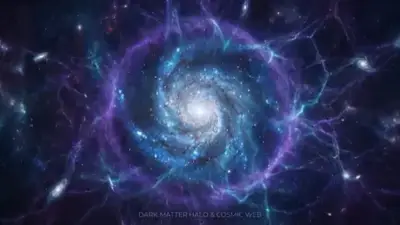
When you look at the night sky, you see stars, nebulae, and galaxies glowing with the light of billions of suns. But all of that luminous matter — everything we can see, touch, or measure with instruments — accounts for only about 5% of the total content of the universe. The remaining 95% consists of two invisible, poorly understood entities: dark matter (27%) and dark energy (68%). Understanding them is one of the most pressing challenges in modern physics.
The Universe's Composition: 5% ordinary matter (atoms, stars, planets), 27% dark matter (unknown particles that interact gravitationally), 68% dark energy (unknown field driving accelerated expansion). We have confirmed evidence for both dark matter and dark energy, but we do not know what either fundamentally is.
Vera Rubin and the Mystery of Galaxy Rotation
The strongest evidence for dark matter comes from galaxy rotation curves. In the 1970s, astronomer Vera Rubin and her colleague Kent Ford made a startling discovery while studying the Andromeda galaxy. According to Newtonian gravity, stars near the outer edges of a galaxy should orbit more slowly than those closer to the massive center — just as outer planets in our solar system orbit the Sun more slowly than inner ones.
But Rubin found the opposite: stars in the outer regions of galaxies orbit at nearly the same speed as those close to the center. The only explanation: there must be far more mass than we can see — an invisible “halo” of matter surrounding every galaxy, extending far beyond the visible disk. This dark matter provides the extra gravitational pull needed to explain the observed rotation speeds.
The Universe's Makeup
Composition of the Universe
The Bullet Cluster: Direct Evidence
The most direct evidence for dark matter as a physical substance (rather than a modification of gravity) comes from the Bullet Cluster — a galaxy cluster system 3.8 billion light-years away observed by the Chandra X-ray Observatory in 2006. Two galaxy clusters passed through each other in a collision. The ordinary matter (hot gas, visible in X-rays) was slowed by electromagnetic interactions and clumped in the middle. But gravitational lensing maps showed that most of the mass had passed straight through, unchanged — exactly what dark matter particles would do if they interact only gravitationally, not electromagnetically.
"We have direct observational proof that the majority of matter in the Bullet Cluster is dark matter. This is the strongest evidence to date that dark matter exists as a physical substance."
— Doug Clowe, lead author of the 2006 Bullet Cluster study (The Astrophysical Journal Letters)What Could Dark Matter Be?
Despite decades of searching, no dark matter particle has ever been directly detected. The leading candidates include:
- WIMPs (Weakly Interacting Massive Particles): Theoretically well-motivated particles predicted by supersymmetry. Underground detectors such as LUX-ZEPLIN (LZ) and PandaX-4T have searched billions of interactions without finding a WIMP signal. Constraints are tightening.
- Axions: Very light particles originally proposed to solve a problem in quantum chromodynamics. Experiments like ADMX (Axion Dark Matter eXperiment) are actively searching. Most promising candidate as of 2024.
- Sterile neutrinos: Hypothetical heavier cousins of the known neutrino, which interact only gravitationally. Still speculative.
- Primordial black holes: Black holes formed in the early universe. LIGO gravitational wave data has constrained much of this parameter space.
Dark Energy: The Accelerated Expansion
In 1998, two independent research teams studying Type Ia supernovae made a shocking discovery: the expansion of the universe is accelerating. Based on Albert Einstein's equations and the known matter/energy content, gravity should be slowing the expansion down. But distant supernovae were dimmer than expected — meaning they were farther away than any standard model predicted. Something was pushing them apart.
The simplest explanation is Einstein's forgotten “cosmological constant” (Λ) — a form of energy inherent to empty space itself. This “vacuum energy” acts as a repulsive force, overwhelming gravity on cosmic scales. Saul Perlmutter, Brian Schmidt, and Adam Riess were awarded the 2011 Nobel Prize in Physics for this discovery. Yet we have no fundamental physical theory that correctly predicts the observed value of dark energy — quantum field theory predicts it to be 10120 times too large. This is the largest discrepancy between theory and observation in all of science.
The Big Rip Scenario: If dark energy grows stronger over time ("phantom energy"), the expansion would eventually accelerate so fast that it overcomes all other forces — first pulling apart galaxy clusters, then galaxies, then solar systems, then planets, and finally atoms themselves, ending the universe in a “Big Rip” in approximately 22 billion years. Most current data suggest dark energy is constant (Λ), making the Big Rip less likely — but not ruled out.
Sources: NASA Dark Matter Overview (science.nasa.gov), Bullet Cluster Study — Clowe et al. (The Astrophysical Journal Letters, 2006), Vera Rubin & Ford (1970) “Rotation of the Andromeda Nebula”, LUX-ZEPLIN Collaboration (2023), Perlmutter et al. / Riess et al. / Schmidt et al. Nobel Prize Studies (1998), ESA Planck Collaboration Cosmological Parameters (2018)
Related Articles
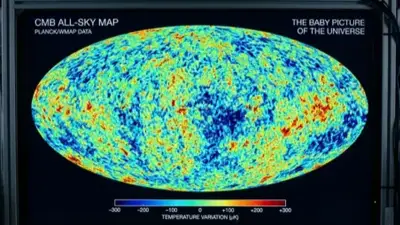
The Cosmic Microwave Background
The oldest light in the universe — a window into the first 380,000 years after the Big Bang.
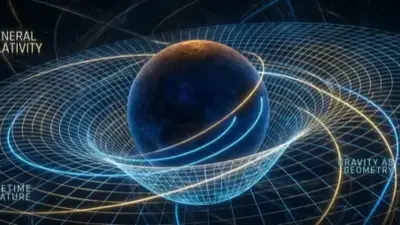
Is Gravity a Force or Spacetime Curvature?
Newton vs Einstein: the fundamental nature of the force that shapes the cosmos.
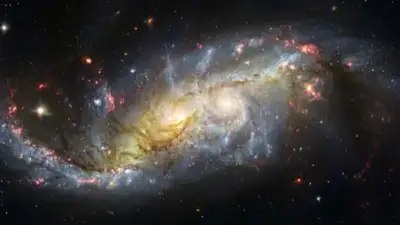
Milky Way & Andromeda Collision
In 4.5 billion years, two galaxies will collide. What happens to us?
Hawking Radiation
Do black holes slowly evaporate? Stephen Hawking's revolutionary quantum prediction.
The Fermi Paradox
If the universe is full of planets, where is everybody? Fermi's unanswered question.
Gravitational Waves
LIGO detected ripples in spacetime — opening a new era of astronomy.