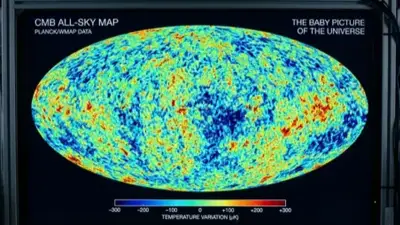
Imagine a photograph of the universe taken when it was just 380,000 years old — a moment when the cosmos was still an infant, invisible and scorching hot. This photograph truly exists: it is the Cosmic Microwave Background (CMB), the oldest radiation we can observe. It is the most ancient light to exist, an echo of the Big Bang traveling toward us for 13.8 billion years. Every point in the sky emits this radiation simultaneously — we cannot see it with the naked eye, but it surrounds us everywhere.
🔍 What Is the CMB — The Birth of the First Light
During the first 380,000 years after the Big Bang, the universe was so hot (above 3,000 Kelvin) that photons could not travel freely — they were continuously scattered by electrons filling all space. The universe was essentially opaque, like an impenetrable foggy cloud. When the temperature dropped enough, electrons combined with protons for the first time, forming neutral hydrogen atoms — this epoch is called the “Recombination Era.”
At that precise moment, photons were set free to travel without obstruction. This event sealed into light every density variation that existed at that time. And that light continues traveling still — now cold, stretched by the expansion of the universe to microwave wavelengths at a temperature of 2.725 Kelvin. It has redshifted so dramatically that it is no longer visible light, but radio radiation.
The CMB does not come from any specific point — it comes from every direction simultaneously. It is as if we are inside a sphere that emits uniformly from all sides, called the “Surface of Last Scattering.”
📡 The Accidental Discovery of 1965
In 1964, physicists Arno Penzias and Robert Wilson were working at Bell Labs with a giant radio horn antenna in Holmdel, New Jersey. They were trying to measure radio waves from our galaxy, but encountered a mysterious “noise” that would not go away — regardless of the direction they pointed, the time of day, or the season. They initially thought the problem was pigeon droppings in the antenna! But after exhaustively eliminating every noise source, the sound remained.
Simultaneously, at Princeton University, Robert Dicke and other cosmologists had theoretically predicted the existence of exactly this radiation. When Penzias and Wilson came into contact with them, everyone realized what had been discovered. The discovery permanently changed cosmology — demonstrating experimentally that the universe truly had a “beginning.” In 1978, Penzias and Wilson were awarded the Nobel Prize in Physics for this discovery.
🌡️ Temperature Across the Entire Universe
The CMB has a mean temperature of 2.725 Kelvin (approximately -270°C) and is uniform to an accuracy of 1 part in 100,000. These microscopic temperature variations correspond to matter density fluctuations that existed 380,000 years after the Big Bang — and became the “seeds” from which galaxies, stars, and planets formed.
🛰️ COBE, WMAP and Planck — Mapping the Early Universe
The first dedicated satellite mission to measure the CMB was NASA's COBE (Cosmic Background Explorer), launched in 1989. COBE confirmed that the CMB is almost perfect blackbody radiation and discovered that it has anisotropies — tiny but crucial temperature variations. For this discovery, George Smoot and John Mather won the Nobel Prize in Physics in 2006.
The next step was NASA's WMAP (Wilkinson Microwave Anisotropy Probe, 2001–2010), which mapped the CMB with much greater precision. WMAP measured the age of the universe (13.77 billion years), its composition (4% ordinary matter, 23% dark matter, 73% dark energy) and confirmed the theory of cosmic inflation.
The most precise mapping to date was performed by ESA's Planck satellite (2009–2013), which produced an image of 50 million pixels of the early universe. Planck data confirmed most cosmological models with stunning accuracy — but also revealed some unexplained anomalies, like a “Cold Spot” in the Southern Sky that remains a subject of active research.
"If you point a telescope in any direction of the sky — up, down, left, right — you will always see the same thing: this light from 380,000 years after the birth of the universe."
— George Smoot, Nobel Prize in Physics 2006, NASA/ESA🔬 What the CMB Tells Us About the Universe
The tiny CMB temperature variations (of order 0.001%) reflect the primordial density fluctuations of matter immediately after the Big Bang. Slightly denser regions attracted more matter through gravity, while less dense regions became cosmic voids. In other words, the CMB was the “seed map” from which today's cosmic structure grew.
The analysis of acoustic peaks in the CMB power spectrum allowed scientists to measure key cosmological parameters with precision: the curvature of the universe (nearly flat), the baryon density in the early epoch, and the total matter density. These measurements agree spectacularly with the Standard Cosmological Model ΛCDM.
🌌 The “Hubble Tension” and the CMB Mystery
Despite the success of CMB measurements, recent years have revealed a serious discrepancy: the value of the Hubble constant (the expansion rate of the universe) calculated from CMB data (67.4 km/s/Mpc) differs significantly from that measured directly via other methods (73 km/s/Mpc). This “Hubble Tension” is one of the biggest open problems in modern cosmology and may indicate physics beyond the Standard Model.
Additionally, the “Cold Spot” discovered by Planck — a region 14 degrees in diameter that is 70 micro-Kelvin cooler than average — remains unexplained. Some scientists propose it may be the imprint of interaction with an adjacent cosmic supervoid, or even the signature of another universe that existed before or coexists with ours — according to various multiverse models.
🚀 The Future of CMB Research
The next generation of CMB experiments includes CMB-S4 (Cosmic Microwave Background Stage 4), a network of ground telescopes at both Earth's poles, designed to detect primordial gravitational waves created by cosmic inflation. If found, they would provide direct proof of inflation theory.
ESA is also designing a successor to Planck, while the James Webb Space Telescope is already contributing by studying the first stars and galaxies that formed from CMB density fluctuations. Every new piece of data brings us a little closer to answering questions like: “Was there anything before the Big Bang?” and “Is cosmic inflation reality or myth?”