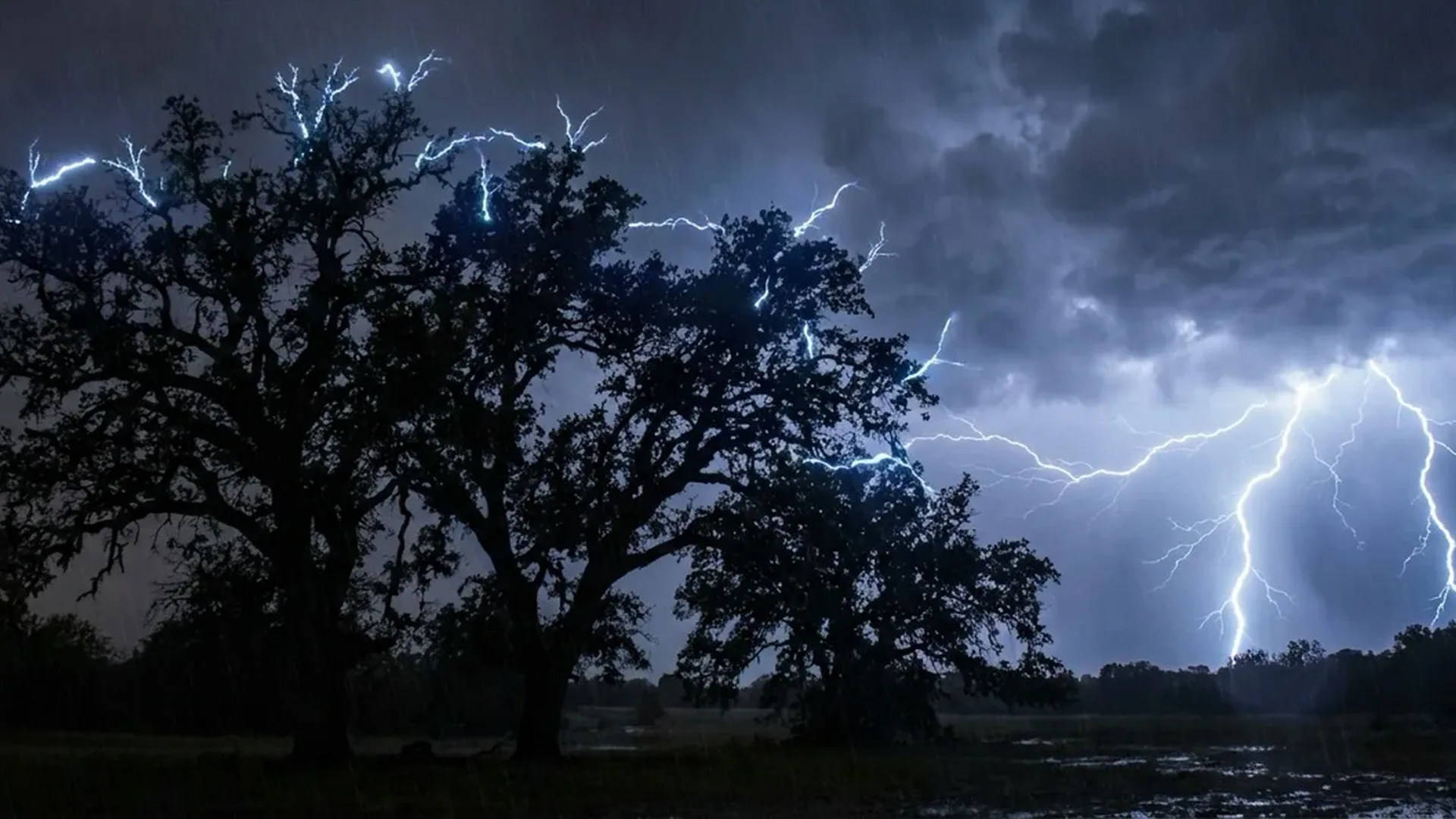
During severe thunderstorms, something strange happens at the tops of trees: tiny violet-blue glows appear at branch tips, accompanied by a soft hissing sound. It's not lightning — it's the corona discharge effect, an electrical phenomenon that occurs before lightning strikes.
📖 Read more: Gravitational Waves: Einstein's Greatest Prediction
🔭 What Is Corona Discharge
Corona discharge occurs when the electric field around a sharp point exceeds the ionization threshold of air (~30 kV/cm). During thunderstorms, enormous electrical charges accumulate at the base of clouds. The electric field near the ground can reach 1–10 kV/m, but at branch tips it concentrates to much higher values.
The result: air molecules become ionized, creating a faint luminous crown around the tip. It resembles a microscopic neon light at the branch ends. It's not dangerous by itself, but serves as a warning sign that a lightning strike is imminent.
📖 Read more: Is Gravity a Real Force or a Curvature of Spacetime?
🔭 The Point Effect: Geometry and Electricity
The key lies in the point effect: the sharper a conductive point, the more the electric field concentrates there. Trees are ideal “concentrators” for three reasons:
- Height: They protrude above the ground, reducing the distance to charged clouds
- Geometry: The needles of conifers enhance the field by up to 100 times
- Conductivity: Tree sap contains salts and water — a relatively good conductor
When the field at the branch tip exceeds the threshold, electrons are stripped from nitrogen and oxygen molecules, creating plasma. As ions recombine, they emit violet-blue photons (405-450 nm) — the characteristic color of corona discharge.
"Corona discharge is nature's way of warning that the electric field has reached dangerous levels. If you see sparks on trees or feel tingling on your skin, you should move away immediately."
📖 Read more: Black Hole Growing 13 Times Faster Than Physics Allows
🔭 St. Elmo's Fire
The corona phenomenon has been known for centuries. Ancient sailors observed it on their ship masts and called it "Fuego de San Telmo" (St. Elmo's Fire, after the patron saint of sailors). Today, it is also observed on:
- Aircraft wingtips and antennas — common during passage through thunderstorms
- Antennas and lightning rods — designed to exploit exactly this phenomenon
- Mountain peaks — climbers frequently report “buzzing metal” on their equipment
💡 Corona vs Lightning: The Difference
Corona discharge is continuous and gentle — microampere current lasting minutes. Lightning is instantaneous and violent — up to 30,000 A in microseconds. Corona often precedes lightning: it creates the conductive channel ("streamer") that the lightning bolt then follows.
🔭 Scientific Recording and Research
Researchers from Langmuir Laboratory at New Mexico Tech and the Leibniz Institute for Tropospheric Research have placed high-speed cameras and sensors on trees during storms. Measurements showed:
📖 Read more: Asteroid Mining: The Legal Gap Scientists Fear Most
- Tall trees (>15 m) produce corona in 80% of thunderstorms
- The glow typically appears 5–30 seconds before a lightning strike
- Conifers are more susceptible due to their needle-shaped leaves
Newer studies investigate whether tree corona affects atmospheric chemistry. The ionization produces ozone (O₃) and nitrogen oxides (NOₓ) — substances that play a role in tropospheric chemistry and air quality.
⚡ Corona on Trees
The most common form. Appears on tall, isolated trees in open fields. Purple glow around branches, accompanied by hissing.
⚓ St. Elmo's Fire on Ships
Historically documented since antiquity. Sailors considered it a divine sign of protection during storms.
✈️ Corona on Aircraft
Common during flights through thunderstorms or volcanic ash. Can cause interference with radio communications.
🔭 Safety Guidelines
If you observe sparks or glowing on trees, antennas, or lightning rods, it means the electric field is dangerously high. Recommendations from NOAA:
- Move away from tall objects and trees
- Get inside a building or car (Faraday cage)
- If your hair stands up or you feel tingling, leave immediately
- Don't hold metallic objects (umbrella, tripod, fishing rod)