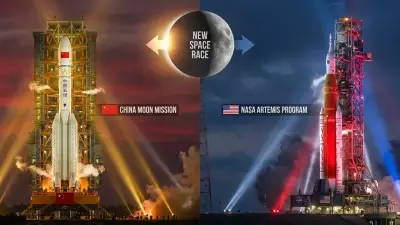
The competition for the Moon has never been this intense since the 1960s. Today, two superpowers — the United States through NASA and China through CNSA — are racing to establish a permanent presence on the lunar surface. But unlike the Cold War Space Race, this contest is about resources, strategy, and long-term dominance.
🏁 The New Moon Race: Why Now?
In the 1960s, the goal was simple: get there first. The US won that race with Apollo 11 in 1969, and after Apollo 17 (1972), no one returned. Now, 50+ years later, the goal is entirely different: permanent bases, resource utilization, and strategic control of an entire lunar infrastructure.
The discovery of water ice at the Moon's south pole by LCROSS (2009) and Chandrayaan-1 (2008) changed everything. Suddenly, the Moon wasn't just a barren rock — it was a potential refueling station for deep space.
🇺🇸 NASA's Plan: The Artemis Program
NASA has built an extensive lunar exploration program known as Artemis. The Artemis III mission — the first crewed landing since Apollo — targets 2027. Key elements:
- SLS Rocket: The most powerful rocket ever built, capable of sending the Orion spacecraft to lunar orbit.
- SpaceX Starship HLS: SpaceX built the lunar lander, based on the Starship. A $2.89 billion contract.
- Blue Origin Blue Moon: Second lander contractor for future Artemis missions (Artemis V+).
- Gateway Station: A small station in lunar orbit that will serve as an intermediate hub.
Artemis has faced significant delays and cost overruns. The SLS costs ~$2.2 billion per launch and is not reusable. However, the use of private companies (SpaceX, Blue Origin, Axiom) gives the program flexibility that the state-centric Chinese approach lacks.
🇨🇳 China's Plan: Methodical Progress
CNSA follows a different philosophy: methodical, phased progress with minimal public setbacks. The Chinese program includes:
- Chang'e-7 (2026): South pole exploration, water ice search.
- Chang'e-8 (2028): ISRU testing, 3D printing with lunar dust.
- Long March 10 + Mengzhou + Lanyue (~2030): Crewed landing of 2 astronauts.
- ILRS (2030s): Permanent lunar base in partnership with Russia.
🇺🇸 NASA Artemis
- Timeline: 2027 (Artemis III)
- Rocket: SLS + Starship HLS
- Lander: SpaceX Starship
- Budget: ~$93B (2012-2025)
- Allies: 35+ countries (Artemis Accords)
🇨🇳 CNSA
- Timeline: ~2030
- Rocket: Long March 10
- Lander: Lanyue
- Budget: ~$15B (estimate)
- Allies: Russia + ILRS partners
🌐 Geopolitical Dimensions: Artemis Accords vs ILRS
The race isn't just about technology — it's about alliances. The US leads the Artemis Accords, a set of principles signed by over 35 countries, including Canada, Japan, South Korea, the UK, and Italy. These principles define rules for peaceful exploration, transparency, and resource management.
China, on its side, is building its own alliances around the ILRS. The Wolf Amendment (2011) prohibits NASA from cooperating with China, effectively creating two separate ecosystems of space exploration. This division echoes the Cold War — but this time, the prize isn't symbolic. It's water ice, Helium-3, and strategic supremacy.
⏰ Who Will Get There First?
NASA has the advantage of experience — the only country that has sent humans to the Moon. However, it faces bureaucratic delays, administration changes, and dependence on SpaceX for critical components. China, while behind in experience, has steady state funding, fewer public failures, and a remarkable track record of meeting deadlines.
India (Chandrayaan-3, 2023) and Japan (SLIM, 2024) are also entering the game, albeit with more limited objectives. Lunar geopolitics has never been more complex.
💎 What's on the Moon? The south pole hides vast quantities of water ice, while the lunar surface is rich in Helium-3 — an ideal fuel for future nuclear fusion. It also contains rare earth elements, titanium, and iron. Whoever controls these resources will have a strategic advantage both in space and on Earth.