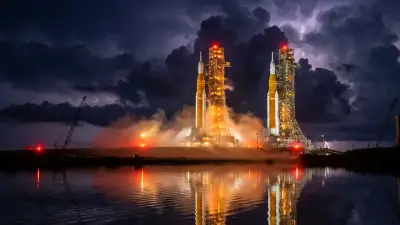
The launch of NASA's Artemis II mission — the first crewed flight to the Moon in over 53 years — has been postponed to at least March 2026, after a practice countdown revealed persistent hydrogen leaks in the SLS rocket. The same problems that delayed Artemis I in 2022 have returned — and NASA faces a familiar, stubborn demon.
📖 Read more: Artemis II: The Heat Shield That Eroded During Artemis 1
🚀 What Happened During the February 3 Test
On February 3, 2026, NASA's launch team began a fueling test (Wet Dress Rehearsal — WDR) of the SLS rocket on Launch Complex 39B at Kennedy Space Center. The test was critical: if everything went smoothly, the launch could have happened as early as February 8.
The fueling operations started late due to cold temperatures in Florida. Almost immediately after beginning to load liquid hydrogen into the SLS core stage, a leak was detected — in the exact same location that had caused problems during the Artemis I campaign nearly three years earlier.
⚡ Why Hydrogen Is So Problematic
Liquid hydrogen is one of the most efficient rocket fuels, but it is notoriously difficult to handle. It must be stored at -253°C (-423°F) — cold enough to change the shape and size of seals at connection points. Meanwhile, the hydrogen molecule is the smallest and lightest in the universe, capable of escaping through the tiniest of openings.
💡 What Are TSMUs?
The Tail Service Mast Umbilicals (TSMUs) are two gray structures approximately 30 feet tall at the base of the launch platform. They route liquid hydrogen and liquid oxygen through 8-inch and 4-inch lines into the SLS core stage. At liftoff, they automatically disconnect as the rocket begins its ascent.
During the test, hydrogen gas concentrations in the area around the fueling connections exceeded NASA's safety limit multiple times. Technicians stopped the hydrogen flow, allowed the interfaces to warm up so the seals could reseat, and adjusted the fuel flow rate.
🕐 The Countdown That Stopped
After an all-day battle, NASA managed to fully load the 322-foot-tall rocket with more than 750,000 gallons of propellant. A closeout crew was sent to the launch pad around 6 PM EST to close the Orion spacecraft hatch — a process that took longer than anticipated due to a pressure valve issue.
Ultimately, the countdown stopped at T-minus 5 minutes and 15 seconds — instead of the target T-minus 33 seconds — due to a sudden spike in the hydrogen leak rate. The test ended before the rocket could switch to internal power, fully pressurize its four propellant tanks, or activate its auxiliary power units for the final engine steering check.
📅 New Timeline: March 2026
NASA immediately announced that the launch would be pushed to March. The first launch opportunity opens on March 6 at 8:29 PM EST, with a two-hour launch window. If the mission doesn't launch by late March, the rocket will need to return to the Vehicle Assembly Building to refresh its flight termination system.
The four astronauts — commander Reid Wiseman, pilot Victor Glover, mission specialist Christina Koch, and Canadian astronaut Jeremy Hansen — had been in medical quarantine since January 21. Following the delay, they were released and returned to Houston to continue training.
"Safety remains our top priority — for our astronauts, our workforce, our systems, and the public. We will only launch when we believe we are ready to undertake this historic mission."
— Jared Isaacman, NASA Administrator🔧 A Familiar Problem, A New Approach
Hydrogen leaks are nothing new for the SLS. The same problem delayed the first Artemis I test flight for several months in 2022. Back then, engineers addressed the leak by changing the hydrogen loading procedure — but the fix clearly wasn't permanent.
After the February 3 test, technicians replaced seals around both fuel supply lines. On February 12, a “confidence test” with partial hydrogen loading showed significantly lower leak rates compared to the first test. However, a new issue was discovered — reduced fuel flow, likely caused by a filter — requiring additional work.
💰 The Deeper Issue: Cost and Flight Rate
Beyond the technical challenges, this situation brings broader questions about the SLS rocket to the surface. According to estimates by NASA's Inspector General, each SLS rocket costs over $2 billion. Spending on ground facilities at Kennedy Space Center reached $900 million in 2024 alone.
The new NASA Administrator, Jared Isaacman — who took over in December 2025 — has criticized the high cost and slow flight rate of the SLS. Three years between Artemis I and II is “a long time,” he acknowledged. For Artemis III, Isaacman has promised that NASA will cryoproof the vehicle before it reaches the launch pad, and that the propellant loading interfaces will be redesigned.
🌙 The Artemis II Mission
Artemis II will send four astronauts on an approximately 10-day journey around the far side of the Moon inside the Orion spacecraft. It will be the first crewed lunar flight since Apollo 17 in 1972, paving the way for landing astronauts at the Moon's south pole as part of the Artemis III mission.
Despite the delays, NASA remains committed to the program. “There is still a great deal of work ahead to prepare for this historic mission,” said Isaacman. "We will not launch unless we are ready — and the safety of our astronauts will remain the highest priority."