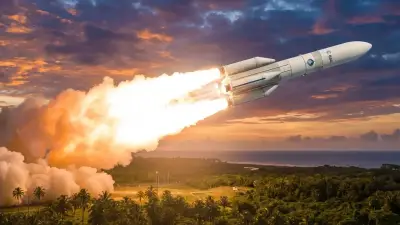
Europe now has the most powerful rocket in its history. The Ariane 6, built by ArianeGroup — a joint venture between Airbus and Safran — marks a new era for European access to space. After years of delays and the retirement of the legendary Ariane 5, the new rocket arrived precisely when Europe needed it most — when Amazon was desperately searching for a ride for its Kuiper satellite constellation.
📖 Read more: 800-Million-Year Rock Gap: Tectonics, Not Ice Scraped Earth
🚀 Europe's New Rocket
The Ariane 6 is the successor to Ariane 5, one of the most reliable rockets in spaceflight history with over 150 successful launches across 27 years of service. Designed from scratch for greater flexibility and lower costs, the Ariane 6 comes in two variants: the Ariane 62 with 2 solid rocket boosters and the Ariane 64 with 4 boosters — the largest and most powerful version in European space history.
Ariane 6's maiden flight took place in July 2024, opening a new chapter following the Ariane 5's final flight in June 2023. The first launch of the Ariane 64 variant with its four boosters was a milestone — the most powerful rocket Europe has ever built, capable of delivering heavier payloads to higher orbits than its predecessor.
🔧 Technical Specifications
At the heart of the Ariane 6 sits the Vulcain 2.1 engine, a cryogenic powerplant burning liquid hydrogen (LH2) and liquid oxygen (LOX). It is an evolved version of the proven Vulcain 2 used on the Ariane 5, with improvements in performance and manufacturability. The Vulcain 2.1 produces approximately 135 tonnes of thrust, powering the rocket's core stage during the first minutes of flight.
The upper stage employs the Vinci engine, also cryogenic (LOX/LH2), with one critical capability: in-orbit restart. This means the Ariane 6 can place multiple payloads into different orbits on a single mission — a feature the Ariane 5 lacked and one that dramatically increases the new rocket's versatility.
The P120C solid rocket boosters, manufactured by Avio in Italy, are shared with the European Vega-C rocket. This standardization reduces production costs and increases manufacturing rates. The Ariane 62 uses two of these boosters for lighter missions, while the Ariane 64 uses four for the heaviest payloads, such as large telecommunications satellites and constellation deployments.
🏗️ From Ariane 5 to Ariane 6
The transition from Ariane 5 to Ariane 6 was anything but smooth. The Ariane 5 flew its last mission in June 2023, leaving a gap of over a year until the Ariane 6's first flight in July 2024. During this period, Europe found itself without an independent means of accessing space — a situation that underscored the critical importance of autonomous launch capability.
The Ariane 5 was a truly legendary rocket. From 1996 to 2023, it successfully launched more than 150 payloads, including iconic missions like the James Webb Space Telescope, satellites for the Galileo navigation system, and dozens of commercial telecommunications satellites. Its reliability exceeded all expectations, making it one of the most successful rockets in history.
However, the Ariane 5 was designed in an era when launch cost was not the primary concern. With the rise of SpaceX and its reusable Falcon 9 rockets, Europe was forced to rethink its strategy. The Ariane 6 was designed with a goal of reducing costs by 40% compared to the Ariane 5, though it remains more expensive than the Falcon 9.
📖 Read more: Artemis II: Humanity\
🌴 Kourou, French Guiana — Europe's Spaceport: The Ariane 6 launches from the Centre Spatial Guyanais in Kourou, French Guiana, near the Equator. The location offers a significant advantage: Earth's rotation at the Equator provides a “free” velocity boost of approximately 460 m/s, increasing payload capacity compared to launches from higher latitudes. Kourou has been Europe's gateway to space since the 1970s.
🌍 European Space Independence
The Ariane 6 is more than just a rocket — it is a symbol of European strategic autonomy. Following Russia's invasion of Ukraine in 2022, Europe lost access to Russian Soyuz rockets, which had been launching from Kourou. This made the need for an autonomous European launch vehicle even more urgent.
ESA (the European Space Agency) and the European Commission have committed to “guaranteed access to space” through the Ariane 6. This means that strategic payloads — military satellites, Earth observation spacecraft, the Galileo navigation constellation — will be launched exclusively on European rockets, regardless of cost.
Ariane 6's customer base spans a wide range: Amazon has booked flights for its Kuiper satellite internet constellation, ESA for scientific missions, the European Union for Galileo satellites, and several member states for military spacecraft. This diversity ensures steady demand and long-term viability for the program.
🔮 What Comes Next
The challenge for Ariane 6 is twofold: to prove its reliability in its first operational flights and to compete in an increasingly fierce market. SpaceX's Falcon 9 dominates the launch market with prices Europe cannot match, largely thanks to reusability. The Ariane 6 remains an expendable rocket — no stage is recovered after flight.
ArianeGroup is already exploring reusability technologies for future evolution. The Themis program, an experimental reusable first-stage demonstrator, is undergoing testing and could be applied to a future upgraded version of the Ariane 6 or an entirely new rocket.
The deal with Amazon for Kuiper launches is especially significant. Amazon needs dozens of launches to deploy its 3,236-satellite constellation, and the Ariane 6 arrived just as Amazon was seeking alternatives beyond American launch providers. This “rescue” came at a critical moment for both sides.
The Ariane 6 may not be the cheapest or most innovative rocket in the world, but it fulfills a strategic role: it guarantees that Europe depends on no one else to reach space. In an era of geopolitical turbulence and growing competition in the space sector, that independence is worth every euro invested.