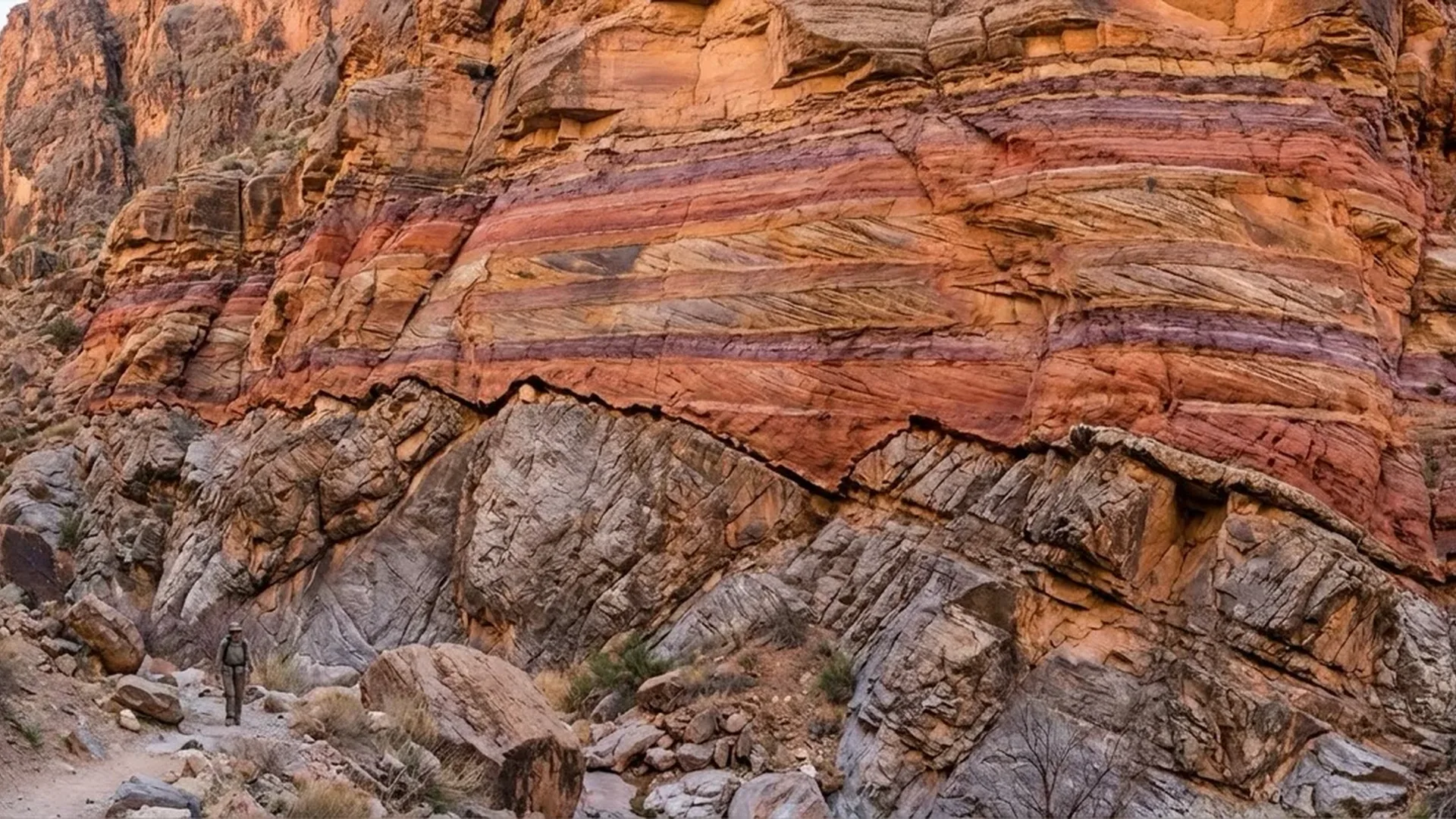
At many locations across the planet, geologists have identified a strange void in rock layers: a gap of approximately 800 million years where all geological records are missing. For decades, the prevailing theories attributed this void to glaciers that scraped away the rocks. A new study overturns this interpretation: the cause is tectonic.
📖 Read more: IXPE Captures First Complete X-Ray Map of Vela Pulsar
🔭 The Great Unconformity
The phenomenon is called the Great Unconformity and was first recognized at the Grand Canyon: the Precambrian crystalline basement (1.7 billion years old) sits directly against layers just 540 million years old (Cambrian), with nothing in between. This means up to 1 billion years of geological history was erased.
🔭 The Old Theory: Snowball Earth Glaciers
The prevailing interpretation was that during the Snowball Earth period (750-635 million years ago), enormous glaciers covered nearly the entire Earth and scraped away kilometers of rock. The theory was attractive: it simultaneously explained the gap and the “Cambrian Explosion” of life that followed.
📖 Read more: Alien Civilizations: Will We Ever Meet Them?
However, the gap also appears in regions that had no glacial coverage during Snowball Earth. This creates a problem.
"Glaciers cannot explain the gap in regions that were near the equator. The mechanism must be global and independent of geographic latitude."
🔭 The New Interpretation: Rodinia Rifting
The new study proposes that the gap was caused by the breakup of the supercontinent Rodinia, which began approximately 800 million years ago. As tectonic plates moved apart, rift zones formed — extension zones that uplifted the ground and exposed rocks to erosion.
📖 Read more: alien-life-probability-statistics-universe
Using thermochronology analysis (zircon U-Pb and apatite fission-track), the researchers demonstrated that kilometers of rock were removed through erosion due to tectonic uplift — not glacial scraping.
💡 What Is an Unconformity?
An unconformity is a contact surface between rock layers that represents a time gap: the rocks that should exist in between either were never deposited or were removed by erosion. The Great Unconformity is the largest known on the planet.
🔭 Implications for Understanding Ancient Earth
The new interpretation has significant implications:
📖 Read more: Ariane 6: Europe's Most Powerful Rocket Takes Flight
🌍 Snowball Earth
If glaciers aren't responsible for the gap, the extent of Snowball Earth glaciers needs reassessment.
🧦 Cambrian Explosion
The connection to the explosion of complex life 540 million years ago takes on a different framework.
🪨 Tectonics
The breakup of Rodinia emerges as the central mechanism sculpting the planet's surface.
🔭 Where the Gap Appears
The Great Unconformity is not a local phenomenon. It appears on every continent: from the Grand Canyon in Arizona, to the Scottish Highlands, Australia, and Brazil. This globality supports the tectonic interpretation: the breakup of a supercontinent affects all fragments simultaneously, whereas glaciers would leave an uneven imprint.
📚 Sources
- McDannell et al. — “Tectonic origin of the Great Unconformity”, Nature Geoscience (2025)
- Live Science — "Billion-year gap in the geologic record may not be the result of Snowball Earth after all"
- ScienceAlert — “Famous gap in rock record wasn’t caused by glaciers, new study suggests”
- Nature News — “The Great Unconformity: Earth’s biggest gap in the rock record explained”