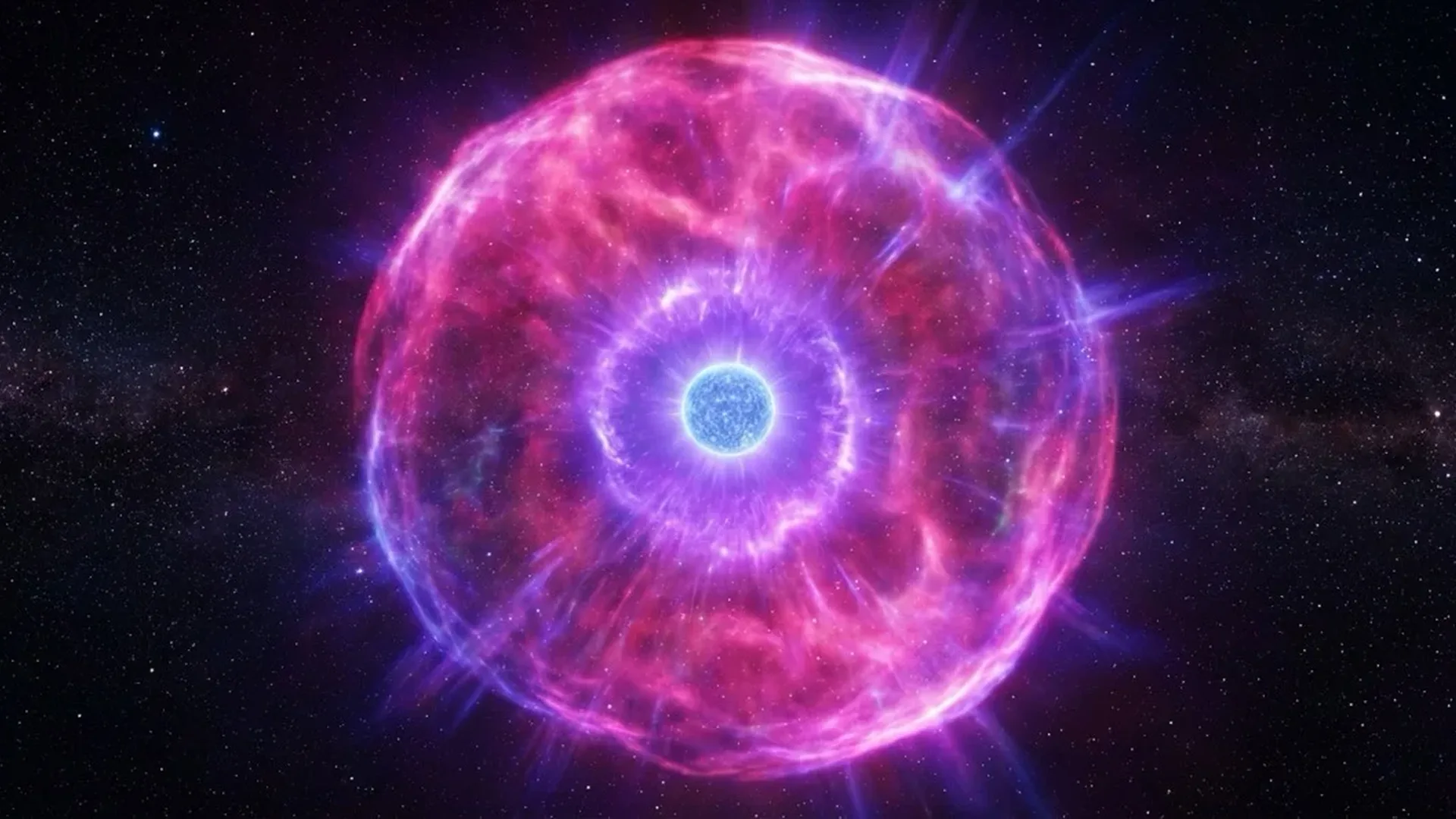
The Vela Pulsar lies 1,000 light-years from Earth: a dead star born from a supernova explosion 11,000 years ago, now spinning 11.9 times per second and firing millions of X-ray photons per millisecond from its magnetic poles. Now NASA’s IXPE (Imaging X-ray Polarimetry Explorer) has captured the first complete polarization map of X-rays from the pulsar and from its surrounding pulsar wind nebula simultaneously.
📖 Read more: Black Holes: How Are They Formed?
The study, published in The Astrophysical Journal Letters on February 25, 2026, was led by Dr. Michela Negro of NASA’s Marshall Space Flight Center and Dr. Niccolò Di Lalla of Stanford University. It represents the most detailed X-ray polarization measurement of a pulsar ever achieved.
IXPE: The Eye That Sees Polarization
IXPE was launched on December 9, 2021, as a joint NASA/ASI mission. It is the first astronomical observatory specifically designed to measure X-ray polarization since 1975. Conventional X-ray telescopes measure only the energy and direction of photons. IXPE adds a third dimension: polarization — the angle at which the electric fields vibrate relative to the star’s magnetic field direction. This is nearly impossible to detect with previous telescopes.
📖 Read more: Neutron Stars: The Densest Objects in the Universe
The Vela Pulsar: The Most Complex Luminous System
The Vela Pulsar is a neutron star with 1.4 solar masses compressed into a diameter of 20 km. It spins 11.9 times per second, firing X-ray pulses from its magnetic poles. It powers an extended pulsar wind nebula (PWN), where electrons and positrons are accelerated and redirected, forming an intricate X-ray nebula.
The IXPE observations revealed:
— In the pulsar itself: 38% polarization, polarization angle parallel to the rotation axis
— In the wind nebula: 10–15% polarization, with directional changes in different zones
— First time: full 360° simultaneous polarization map of both system components (pulsar + PWN)
📖 Read more: Gravitational Waves: How Are They Caused and Detected?
What Polarization Reveals for Astrophysics
“Polarization is like the DNA of radiation,” says Dr. Negro. “It doesn’t just tell us how much energy is emitted, but how the magnetic field is organized inside the star, in the magnetosphere, and in the nebula.”
📖 Read more: Russian Spy Satellites Intercepting EU Communications
The high polarization (38%) in the pulsar itself demonstrates that the magnetic field is exceptionally uniform and powerful. This confirms models showing that the X-ray emission mechanism is pure synchrotron radiation (acceleration of electrons in a strong magnetic field) rather than surface emission from the magnetar as previously debated.
In the wind nebula, the zone-by-zone changes in polarization direction reveal the real-time architecture of magnetic field lines — improving MHD models that predict the ejection (jets) of high-energy particles from the pulsar into the nebula.
First Simultaneous Complete Mapping
The big novelty is that the pulsar’s rotation allowed the team to view the system in X-rays through 360°, with the same image captured simultaneously for both the pulsar and the nebula. Di Lalla calls it a “rotation-powered” understanding of stellar fields.
The IXPE mission continues to observe magnetars, black holes, and supernovae without exhausting its resources. It is the only instrument giving us access to this architectural information about the most extreme stellar objects in the universe. Research was funded by NASA/ASI (Agreement #2021-I.R.) and the Kavli Institute for Particle Astrophysics and Cosmology at Stanford.