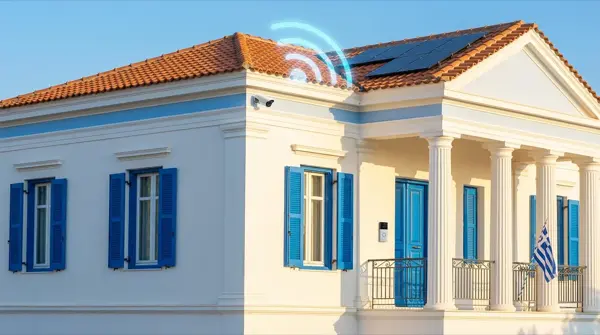
Smart home is no longer a foreign-market luxury. In Greece of 2026, the smart device market is booming — with Greek online stores now offering dozens of options, prices dropping steadily and the Matter protocol solving every beginner's compatibility headache. In this complete guide, we break down what actually works in the Greek market, how much it costs and how you can set up a full system step by step.
The Smart Home Market in Greece — Where We Stand in 2026
According to Statista data, the global smart home market is expected to reach $193.5 billion in 2026, with annual growth of 11.2%. Europe is the second-largest market, with emphasis on energy savings and sustainability — two areas that directly concern Greek consumers.
In Greece, the smart home market remains smaller compared to countries like Germany or the Netherlands, but growth is impressive. Household penetration has tripled over the past three years, mainly due to three factors: first, rising electricity bills that pushed thousands of households to seek energy-saving solutions. Second, the maturation of the Matter protocol that eliminated compatibility issues. Third, increased availability in Greek online stores, with platforms like Skroutz, Public.gr and Plaisio.gr now carrying hundreds of products.
Why Greece Is Ideal for Smart Home
The Greek climate brings high temperatures during summer months, making smart thermostats and smart A/C units almost a necessity. Sunny days also favour combining smart home with solar panels, while the Mediterranean culture of “home as the centre of life” makes smart devices more useful here than in many northern countries.
What Works Excellently in Greece (and What Doesn't)
Lighting — The Easiest Starting Point
Smart lighting is the category with the widest availability in Greece. Philips Hue bulbs, affordable Ikea TRÅDFRI and new Matter-compatible bulbs (e.g. AiDot Linkind) are now available in all major online stores. A basic smart bulb starts from €10-15, while a complete Philips Hue Starter Kit costs €80-140 depending on the number of bulbs.
The big advantage is that lighting requires zero changes to your electrical installation — you swap the bulb and you're done. Plus, with Matter-compatible bulbs, you don't even need a separate hub: plug them in, connect to Google Home or Amazon Alexa, and control everything from your phone.
Thermostats — Real Energy Savings
Smart thermostats are the second most popular category in Greece, mainly due to high electricity bills. The Ecobee Smart Thermostat Premium (€200-270) and the tado° Smart Thermostat (€150-200) are the most popular choices. For a more affordable option, the Amazon Smart Thermostat is available at €70-90.
Energy savings with a smart thermostat can reach 15-23% on heating/cooling bills. In Greece, this translates to €150-400 in annual savings, depending on home size and air conditioning usage. The thermostat essentially pays for itself within 6-18 months.
Robot Vacuums — An Undeniable Must-Have
The robot vacuum category has exploded in Greece. Brands like Roborock, Ecovacs, iRobot Roomba and TP-Link Tapo offer models for every budget. The TP-Link Tapo RV30 Max Plus (€170-220) is an excellent choice if you want self-emptying at an affordable price. In the premium segment, the Ecovacs Deebot X8 Pro Omni (€600-800) offers all-in-one vacuuming and mopping.
In Greece, robot vacuums are particularly useful due to marble and ceramic tile floors — mopping robots work exceptionally well on such surfaces. Skroutz lists over 200 robot vacuum models, with prices from €120 to €1,400.
Security Cameras — Mind the GDPR
Smart security cameras are an important part of the smart home in Greece, especially for detached houses and holiday homes. The Aqara Camera Hub G5 Pro (€160-190) doubles as a hub for Matter/Thread/Zigbee devices, while the Eufy E220 Indoor Cam (€30-45) is the most affordable reliable option.
Important note: Greece strictly enforces GDPR regulations. If you install an outdoor camera, it must not record public spaces or your neighbour's property. Prefer cameras with local storage instead of cloud for greater privacy and to avoid monthly subscriptions.
Voice Assistants — Greek Language Support
Google Assistant has supported Greek for several years, making it the top voice assistant for Greek users. Google Nest devices (Nest Mini €50-60, Nest Audio €70-100) work fully in Greek. Amazon Alexa, despite being an excellent assistant, still doesn't support Greek — this doesn't stop it from selling, but it means you'll use English commands.
Apple's HomePod (€100 for the mini, €300 for the full-size) supports Greek through Siri, but HomeKit smart home integration remains more limited compared to Google Home or Alexa.
How Much Does a Basic Smart Home Setup Cost in Greece
One of the most common questions: “How much will I spend?”. The answer depends on your needs, but here are three realistic scenarios with February 2026 prices from Greek online stores:
Starter Pack — €150-250
2-3 smart bulbs (€30-45) + 1 smart plug (€15-25) + 1 Google Nest Mini (€50-60) + 1 smart camera (€35-60). This gives you voice-controlled lighting, remote home monitoring and the ability to toggle devices from anywhere.
Mid-Range Setup — €400-700
Philips Hue Starter Kit (€100-140) + tado° Smart Thermostat (€150-200) + TP-Link Tapo Robot Vacuum (€170-220) + 2-3 smart plugs (€30-50) + Google Nest Audio (€70-100). Full lighting automation, energy savings and automated floor cleaning.
Premium Setup — €1,200-2,000+
Full Philips Hue (€300-500) + Ecobee Premium Thermostat (€250) + Ecovacs Deebot X8 Pro Omni (€700-800) + Aqara Camera Hub G5 Pro (€170) + Smart lock (€120-250) + Outdoor cameras (€100-200). Complete ecosystem with security, automation and premium devices.
Where to Buy Smart Home Devices in Greece
Smart home product availability in Greece has improved dramatically. The main purchasing platforms are:
- Skroutz.gr — The largest price comparison platform. You can find almost everything, with full user reviews and store ratings. Ideal for price comparison.
- Public.gr — Wide variety of smart speakers, lighting and robot vacuums. Advantage: in-store pickup option.
- Plaisio.gr — Good prices on security cameras and networking equipment. Reliable after-sales support.
- Kotsovolos.gr — Strong presence in Philips Hue, Google Nest and large heating/cooling appliances.
- Amazon.de — For products not available in Greece (e.g. certain Ecobee models). Delivery in 5-10 days, watch for shipping costs.
Challenges & Pitfalls in Greece
Despite impressive progress, there are still hurdles you should know about before buying:
Wi-Fi in Greek homes: Older Greek houses with thick walls (stone, concrete) create serious WiFi coverage problems. If your router is in the living room and the bedroom is two walls away, you probably need a mesh WiFi system (€100-200 for a basic two-node kit). Thread and Zigbee protocols help as they create mesh networks between devices.
Old electrical installations: Many Greek homes, especially pre-2000 builds, lack neutral wire in switch boxes — something required by certain smart switches. Solution: choose smart bulbs instead of smart switches, or use Shelly modules that work without neutral wire.
Voice commands in Greek: Only Google Assistant fully supports Greek. If you want to speak Greek to your devices, stick with the Google ecosystem. If English doesn't bother you, Alexa or Siri are equally good options.
Air conditioning: Most Greek households use split-unit air conditioners instead of central HVAC. Smart thermostats are primarily designed for central systems. For split units, you need a smart IR controller (€20-40) that controls the A/C via infrared — brands like Switchbot, Broadlink or Tuya offer reliable solutions.
First Purchase Guide — 5 Steps to Get Started
Step 1 — Choose a Platform: If you want Greek voice commands, go with Google Home. If English is fine and you want the widest variety, Amazon Alexa. If you're already in the Apple ecosystem, Apple HomeKit. In every case, choose devices with Matter support — this guarantees compatibility with all platforms.
Step 2 — Start with a Speaker: Buy a Google Nest Mini (€50) or Amazon Echo Dot (€40-50). This becomes the “control centre” of your smart home.
Step 3 — Lighting: Buy 2-3 smart bulbs for the rooms you use most. Try automations (e.g. lights that turn on automatically at sunset).
Step 4 — Save Energy: Add smart plugs to devices that consume standby power (TV, console, chargers). If you have central heating, consider a smart thermostat.
Step 5 — Expand: Robot vacuum, security cameras, smart lock. Add something new each month — this way you build gradually without blowing your budget.
What to Expect in H2 2026
The Greek smart home market is expected to accelerate further in the second half of 2026. The new Matter 2.0 generation will bring support for cameras and robot vacuums, while new products with built-in AI for automatic heating/cooling adjustment based on preferences are expected. Also, the Greek energy subsidy programme may soon include smart thermostats among eligible interventions, which would dramatically reduce costs for Greek households.
Greece in 2026 is more ready than ever for smart home. Prices are falling, availability is increasing and technology is getting easier by the day. If you've been thinking about getting started, now is the time.