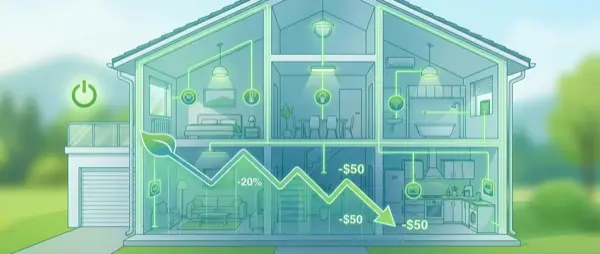
🔋 How Smart Home Reduces Consumption
Smart home energy saving does not rely on a single technology but rather on the combination of multiple strategies working in concert. A comprehensive automation system monitors real-time consumption for every device, automatically applies energy-saving scenarios based on presence and time of day, and provides detailed analytics that allow the user to identify the biggest energy consumers in their household. The real power lies in synergy: heating coordinates with open windows, lighting responds to occupancy, and air conditioning adapts to weather conditions.
🌡️ Smart Heating and Cooling
Heating and cooling represent by far the largest consumption category in a European home, reaching 50-60% of the total electricity bill. Smart thermostats are the single largest source of savings in any smart home setup. Devices like Tado, Netatmo, and Ecobee learn your household habits and automatically adjust the temperature throughout the day. The geofencing feature automatically reduces heating when you leave the house and increases it before you return, ensuring comfort without wasted energy.
For air conditioning, smart IR blasters like Sensibo and SwitchBot Hub enable control of any AC unit via smartphone. You can set maximum temperature limits, automatic shutdown after hours of inactivity, and scheduling based on your home presence patterns. The savings from proper AC management can reach €150-250 annually during a typical European summer season, making this one of the highest-impact smart home investments available.
💡 Small Changes, Big Impact
Every 1°C reduction in heating saves 7% energy. A smart thermostat that automatically adjusts 2-3°C lower during nighttime or absence saves 15-20% on the heating bill alone.
💡 Lighting: The Easy Win
Smart lighting is the easiest and quickest change with immediately visible results. Replacing traditional bulbs with smart LEDs reduces lighting consumption by 75-85%. Adding scheduling automations and motion sensors pushes savings to over 90%. The initial investment in smart bulbs pays for itself in 12-18 months, while their lifespan of 25,000+ hours means you will not need replacements for over a decade of typical residential use.
The most effective lighting scenarios include reducing brightness during evening hours, automatic shutdown in unoccupied rooms through motion sensors, and daylight harvesting that dims artificial lighting when sufficient natural light enters the space. A comprehensive smart lighting system costs €200-400 for a typical home and saves €120-180 annually on electricity costs alone.
🔌 Smart Plugs and Consumption Monitoring
Smart plugs with consumption metering are an exceptionally useful tool costing just €10-15 per unit. Placing them on major appliances like water heaters, night-rate heaters, dehumidifiers, and washing machines allows you to see exactly how much each appliance costs to operate. In many cases, users discover that certain devices consume significantly more than expected, especially in standby mode where energy silently drains without providing any useful function.
| Appliance | Typical Consumption | Standby | Annual Standby Cost |
|---|---|---|---|
| 55″ TV | 80-120W | 0.5-3W | €1-7 |
| AC Unit 12,000 BTU | 900-1200W | 1-5W | €2-12 |
| Water Heater 80L | 2000-4000W | N/A | Depends on scheduling |
| Gaming Console | 50-200W | 5-15W | €12-36 |
| WiFi Router | 8-20W | - | €19-48 (24/7) |
The most impactful smart plug application is the water heater. A smart plug on your water heater that activates only 1-2 hours before hot water usage instead of running continuously can save €100-200 annually. This single saving alone far exceeds the cost of multiple smart plugs, making it the highest return-on-investment smart home upgrade available.
📊 Energy Dashboard: Knowledge Saves Money
The first step of any energy-saving strategy is understanding your current consumption patterns. Platforms like Home Assistant Energy Dashboard, Shelly Cloud, and the TP-Link Tapo app provide detailed consumption charts by device, by room, and by time of day. Studies show that simply monitoring consumption reduces energy usage by 5-15% due to increased awareness alone, even without implementing any automations or scheduling routines.
For more advanced monitoring, you can install whole-house consumption meters at the main electrical panel, such as the Shelly 3EM or Emporia Vue. These provide real-time data for your home's total consumption and alert you when daily or monthly thresholds are exceeded. Combined with smart plugs on individual appliances, you can create a complete consumption map of your entire household.
🏠 Comprehensive Saving Strategy
The most effective approach combines multiple automations into a cohesive integrated system. An «Away from Home» scenario can simultaneously turn off all lights, reduce heating by 3°C, shut down televisions and non-essential devices, and arm the security system. Correspondingly, a «Coming Home» scenario restores everything to your preferred comfort levels. Through geofencing technology, these scenarios execute automatically without any manual intervention from the user whatsoever.
- Away Mode: Automatic heating reduction, lights off, standby device deactivation
- Sleep Mode: Reduced lighting, lower bedroom temperature, entertainment center shutdown
- Morning Routine: Gradual light activation, bathroom heating, water heater activation
- Eco Mode: Minimum energy consumption without compromising essential security systems
☀️ Solar Energy and Smart Home Integration
Combining solar panels with smart home automations maximizes solar energy self-consumption. Instead of sending surplus electricity to the grid at low compensation rates, automations strategically activate the water heater, washing machine, or electric vehicle charging when production exceeds consumption. This strategy can increase the self-consumption ratio from 30-40% to 70-80%, significantly maximizing the return on your solar panel investment over its operational lifetime.
📈 Realistic Savings Analysis
Heating/cooling: €150-300/year savings with smart thermostat
Lighting: €120-180/year savings with smart LED + automations
Water heater: €100-200/year savings with smart plug scheduling
Standby elimination: €30-80/year savings
Total: €400-760 annually in a typical 100 sqm home
🎯 Step-by-Step Getting Started Guide
- Install metering smart plugs: Place on water heater, TV, gaming console. Cost: ~€40
- Replace lighting: 10-20 smart LED bulbs in most-used rooms. Cost: ~€150
- Motion sensors: 2-3 sensors in hallways and bathrooms. Cost: ~€60
- Smart thermostat: Install Tado or Netatmo. Cost: ~€200
- Smart IR blaster: For AC control. Cost: ~€30
- Automations: Create Away/Sleep/Morning scenarios via Home Assistant or Google Home
✅ Conclusions
Smart home energy saving is a real, measurable, and highly cost-effective investment. With an initial cost of €400-600 for a basic system, you can save €400-760 annually — meaning the payback completes within the first year. The key is combination: smart thermostat for heating, smart LEDs for lighting, smart plugs for monitoring and water heater scheduling, and presence-based automations for everything else. The technology is now mature, affordable, and easy to install — you do not need specialized technical knowledge to get started and begin seeing meaningful reductions in your electricity bill.