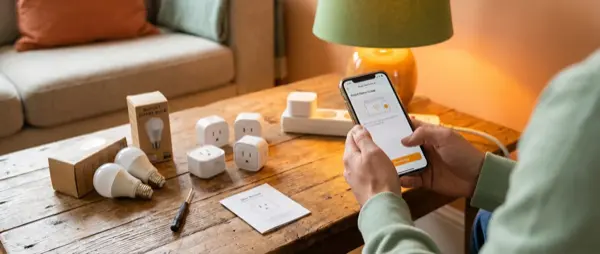
You don't need thousands of euros to build a smart home. With the right strategy and affordable devices, you can start your smart home with a budget under €100 — and expand gradually. In this guide, we'll look at which devices are truly worth it, how to avoid marketing traps, and how to build a complete system step by step without breaking your budget.
Phase 1: The Basics (Under €50)
Start with the 3 most useful things that immediately change your daily life:
Smart Plugs (2 units) — €15-20
The most cost-effective smart home gadgets. They make any appliance "smart": lamps, coffee maker, space heater, fan. Schedule ON/OFF, voice control, energy monitoring. Recommendation: TP-Link Tapo P110 (€10/unit) — WiFi, energy monitoring, timer, Alexa/Google compatible. Alternative: Shelly Plug S (€12) for local control.
Smart Bulb (1 unit) — €8-12
One smart bulb in the living room or bedroom. Start with warm/cool white — you don't need RGB initially. Recommendation: TP-Link Tapo L510E (€8) or IKEA TRÅDFRI (€9). Dimming, scheduling, sunrise alarm.
Smart Speaker Mini — €20-30
Google Nest Mini or Amazon Echo Dot on sale (€20-30). Becomes your central control unit: voice commands, timers, news, music, intercom. Without a speaker, the smart home experience drops dramatically — worth the investment.
Phase 1 Total: €45-60 — You already have voice control, automations, and energy monitoring.
Phase 2: Security & Sensors (€50-80)
Door/Window Sensor — €8-12
Aqara Door Sensor (Zigbee, €10) or Shelly Door/Window (WiFi, €12). Notification when door/window opens or closes. Automation: “if window opens → turn off heating”. Small size, 2+ year battery life.
Motion Sensor — €10-15
Automatic night light in the hallway, motion alert when you're away. Aqara Motion Sensor P1 (€12) or IKEA VALLHORN (€10). Perfect for switchless lighting — motion → lights ON, no motion for 5 minutes → OFF.
Temperature/Humidity Sensor — €8-10
Aqara Temperature Sensor (€9) — shows temperature and humidity in each room. Trigger automations: “if temperature > 26°C → activate AC” or “if humidity > 65% → notify”. Historical charts in the app.
Indoor Smart Camera — €25-35
TP-Link Tapo C200 (€25): 1080p, night vision, motion detection, two-way audio, microSD recording. Free cloud clip storage. Alternative: Xiaomi C200 (€22). No subscription needed — SD card recording does the job.
Phase 2 Total: €50-70 — Motion automations, temperature monitoring, and basic security.
Phase 3: Climate & Energy (€60-120)
IR Blaster for AC/TV — €15-25
Broadlink RM4 Mini (€18) or SwitchBot Hub Mini (€25): controls AC, TV, fan via infrared. Voice control AC, scheduling, geofencing (turns on AC before you get home). Replaces a smart thermostat for AC at a fraction of the cost.
Shelly 1 for Water Heater — €12-15
Install behind the water heater switch. Schedule: 30 minutes morning + 30 minutes evening instead of 24/7 operation. Savings: €30-40/month depending on usage. ROI in less than 1 month — the best smart home investment.
Smart Power Strip — €20-30
TP-Link Tapo P300 (€25): 3 individually controlled outlets + 2 USB. Ideal for entertainment center (TV, soundbar, console) or desk. One plug controls multiple devices — all-off with one command.
Phase 3 Total: €50-70 — Climate control, water heater, and energy management.
Phase 4: Lighting & Automations (€40-80)
LED Strip — €15-25
Govee or Tapo LED strip (€15-20 for 5 meters). Behind the TV, under kitchen cabinets, or as accent lighting. RGB dimming, scenes, music sync. Low cost, huge change in your home's atmosphere.
Additional Smart Bulbs — €20-30
2-3 more bulbs in key areas: bedroom, kitchen, entrance. Group into rooms in the app. Scenes: “Movie Night”, “Reading”, “Goodnight”. Voice control each room separately.
Smart Button/Switch — €8-15
IKEA SOMRIG or Aqara Mini Switch (€8-12). Physical button that triggers automations without voice. Next to the bed: press → everything turns off. At the entrance: press → “leaving home” mode activates.
Phase 4 Total: €45-70
Total Budget Per Phase
| Phase | What You Get | Budget | Running Total |
|---|---|---|---|
| 1. Basics | 2 plugs, 1 bulb, speaker | €45-60 | €45-60 |
| 2. Security | Sensors, camera | €50-70 | €95-130 |
| 3. Climate | IR blaster, Shelly, strip | €50-70 | €145-200 |
| 4. Lighting | LEDs, buttons, bulbs | €45-70 | €190-270 |
Mistakes to Avoid
Don't buy a hub first: Start with WiFi devices (Tapo, Shelly). A hub (Zigbee) is only needed when you have 10+ devices. Don't spend €80 on a hub from the start.
Don't go for brand-name first: A Philips Hue bulb costs €25, Tapo does almost the same for €8. Start budget, upgrade if needed.
Don't buy everything at once: Gradual purchasing helps you understand what you actually use. Many people buy 10 devices, use 4.
Watch your WiFi: Every smart device takes a spot on your network. With 15+ WiFi devices you need a decent router. Mesh WiFi (TP-Link Deco, €80 for 2-pack) solves the problem long-term.
Conclusion
Smart home doesn't mean expensive home. With €50 initially you get voice control, automations, and energy monitoring. With €200 total you have a complete system: lighting, climate, security, sensors. The key is gradual upgrading — start small, learn what you need, and add step by step. Energy savings (water heater + heating) often cover the cost of devices within a few months. In 2026, budget smart home is more accessible than ever.