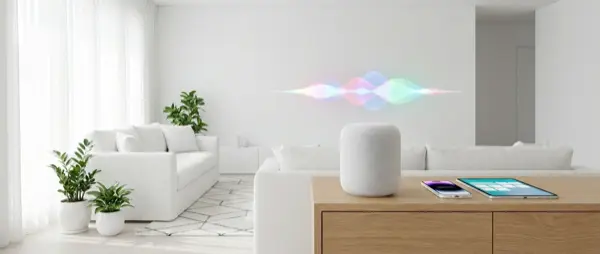
Apple Home Ecosystem: The 3 Pillars
Apple's smart home strategy in 2026 is built on three pillars: Siri + Apple Intelligence, Matter protocol, and Apple Home app. This combination creates a unified experience where your voice, automations, and devices work together seamlessly — always within Apple's privacy-first philosophy.
Siri + Apple Intelligence
Apple Intelligence empowers Siri to understand complex commands and home context. “Turn off all lights except the bedroom” or “Set the thermostat based on the weather” now work with natural language processing that learns your habits. The on-device processing ensures speed without depending on cloud services, and Apple Intelligence recognizes patterns like your morning routine or when you leave for work.
Matter Protocol
Matter is the universal smart home standard, and Apple was among the first to support it natively in HomeKit. This means you can now buy devices from any manufacturer (Google, Samsung, Amazon) and connect them to Apple Home without additional bridges. In 2026, most new smart devices support Matter out of the box, which dramatically expands the Apple Home compatible devices list.
Apple Home App
The redesigned Apple Home app offers a cleaner interface with room-by-room management, live cameras, energy monitoring, and smart suggestions. The new “Activity History” feature logs all device events, while “Home Reports” provide weekly summaries of energy usage and automation triggers. The integration with Apple Watch allows quick control directly from your wrist, and the iPad can serve as a always-visible home dashboard.
Proactive Automations with AI
The biggest innovation of 2026 is Proactive Automations. Rather than setting static rules (e.g., lights on at 7 PM), Apple Intelligence observes your daily patterns and suggests intelligent automations. For example, if you always lower the blinds at sunset and turn on specific lights, Siri will propose this as an automation.
- Adaptive Lighting: Adjusts color temperature throughout the day based on natural light levels and your preferences
- Smart Energy: Learns when you're away and reduces heating/cooling automatically to save energy
- Security Patterns: Simulates presence when you're on vacation by randomly toggling lights and blinds at varying times
- Context Awareness: Recognizes events like “movie time” and adjusts multiple devices at once — dims lights, lowers blinds, turns on the TV, and sets speakers to surround mode
Apple TV 4K: The Smart Home Hub
Apple TV 4K serves as the central hub for Apple Home, enabling remote access and automations even when you're away. It supports Thread protocol for low-latency local communication with devices, and acts as a Matter controller for your network. The 2026 update brings improved processing that handles up to 200 connected devices with zero lag.
HomePod and HomePod mini also function as home hubs, but Apple TV offers the advantage of connecting to your TV for visual dashboard display. With tvOS 20, you can now view all cameras, device statuses, and automation history directly on the TV screen. This makes it the ideal central control point for any Apple smart home setup.
Voice Commands That Actually Work
Siri's voice control in 2026 supports complex, multi-step commands and follow-ups — a major leap from the basic commands of previous years:
- Multi-device: “Turn off all lights, lock the doors, and set the alarm” — a single command handles three device types
- Conditional: “If it's raining tomorrow, turn on the dehumidifier in the morning”
- Contextual: “Make the living room cozy” → Siri knows to dim lights to warm 2700K, close blinds, and raise the thermostat
- Queries: “What's the temperature in the bedroom?” or “How much energy did I use this week?”
- Scene chaining: “Activate goodbye scene in 10 minutes” or “Undo the last change”
Siri vs Alexa vs Google Assistant
| Feature | Siri / Apple Home | Alexa | Google Assistant |
|---|---|---|---|
| Privacy | On-device processing | Cloud-based | Cloud-based |
| Matter | Full support | Full support | Full support |
| Compatible Devices | ~2,500+ | ~100,000+ | ~50,000+ |
| Voice Quality | Very good (2026) | Excellent | Excellent |
| AI Automations | Proactive Automations | Hunches | Suggested Routines |
| Local Control | Thread + HomeKit | Zigbee (Echo) | Thread (Nest) |
| Hub Required | Apple TV / HomePod | No (Echo) | No (Nest) |
| Hub Cost | €180 - €300 | €30 - €60 | €30 - €100 |
| Best For | Apple users + privacy | Max compatibility | Google services |
Privacy: Apple's Biggest Advantage
Apple's approach to smart home privacy fundamentally differs from competitors. Siri processes voice commands on-device — your audio never leaves your iPhone, HomePod, or Apple TV. There are no recordings stored on remote servers, no voice history logs accessible by third parties, and no data sold to advertisers. This is a critical advantage for anyone concerned about privacy in their home.
Additionally, Apple uses HomeKit Secure Video for camera recordings, which are encrypted end-to-end and stored in iCloud. Not even Apple itself can view your footage. Camera analysis (person detection, facial recognition) happens locally on Apple TV or HomePod, so your video streams remain within your home network. This level of privacy is unmatched by any other major smart home platform in 2026.
In contrast, Alexa and Google Assistant send voice recordings to cloud servers for processing. While both offer options to delete recordings, the fundamental architecture relies on cloud processing. Apple's on-device approach means your smart home data remains truly private, making it the clear choice for security-conscious users.
Compatible Devices in 2026
Thanks to Matter, the Apple Home device ecosystem has expanded significantly:
- Lighting: Philips Hue, IKEA, Nanoleaf, Meross, Wiz
- Thermostats: Ecobee, tado°, Netatmo, Honeywell Home
- Cameras: Logitech Circle, Eve Cam, Eufy (with HomeKit Secure Video support)
- Locks: Yale, Schlage, Nuki, Aqara
- Sensors: Eve, Aqara, Fibaro — temperature, humidity, motion, door/window contact sensors
- Robot Vacuums: Roborock, iRobot, Ecovacs (via Matter integration)
- Blinds: IKEA FYRTUR, Somfy, Hunter Douglas
Disadvantages
- Cost: The Apple ecosystem is more expensive (HomePod €300, Apple TV €180) compared to €30-60 for Alexa devices
- Fewer Devices: Still fewer native HomeKit devices vs Alexa, although Matter is closing the gap rapidly
- Greek Language: Siri in Greek is more limited — use English for better results and wider command support
- Apple Lock-in: You need iPhone + Apple TV/HomePod — the system doesn't work without the Apple ecosystem
- Simpler Routines: Apple Home automations are more basic than Alexa Routines or Google Assistant routines
Conclusion
Siri and Apple Home in 2026 have improved significantly thanks to Apple Intelligence and Matter. If you're already in the Apple ecosystem (iPhone, Apple TV, HomePod), it's worth building your smart home around HomeKit/Matter. The integration of Proactive Automations brings genuine AI intelligence to your home, while Matter support ensures broad compatibility with third-party devices. If privacy is your top priority, Apple is the best choice without a second thought. If you're just starting out and want maximum device compatibility at the lowest price, Alexa remains the most practical option for beginners.