motion sensors PIR sensor mmWave radar smart home automation presence detection AI cameras home security IoT sensors
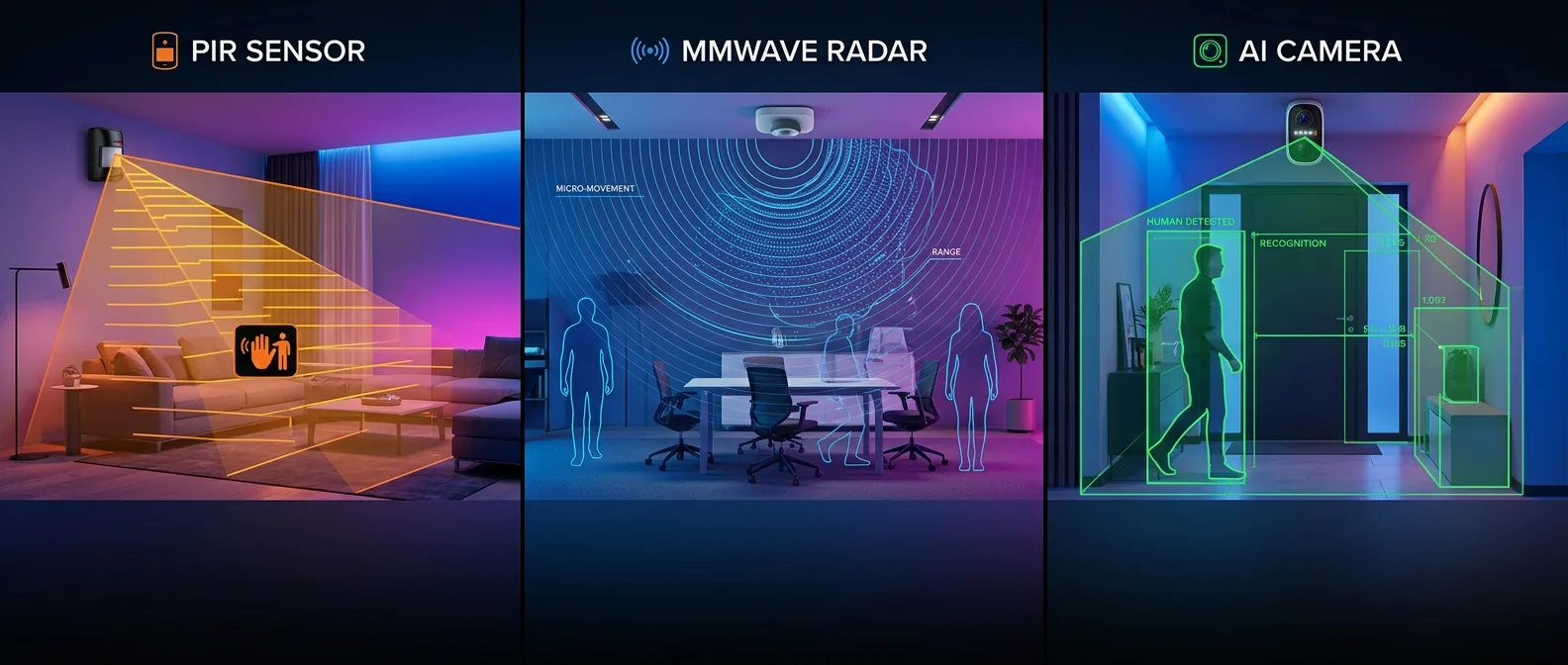
Your smart home's lights turn on when you walk into a room. Sounds simple, right? Wrong. Behind that split-second response lies a technological battle between three fundamentally different approaches to detecting human presence. PIR sensors read heat signatures. mmWave sensors bounce radio waves off your body. AI cameras actually see you move. Each has carved out its own territory in the smart home ecosystem, and choosing the wrong one can mean lights that never turn on when you're reading quietly or security systems that trigger every time your cat walks by.
How Each Motion Detection Technology Actually Works
PIR Sensors: The Heat-Seeking Workhorses
PIR sensors (Passive Infrared) have been the backbone of motion detection for decades. They work by detecting changes in infrared radiation — essentially, the heat your body gives off. When you move across their field of view, they spot the temperature difference between your 98.6°F body and the cooler background. That's it. No complex processing, no wireless signals, just pure thermal detection.
This simplicity makes PIR sensors incredibly energy-efficient. A battery-powered PIR motion sensor can run for years without needing a charge. They're also dirt cheap — you can find decent ones for under $20. But that simplicity comes with trade-offs that become obvious once you start using them for anything beyond basic "turn on lights when someone enters" scenarios.
PIR sensors need actual movement to trigger. Sit perfectly still while reading, and they'll assume you've left the room. They also struggle with temperature extremes — in a hot room where your body temperature barely differs from the ambient air, they might miss you entirely. And forget about detecting motion through glass; infrared radiation doesn't penetrate it.
mmWave Technology: The Radar Revolution
mmWave sensors represent a quantum leap in motion detection sophistication. These radar sensors transmit millimeter-wave radio signals (typically 24GHz or 60GHz) and analyze the reflections that bounce back. They can detect the tiniest movements — even your breathing or heartbeat — making them exceptional presence sensors rather than just motion detectors.
The Aqara FP2 popularized mmWave technology in the consumer smart home market, and it's easy to see why. These sensors can detect someone sitting motionless at a desk, track multiple people in a room simultaneously, and even work through thin materials like plastic enclosures. They create detailed maps of movement patterns and can distinguish between different types of motion.
But mmWave sensors demand more power than PIR units and require careful calibration. Set the sensitivity too high, and they'll trigger from micro-movements like curtains swaying. Too low, and they'll miss subtle presence cues. They also cost significantly more — expect to pay $60-80 for a quality mmWave sensor versus $10-30 for PIR.
Strengths and Weaknesses of Each Technology
PIR Sensors: Reliable But Limited
Strengths:
- Ultra-low power consumption (years of battery life)
- Proven reliability in diverse conditions
- Immune to lighting changes and weather
- Extremely cost-effective
Weaknesses:
- Cannot detect stationary presence
- Blocked by glass and solid barriers
- False triggers from pets and moving objects
- Poor performance in high ambient temperatures
PIR sensors excel in straightforward applications. Hallway lighting, outdoor security lights, and basic occupancy detection work perfectly with PIR technology. But they fall short when you need nuanced presence detection or want to avoid the "lights turning off while you're sitting still" problem.
mmWave vs Camera Detection: The Modern Showdown
mmWave radar and AI cameras now compete for the high-end market. Both represent cutting-edge approaches to motion detection, but they solve different problems.
mmWave sensors offer privacy-first detection. They can't identify who you are or what you're doing; they just know someone is present and roughly where. This makes them perfect for bedrooms, bathrooms, and other privacy-sensitive areas. They work equally well in complete darkness and bright sunlight, and they can detect presence through thin walls or furniture.
AI camera detection provides rich contextual information. Modern smart cameras don't just detect motion — they can identify specific people, distinguish between humans and pets, recognize activities, and provide visual confirmation of events. The AI processing happens either locally on the device or in the cloud, enabling sophisticated behavior analysis.
Power requirements differ significantly. mmWave sensors sip power continuously but at low levels. AI cameras need substantial processing power for image analysis, making them hungrier for electricity and typically requiring constant power connections.
Which Technology Wins for Different Use Cases?
The "best" smart motion sensor depends entirely on what you're trying to accomplish. For basic automation like turning lights on in hallways or triggering outdoor security lights, PIR sensors remain unbeatable. They're reliable, cheap, and have proven themselves over decades of use.
For sophisticated presence detection — keeping lights on while you work at a desk, detecting occupancy in conference rooms, or creating responsive environments that adapt to subtle human presence — mmWave sensors like the Aqara FP2 dominate. They can maintain awareness of stationary humans and provide the granular detection needed for advanced automation.
AI cameras shine when you need identification and verification. Home security systems benefit enormously from being able to distinguish between family members and strangers, or between a person and a delivery package. They're also invaluable for monitoring elderly relatives or detecting unusual situations that require human interpretation.
- Basic automation: PIR sensors win on cost and reliability
- Presence detection: mmWave sensors provide unmatched accuracy
- Security and analytics: AI cameras offer visual confirmation
- Outdoor applications: PIR or weatherproof cameras
- Privacy-sensitive areas: mmWave or PIR avoid recording
Cost and Installation: Real-World Considerations
Budget plays a huge role in sensor selection. PIR sensors start around $10 for basic units and rarely exceed $30 even for premium models. mmWave sensors like the Aqara FP2 typically cost $60-80. AI-enabled cameras span a massive range from $50 for basic models to $300+ for professional-grade units with advanced AI processing.
Installation complexity varies dramatically. PIR and mmWave sensors are generally plug-and-play — mount them, connect to your smart home hub, and they work. Cameras require more thought about positioning, network connectivity, and privacy considerations. mmWave sensors need a "learning period" to map their environment and reduce false triggers.
The ongoing costs matter too. PIR sensors might need battery replacements every few years. mmWave sensors typically plug into wall power. AI cameras often require cloud subscriptions for advanced features, adding $3-10 monthly to your smart home budget.
Smart home setups typically use multiple sensor types. They deploy PIR sensors for basic automation, mmWave for presence detection in key rooms, and cameras where security or identification matters. The key is understanding each technology's strengths and matching them to your specific needs rather than trying to force one solution to handle every scenario.
The motion sensor wars aren't about finding a single winner — they're about deploying the right tool for each job. PIR sensors handle the basics reliably and cheaply. mmWave sensors excel at nuanced presence detection. AI cameras provide intelligence and verification. Choose based on your specific use case, privacy requirements, and budget, and you'll build a smart home that actually responds intelligently to your presence.
Picking the right sensor for motion detection in your smart home seems straightforward until you dig into the technology. The differences between PIR sensors, mmWave sensors, and AI camera detection are massive — each excels in different scenarios and fails spectacularly in others. Understanding how each technology works helps you choose correctly.
How Each Motion Detection Technology Actually Works
PIR Sensors: The Classic Heat Detectors
PIR sensors (Passive Infrared) are the most widespread motion detection technology and form the backbone of most smart motion sensors. They work by detecting changes in heat emitted by the human body. When you move through their field of view, they spot the temperature difference between your body and the surrounding environment.
The big advantage of PIR is simplicity and ultra-low power consumption, making them perfect for battery-powered devices. But they have significant limitations — they can't detect motion through glass and need relatively large movements to trigger. They're essentially heat-change detectors, not true presence sensors.
mmWave Technology: Next-Gen Radar Sensors
mmWave sensors use high-frequency radar technology to "see" through materials and detect even the smallest movements. These radar sensors can spot someone's presence even when sitting perfectly still, making them excellent presence sensors. mmWave technology works by sending out radio waves and analyzing the signals that bounce back.
One of the most popular examples is the Aqara FP2, which has made mmWave sensors mainstream in the smart home community. These sensors offer precision that extends to detecting breathing, making them ideal for automation that requires high sensitivity.
Advantages and Disadvantages of Each Technology
PIR Sensors: Reliability with Limits
Advantages:
- Ultra-low power consumption
- Budget-friendly pricing
- Proven reliability
- Unaffected by light or weather conditions
Disadvantages:
- Don't work through glass
- Need visible movement to activate
- Can be triggered by pets
- Limited accuracy in location detection
mmWave sensors and camera-based solutions offer completely different capabilities. Radar sensors can work in complete darkness and penetrate thin materials, while AI cameras provide visual confirmation and recognition capabilities.
mmWave vs Camera Detection: Battle of Modern Solutions
The choice between mmWave and camera detection largely depends on your privacy needs and the accuracy you require. mmWave sensors offer complete privacy protection since they don't record images, while they can operate continuously without being affected by lighting conditions.
On the flip side, cameras with AI camera detection can provide much more detailed information. They can distinguish between different people, recognize pets, and even detect specific activities. AI technology allows them to "learn" and improve their accuracy over time.
Regarding power consumption, mmWave sensors are generally more energy-efficient than cameras, especially when operating continuously. Cameras need processing power for image analysis, which increases consumption.
Which Technology Is Better for Different Uses?
Choosing the right smart motion sensor depends on your specific use case. For simple lighting automation in hallways or outdoor spaces, traditional PIR sensors remain an excellent choice. They're reliable, economical, and have long battery life.
For more advanced automation, like presence detection in offices or bedrooms, mmWave sensors like the Aqara FP2 offer superior accuracy. They can keep lights on when you're sitting or reading, something PIR sensors can't do reliably.
Camera-based solutions are ideal when you need detailed analysis and visual confirmation. For example, in security systems where you want to know not just that someone entered the house, but who it is. They're also excellent for monitoring elderly people or detecting unusual situations.
- Basic automation: PIR sensors
- Presence detection: mmWave sensors
- Security and analytics: AI cameras
- Outdoor spaces: PIR or cameras
- Privacy-sensitive areas: mmWave or PIR
Cost and Installation: Practical Advice
Acquisition costs vary significantly between technologies. PIR sensors can be found for 10-30 euros, while mmWave sensors like the Aqara FP2 cost around 60-80 euros. Smart cameras with AI detection range widely from 50 to 300+ euros depending on their features.
Installation-wise, PIR and mmWave sensors are generally plug-and-play, while cameras may need more careful setup for optimal placement and configuration. mmWave sensors require a "learning period" to adapt to their environment and reduce false triggers.
The final choice between PIR, mmWave, or camera detection isn't absolute — many smart home users combine different technologies depending on the space and usage. The key is understanding your needs, evaluating the limitations of each technology, and choosing the solution that offers the best balance of performance, cost, and ease of use for your specific conditions.