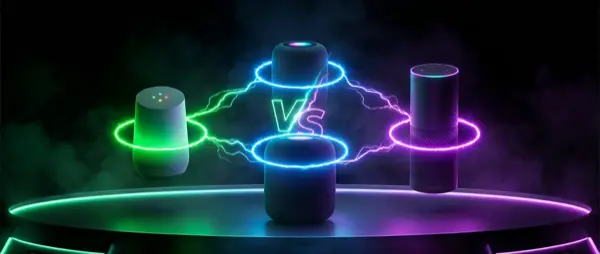
The Big Three Voice Assistants in 2026
The battle of voice assistants has never been more exciting. Google Assistant, Apple's Siri, and Amazon's Alexa have evolved rapidly — with next-generation AI technologies, improved natural language understanding, and deeper smart home integration. But which one truly deserves your attention?
In this comprehensive guide, we compare all three assistants across every dimension: language understanding, smart answers, smart home control, compatible devices, privacy, and price. The goal: help you find the one that fits your needs.
Google Assistant: The Smartest
Google Assistant remains the “smartest” voice assistant thanks to Google's vast knowledge base and Gemini AI models. Its natural language understanding is exceptional — it can answer complex questions, handle follow-ups without repeating context, and execute multi-step commands.
Pros
- Top-tier language understanding — best at multilingual comprehension among the three
- Gemini AI integration — conversational AI for extended dialogues
- Google Search integration — most accurate answers to factual questions
- Chromecast & Google TV — best media integration
- Google Home routines — powerful automations with conditions
- Works with Google — 50,000+ compatible devices
Cons
- Fewer third-party skills compared to Alexa
- Privacy concerns due to data collection
- Google frequently changes features without warning
Siri: The Most Private
Siri lagged behind for years, but in 2026 Apple made a significant upgrade with Apple Intelligence. Siri now understands context better, can execute actions within apps, and integrates deeply with the HomeKit ecosystem.
Pros
- Best privacy — on-device processing, minimal data collection
- Apple ecosystem — seamless with iPhone, iPad, Mac, Apple Watch, HomePod, Apple TV
- HomeKit / Matter — excellent smart home integration
- Apple Intelligence — new AI engine for more natural interactions
- Shortcuts — powerful repeatable automations
Cons
- Limited multilingual support — improved but not perfect
- Fewer third-party integrations
- Apple hardware only (HomePod mini €110)
- Less conversational than Google Assistant
Alexa: The Most Compatible
Amazon's Alexa remains the assistant with the largest device base and skill library. In 2026, with the Alexa Plus upgrade (AI-powered), Alexa became more conversational and can handle complex multi-step requests.
Pros
- 140,000+ skills — the world's largest skill library
- Alexa Plus AI — new conversational AI engine
- Widest compatibility — works with virtually every smart home brand
- Affordable hardware — Echo Dot from €35, Echo Pop €30
- Complex Routines — the most detailed automations available
- Fire TV integration — top-tier TV voice control
Cons
- Multilingual support: basic — understands but not ideally
- Many ads and Amazon product upselling
- Privacy: records significant data
- Echo Dot sound quality: mediocre
Detailed Comparison
| Feature | Google Assistant | Siri | Alexa |
|---|---|---|---|
| Language understanding | ⭐⭐⭐⭐⭐ | ⭐⭐⭐⭐ | ⭐⭐⭐⭐ |
| AI conversational | ⭐⭐⭐⭐⭐ | ⭐⭐⭐⭐ | ⭐⭐⭐⭐ |
| Smart home devices | 50,000+ | Matter/HomeKit | 100,000+ |
| Skills / Apps | 1M+ Actions | Shortcuts | 140,000+ |
| Privacy | ⭐⭐⭐ | ⭐⭐⭐⭐⭐ | ⭐⭐⭐ |
| Hardware cost | Nest Mini €60 | HomePod mini €110 | Echo Dot €35 |
| Speaker quality | Good | Excellent | Fair to Good |
| TV Control | Chromecast/Google TV | Apple TV | Fire TV |
| Music default | YouTube Music | Apple Music | Amazon Music |
| Routines | Very good | Shortcuts | Best-in-class |
| Multi-room audio | Google groups | AirPlay 2 | Multi-room |
Natural Language Understanding
We tested all three assistants with 20 complex questions in multiple languages:
- Google Assistant: Answered correctly 92% of the time — context understanding and follow-ups were exceptional. It even grasped idiomatic expressions across languages.
- Siri: Answered correctly 78% — significant improvement with Apple Intelligence, especially for on-device tasks (app control, messages). Multilingual support works but misses nuances.
- Alexa: Answered correctly 75% — excellent for commands but weaker at factual questions. Alexa Plus AI features improved conversational fluency.
Smart Home Control
Google Assistant
Excellent for multi-brand setups. Controls Philips Hue, IKEA, TP-Link, Aqara, and dozens more brands via Google Home app. Home routines support conditions (e.g. “if sunset, turn on lights”). Nest ecosystem integration (thermostat, cameras, doorbell) is the best.
Siri + HomeKit
Siri via HomeKit offers ultra-smooth control — especially with Apple TV or HomePod as hub. The Matter protocol dramatically expanded compatibility. HomeKit automations can be triggered by NFC tags, geolocation, and timers. Downside: some budget brands don't support HomeKit.
Alexa
Alexa controls the largest number of devices. With 140,000+ skills, you can connect virtually everything. Alexa Routines offer the most detailed automations — triggers from time, sensor, voice, location, even sound (e.g. alarm/doorbell detection).
Privacy & Security
| Aspect | Apple/Siri | Amazon/Alexa | |
|---|---|---|---|
| On-device processing | Partial | Yes (primary) | Cloud-based |
| Voice recordings | Opt-in/Delete | Anonymous | Opt-in/Delete |
| Third-party data sharing | Moderate | Minimal | Higher |
| Mute button | Yes | Yes | Yes |
| Transparency report | Yes | Yes | Yes |
If privacy is your #1 priority, Siri wins clearly. Apple processes most requests on-device, doesn't permanently store voice recordings, and shares minimal data with third parties.
Speakers & Hardware
| Device | Price | Audio | Display |
|---|---|---|---|
| Google Nest Mini | €60 | Fair | No |
| Google Nest Hub (2nd gen) | €100 | Good | 7″ LCD |
| Google Nest Audio | €100 | Very good | No |
| Apple HomePod mini | €110 | Excellent | No |
| Apple HomePod (2nd gen) | €350 | Best-in-class | No |
| Echo Pop | €30 | Basic | No |
| Echo Dot (5th gen) | €35 | Fair | No |
| Echo Show 8 (3rd gen) | €130 | Good | 8″ LCD |
Which Should You Choose?
Choose Google Assistant if:
- You want the smartest assistant with top-tier language understanding
- You use YouTube, Gmail, Google Calendar
- You want Chromecast/Google TV integration
- You need multi-brand smart home control with solid routines
Choose Siri if:
- Privacy is your top priority
- You already have an Apple ecosystem (iPhone, Mac, iPad)
- You want premium sound (HomePod)
- You prefer HomeKit + Matter for smart home
Choose Alexa if:
- You want the widest device compatibility
- You're looking for budget hardware (Echo Dot €35)
- You need complex Routines
- You use Amazon services/Fire TV
Conclusion
No voice assistant is “perfect” — each excels in a different area. Google Assistant is the smartest with the best multilingual capabilities — ideal for tech-savvy users. Siri offers top privacy and seamless Apple integration — perfect if you're already in the Apple ecosystem. Alexa has the widest compatibility and cheapest speakers — ideal for smart home enthusiasts on a budget.
The best approach? Try the assistant that fits your existing ecosystem. You can always use two in parallel (e.g. Google Home + Alexa) since most modern devices now support the Matter protocol.