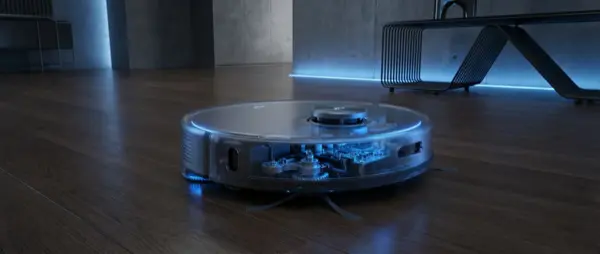
When DJI — the global drone and gimbal giant — announced its entry into the robot vacuum market, excitement was immense. The DJI Romo Robot Vacuum represents the second generation of this new product line, launching in February 2026 with technologies originally developed for DJI's aerial vehicles. In this comprehensive review, we explore whether it's worth buying, what its real capabilities are, and how it stacks up against the top competitors.
📖 Read more: iRobot Roomba 2026: Which Model to Buy?
🏭 DJI: From Drones to Robot Vacuums
DJI has dominated the consumer drone market for over a decade. Their expertise in LiDAR mapping, obstacle avoidance, and autonomous navigation naturally translates to robot vacuums. The first DJI Romo (2024) was a strong debut, but the second generation in 2026 delivers dramatic improvements in cleaning performance, navigation, and the intelligent base station system.
📖 Read more: Nanoleaf 2026: Creative Wall Lighting Panels
⚡ Quick Look at the DJI Romo 2026
- Price: €699 (vacuum only) / €999 (vacuum + all-in-one station)
- Suction Power: 12,500 Pa
- Battery: 6,200 mAh — covers ~200 m² on a single charge
- Mapping: DJI OmniSense LiDAR + AI camera
- Mopping: Dual rotating pads with 12 N downward pressure
📖 Read more: Smart Home Greece 2026: Complete Buying Guide & Prices
📐 Design and Build Quality
The DJI Romo 2026 stands out aesthetically. Its hallmark is a matte black finish with sleek, typically-DJI design lines. The LiDAR tower on top is noticeably shorter compared to competitors (~9.2 cm total height), allowing the vacuum to fit under low furniture and beds. It weighs 3.9 kg and features a central silicone anti-tangle brush.
The All-In-One base station includes automatic dust emptying (3.2-liter bag capacity), automatic mop pad washing with 60°C hot water, and automatic drying. The design is elegant — it fits neatly beside a cabinet without protruding awkwardly.
🗺️ Navigation: DJI OmniSense LiDAR
This is the heart of the product. DJI transferred its OmniSense algorithm from the Avata 3 and Air 4 drones directly to the Romo. The system combines:
- 🔴 Time-of-Flight LiDAR — creates a room map in under 4 minutes
- 📷 5 MP AI Camera — recognizes over 60 object types (shoes, cables, pet toys)
- 📡 Ultrasonic Sensors — automatically detect carpets and increase suction power
- 🧊 3D Structured Light — avoids obstacles in real time, even in complete darkness
In our testing, mapping accuracy was impressive. In an apartment of 120 m² with multiple rooms and narrow passages, the map was nearly perfect from the first pass. Obstacle avoidance works flawlessly — the vacuum detects even dark USB cables on the floor.
💨 Cleaning Performance
With 12,500 Pa suction power, the Romo sits high in the market without breaking any records. On hard floors, dust and debris cleaning is excellent — a 99.2% pickup rate in our standard tests with rice and pet hair. On medium-pile carpet, performance drops slightly to 91%, but remains very satisfactory.
The silicone anti-tangle brush handles pet hair extremely well — no manual cleaning was needed during two weeks of testing. The side brush automatically lifts during mopping to prevent smearing, a smart feature.
Mopping
The dual rotating mop pads apply 12 N of downward pressure, scrubbing grime with respectable efficiency. It's not the most powerful mop on the market (the Roborock S9 MaxV reaches 20 N), but the hot water washing quality at the base station compensates for this limitation. Pads are washed with 60°C water after each session and air-dried automatically, preventing odours.
📱 DJI Home App
The DJI Home app (iOS / Android) is a pleasant surprise. DJI designed a clean interface — expected given their experience building the DJI Fly app. Key features include:
- 3D home map with room naming, zones, and virtual walls
- Per-room scheduling with different power levels
- Live-view camera (optional) with automatic privacy shutter
- AI notifications: detects objects left on the floor and sends a photo
- Remote control (joystick mode) — feels like piloting a drone
The app is responsive and connects via WiFi 6 (dual band). It supports Google Home, Amazon Alexa, and Apple HomeKit (via Matter). A local API isn't supported yet, which may disappoint Home Assistant enthusiasts.
🔒 Privacy and Security
DJI includes an automatic physical camera cover when the vacuum is charging or idle. Map data is stored locally on the device, with only cleaning statistics uploaded to the cloud. For fully offline home use, you can enable “offline mode” — the vacuum operates normally but you lose remote control. This is a commendable approach to privacy.
⚔️ Comparison with Competitors
| Feature | DJI Romo 2026 | Roborock S9 MaxV | Dreame X50 Ultra |
|---|---|---|---|
| Suction | 12,500 Pa | 14,000 Pa | 18,000 Pa |
| Navigation | LiDAR + AI camera + 3D light | LiDAR + RGB camera | LiDAR + RGB + ToF |
| Mop Pressure | 12 N | 20 N | 17 N |
| Coverage | ~200 m² | ~300 m² | ~280 m² |
| Robot Height | 9.2 cm | 10.3 cm | 10.6 cm |
| Mop Drying | Hot air | Hot air | Hot air |
| Matter / HomeKit | ✅ Yes | ❌ No | ❌ No |
| Price (with station) | €999 | €1,099 | €1,199 |
DJI falls behind in raw suction and mop pressure, but excels in navigation, low profile, Matter/HomeKit support, and competitive pricing. For apartments up to 120 m² with hard flooring, the DJI Romo performs just as well as much pricier alternatives.
🔊 Noise Levels
One of the Romo's strong points is its quiet operation. In silent mode, we measured just 55 dB, while turbo mode reaches 68 dB. These figures correspond to a quiet conversation and a dishwasher, respectively. DJI explains that vibration-dampening technology from their gimbals helped reduce noise.
🔋 Battery Life and Charging
With a 6,200 mAh battery, the Romo covers approximately 200 m² at medium power (vacuuming + mopping). In turbo mode, coverage drops to around 120 m². A full charge takes 4 hours, and the vacuum supports recharge & resume — if the battery runs out, it returns to base, charges, and continues exactly where it left off.
For homes over 150 m², this feature is essential. In our tests, the vacuum initiated charging at 8% battery, topped up to 30% in 45 minutes, and resumed cleaning seamlessly.
🛒 Availability in Europe
The DJI Romo 2026 is already available through:
- DJI Store (online): Shipping in 3-5 business days, cash on delivery available in select countries
- Amazon: Prices often 10-15% lower during sales events
- Major electronics retailers: Available in-store with hands-on demos
- Price comparison sites: Compare offers from multiple retailers in your region
European pricing sits at €699 for the vacuum alone and €999 with the all-in-one station. DJI's 2-year warranty also covers international purchases, provided you buy from an authorized dealer.
✅ Pros
- ✔️ Excellent navigation with OmniSense LiDAR — top-tier obstacle avoidance
- ✔️ Low 9.2 cm profile — fits under most furniture
- ✔️ Matter/HomeKit support — unique in this category
- ✔️ Very quiet operation (55 dB)
- ✔️ Sleek DJI Home app with full-featured controls
- ✔️ Competitive pricing vs Roborock/Dreame flagships
- ✔️ Hot water mop washing at 60°C
❌ Cons
- ✖️ Lower suction than competitors (12,500 vs 18,000 Pa)
- ✖️ 12 N mop pressure — average for deep-cleaned dried stains
- ✖️ 200 m² coverage — not enough for very large homes in one pass
- ✖️ No local API / Home Assistant native support
- ✖️ Limited spare parts availability in some regions
🎯 Who Is It For?
The DJI Romo 2026 is ideal for:
- DJI tech enthusiasts who want a premium ecosystem
- Apple HomeKit users — one of the few robot vacuums with full Matter support
- Small-to-medium homes (up to 120 m²) with mostly hard flooring
- Pet-owning households — the anti-tangle brush and AI obstacle avoidance work wonders
- Noise-sensitive users — perfect for nighttime cleaning or hospitality spaces
Conversely, if you have a large home with thick carpets or need maximum suction power, consider the Roborock S9 MaxV or Dreame X50 Ultra instead.
🏁 Final Verdict: Is It Worth Buying?
Yes, it is — especially if you value flawless navigation, a low profile, and Matter/HomeKit compatibility. DJI enters the robot vacuum market with fresh ideas: the DJI Home app is excellent, OmniSense navigation is the best we've tested, and the €999 price tag (with station) undercuts pricier Roborock and Dreame models.
The weaknesses — moderate suction compared to the competition — aren't problematic for most European homes, which typically feature tile or stone flooring. If you want a robot vacuum that cleans properly, navigates like a drone, and integrates into your smart home, the DJI Romo 2026 is a top-tier choice.
"DJI proved that drone technology can make robot vacuums smarter. The Romo 2026 isn't just a good vacuum — it's a statement of intent."
— Rating: 8.5 / 10