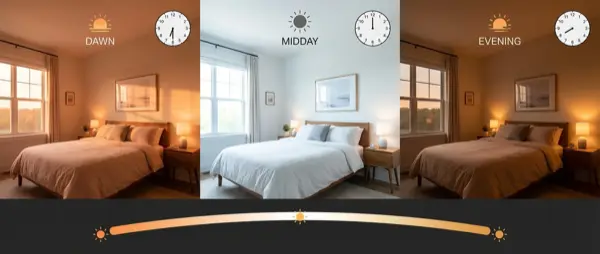
What Is the Circadian Rhythm
The circadian rhythm is your body's internal “clock” that regulates the sleep-wake cycle over 24 hours. Light is the primary synchronizer — the brain uses mainly blue wavelengths (460-490nm) to determine whether it's day or night. When it detects blue light, it produces cortisol (alertness). When it doesn't, it produces melatonin (sleepiness).
The problem? Modern LED lights emit constant cool white light (5000-6500K) all day long. This confuses your brain — especially in the evening, when blue light suppresses melatonin production and makes it significantly harder to fall asleep. Research consistently shows that exposure to cool-tone artificial lighting after sunset delays sleep onset by 30-60 minutes. This is where circadian lighting comes in to solve the problem.
How Circadian Lighting Works
Circadian lighting automatically adjusts two parameters:
- Color temperature (CCT): From 5000-6500K (cool) in the morning to 2200-2700K (warm) in the evening
- Brightness: 100% during peak hours, gradually decreasing to 20-40% after sunset
The change happens gradually and invisibly — you don't see a sudden color shift. Each transition takes 30-60 minutes per phase, making it completely natural and unnoticeable during daily activities.
Typical Circadian Lighting Schedule
| Time | CCT | Brightness | Purpose |
|---|---|---|---|
| 06:00-09:00 | 5000-6500K | 80-100% | Wake-up, energy |
| 09:00-17:00 | 4000-5000K | 100% | Productivity |
| 17:00-20:00 | 3000-4000K | 70-80% | Transition relaxation |
| 20:00-22:00 | 2200-2700K | 30-50% | Evening wind-down |
| 22:00+ | 1800-2200K | 5-20% | Night mode |
How to Set Up Circadian Lighting
Method 1: Philips Hue (Easy)
The Hue app has a built-in "Natural Light" scene that automatically adjusts color temperature. It activates per room. No code needed — just a Hue Bridge + tunable white bulbs (Hue White Ambiance or Color).
Method 2: Home Assistant (Advanced)
In Home Assistant, the "Adaptive Lighting" add-on automatically applies circadian lighting to any smart bulb that supports tunable white. Configure: min/max CCT, min/max brightness, sleep mode CCT, transition time, and sunrise/sunset offsets. Supports sunrise/sunset-based changes or manual time schedules. Works with Zigbee, Z-Wave, WiFi — any smart bulb you have.
Method 3: IKEA TRÅDFRI
IKEA smart lights (with DIRIGERA hub) support three temperatures: warm (2200K), neutral (2700K), cool (4000K). They don't do smooth transitions but you can create morning/evening scenes through the IKEA Home app for manual or scheduled activation.
Benefits of Circadian Lighting
Proven Benefits
- Better sleep: Studies show 20-30% improvement in sleep quality
- Less eye strain: Correct CCT reduces digital eye fatigue
- Increased productivity: Cool morning light = more alertness and focus
- Better mood: Melatonin at the right time = stable mood throughout the day
What Devices You Need
- Tunable White bulbs: Philips Hue White Ambiance (€20-30), IKEA TRÅDFRI (€10-15), LIFX Mini Day & Dusk (€30)
- Hub: Hue Bridge (€50), IKEA DIRIGERA (€60), or Home Assistant + Zigbee dongle
- Optional: Light sensor (for auto-adjust based on natural light), smart curtains
Common Mistakes and Tips
- Don't rely on RGB only: RGB bulbs aren't ideal for circadian — you need tunable white that changes actual color temperature
- Don't forget screens: Even with perfect circadian lighting, looking at your phone/laptop after 10 PM without night mode negates the benefits
- Bathroom night light: Add a separate warm bulb (2200K, 5%) for nighttime visits — keeps melatonin levels high
- Don't ignore windows: If you have natural light, use it first — smart curtains help control exposure
- Start gradually: You don't need to change all lights — start with bedroom and living room
Conclusion
Circadian Lighting is one of the most worthwhile smart home upgrades with immediate impact on your daily life. With tunable white bulbs at €10-30 each and a compatible app, you can automate color temperature and brightness to follow the natural light cycle throughout the day. You'll sleep better, wake up easier, feel more energetic during daylight hours, and have a more stable mood overall. If you can invest in only one smart home feature, this one delivers more tangible value than any other upgrade — because better sleep improves everything else in your life.