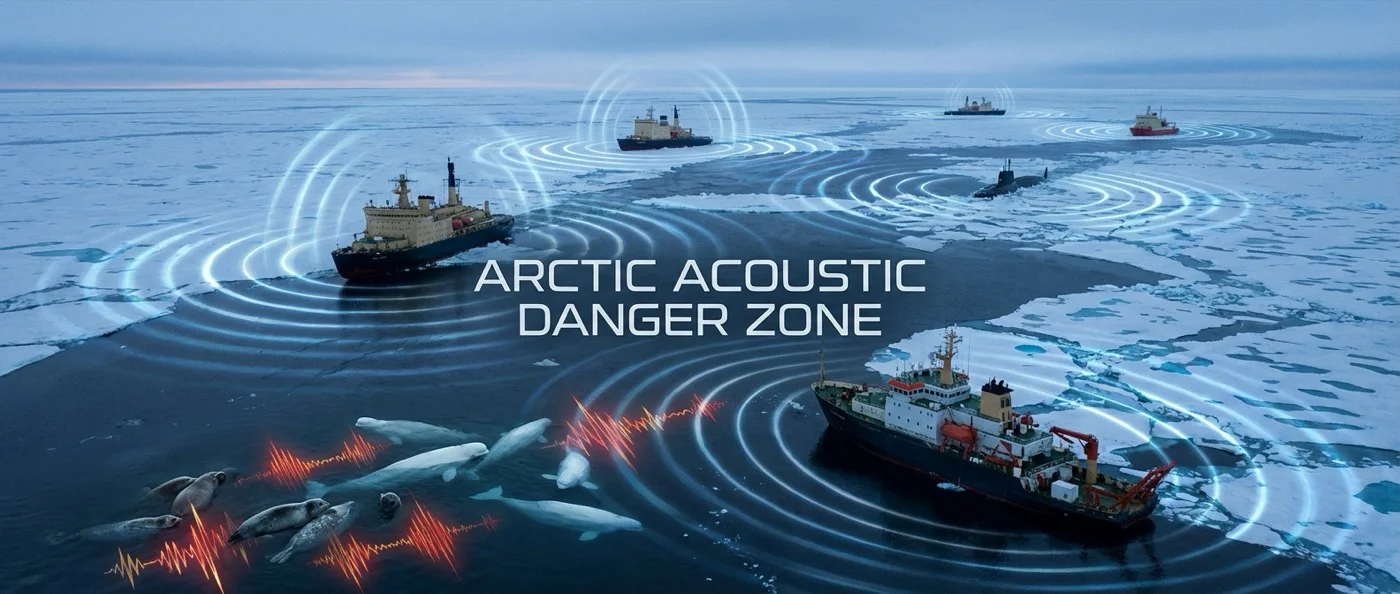
The Arctic Ocean was once one of the quietest ocean floors on the planet — protected by sea ice that absorbed acoustic energy and limited human shipping. That era is ending. A new study published in Nature Climate Change on February 25, 2026 reveals that anthropogenic noise in the Arctic has increased dramatically over the past 15 years — and the full consequences are only beginning to emerge.
The research is based on hydrophone recordings from 28 buoy-mounted stations distributed across the Arctic Ocean for the period 2010–2025. Lead researcher was Dr. Sebastian Menze of the Alfred Wegener Institute (AWI) in Germany, in collaboration with NOAA scientists and the Scripps Institution of Oceanography.
📖 Read more: AC by 2050: CO2 Emissions Could Double Without Clean Energy
What 15 Years of Acoustic Data Revealed
The results are striking. Commercial shipping noise levels increased by approximately 3 dB per decade in the 20–300 Hz frequency range — the primary band used by marine mammals for communication. Acoustically, 3 dB equals a doubling of sound energy. In the Beaufort Sea, the increase was even steeper: 4.5 dB per decade.
Meanwhile, the number of seismic surveys (air gun techniques) for hydrocarbon exploration tripled from 4 campaigns per year in 2010 to 13 in 2024. Each air gun emits pulses up to 250 dB re 1 μPa@1m — loud enough to alter whale behavior across hundreds of kilometers.
“The Arctic Ocean is changing at a pace that exceeds all projections,” says Dr. Menze. “Melting sea ice doesn’t just open shipping lanes — it opens acoustic pathways that didn’t exist before.”
📖 Read more: Ghost Particle from a Black Hole Upends Physics
The Victims: Narwhals, Belugas, Bowhead Whales
The impact on Arctic marine mammals is serious. The study combined acoustic data with telemetry records from 240 narwhals, 180 beluga whales, and 85 bowhead whales tracked in Canada, Greenland, and Russia.
Results showed:
— Belugas change direction at distances up to 48 km from a ship
— Narwhal song activity drops by 30–40% during high shipping periods
— Bowhead whales abandon feeding zones during seismic surveys
“These animals rely on sound for everything — finding food, mating, avoiding predators,” explains Dr. Ilse Van Opzeeland, a bioacoustician at AWI. “Noise doesn’t kill them immediately, but it forces them to ‘shout’, abandon optimal habitats, and spend more energy.”
The Northern Route Opens as Trade Grows
In 2010, just 4 commercial vessels completed full transits of northern Arctic routes. In 2025, that number exceeded 260 — a 6,400% increase. Declining sea ice makes these routes increasingly attractive, cutting 30–40% off Europe-Asia journeys compared to the Suez Canal.
The study estimates that if current trends continue, the Arctic Ocean will approach North Atlantic noise levels by 2060.
📖 Read more: New Scan Shows the Human Body in 3D and Color
Regulatory Gaps and International Responsibility
There is currently no comprehensive international framework regulating underwater noise in the Arctic Ocean. The IMO (International Maritime Organization) issued “guidelines” in 2014 — but they are not legally binding. The Arctic Ocean treaty makes no explicit mention of acoustic pollution.
“We have rules for air particles, for marine light, for electromagnetic radiation,” says Dr. Menze. “But sound — the ocean’s most powerful pollutant — remains almost entirely unregulated.”
The research was funded by the European Research Council (ERC-2024-ADG), Germany’s Bundesministerium für Bildung und Forschung (BMBF), and the NOAA Arctic Research Program. The 28-station acoustic dataset is publicly available through the International Quiet Ocean Experiment (IQOE) data portal.