📖 Read more: Impossible Glass-Plastic Hybrid Created
🦑 The Inspiration: Cephalopods of the Sea
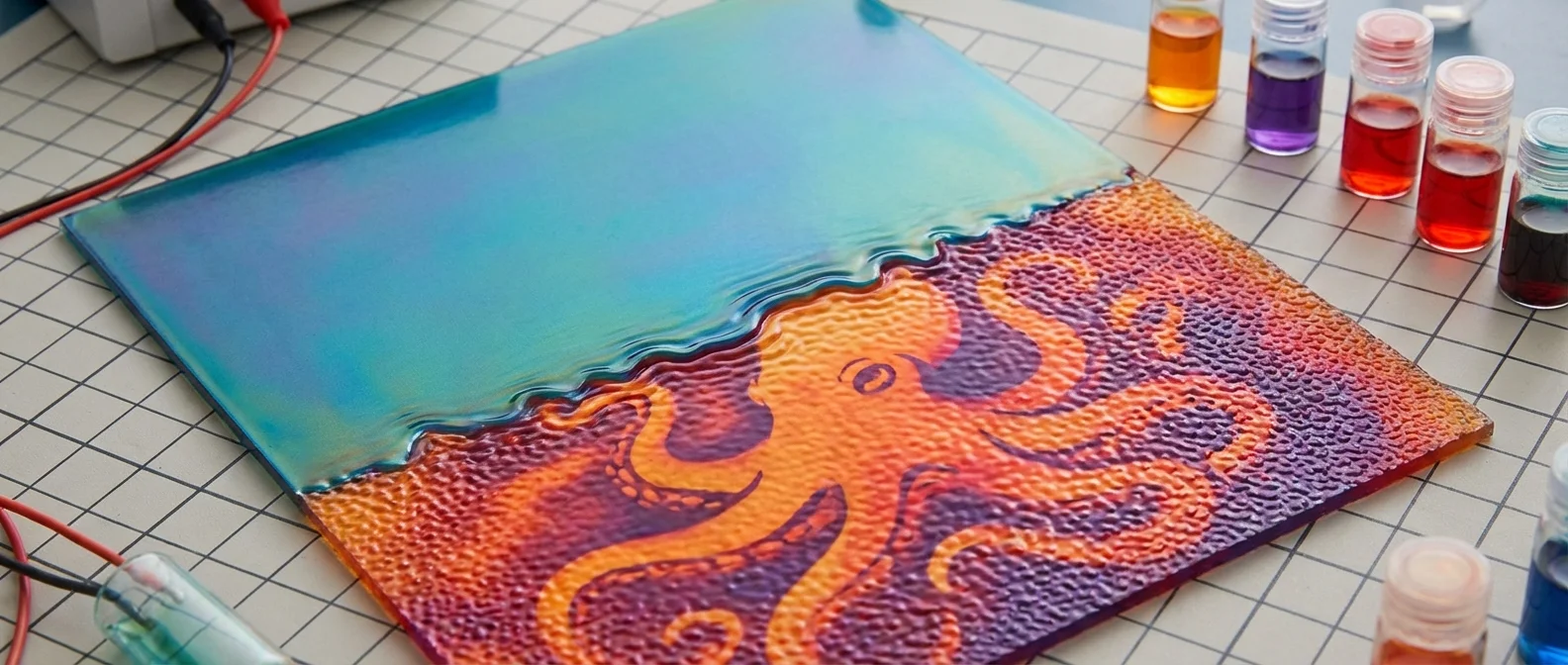
Cephalopods — octopuses, cuttlefish, squid — possess something that no technological achievement has yet fully replicated. Their skin doesn't simply change color. It changes texture. It creates three-dimensional protrusions — called papillae — that pop up in one-fifth of a second and then vanish just as quickly. Roger Hanlon, a leading cephalopod biologist at the Marine Biological Laboratory (MBL), describes these protrusions as “hydrostatic muscles without skeletal support” — structures analogous to the human tongue, controlled directly by the brain.
In the European cuttlefish, for example, there are at least nine independent sets of papillae, each with a different shape — conical, trilobed, or one of twelve other possible patterns. "These soft-bodied, shell-less creatures rely on their shape-shifting skin for defense," explains Hanlon. It was precisely this ability that inspired a new generation of engineers to create materials that mimic this remarkable biological machinery.
📖 Read more: 100 Trillion Mechanical Bonds: New Polymer Chainmail
🔬 The Discovery: Artificial Skin Made of Hydrogel with Hidden Images
In February 2026, a research team at Penn State led by Hongtao Sun, an assistant professor of industrial engineering, published a landmark study in Nature Communications. The team developed a fabrication technique called halftone-encoded 4D printing — which embeds digital instructions directly within the material.
The idea is elegantly simple in concept: the technique converts image or texture data into binary codes (zeros and ones) and embeds them in the structure of a hydrogel — a soft, water-rich material. These patterns determine how each region of the material will react: some areas may swell, others shrink, others soften — depending on the stimulus. “Essentially, we print instructions into the material,” Sun explained. “These instructions tell the skin how to react when something changes around it.”
Sun calls the process “4D printing” because the printed objects are not static — they can actively change in response to environmental conditions. This fourth “spatiotemporal” factor is what sets it apart from conventional 3D printing.
The Mona Lisa That Appears
In a striking demonstration, the team encoded the image of the Mona Lisa inside a hydrogel film. When the material was washed with ethanol, it appeared transparent — with no visible trace of an image. The hidden image was revealed only when the film was placed in ice-cold water or gradually heated. The Mona Lisa was just an example — the technique allows encoding of any image.
🧩 How It Transforms: From Flat Sheet to Three-Dimensional Shape
Perhaps the most impressive capability of the material is not image encryption, but its ability to morph its shape. Unlike many other shape-changing materials, this transformation doesn't require multiple layers or different substances. The changes are controlled entirely by the digitally printed patterns within a single sheet.
Sun's team demonstrated that multiple functions can be programmed to operate simultaneously. By carefully designing the halftone patterns, they encoded the image of the Mona Lisa into flat sheets that then transformed into three-dimensional forms. As the sheets curved into dome shapes, the hidden image was gradually revealed. "Similar to how cephalopods coordinate body shape and skin pattern, the synthetic smart skin can simultaneously control how it looks and how it deforms, within a single, soft material," Sun noted.
The study's lead author, Haoqing Yang, a doctoral candidate at Penn State, emphasized that this behavior opens the door both to adaptive camouflage — where a surface blends with its surroundings — and to information encryption, where messages remain hidden and are revealed only under specific conditions.
📖 Read more: Spider Silk Gives Superpowers to Aircraft
📜 The Background: Decades of Inspired Research
The Penn State study didn't come out of nowhere. It builds on decades of research in biomimetics. In 2015, engineers at UC Berkeley, led by Connie J. Chang-Hasnain, created a thin, flexible material — a silicon membrane just 120 nanometers thick, a thousand times thinner than a human hair — with thousands of microscopic ridges etched onto its surface. These ridges, smaller than the wavelength of light, interact with light to produce structural color rather than chemical color — just like butterfly wings or blue-irised eyes. By changing the dimensions by just 25 nanometers, the team achieved transitions from green to yellow, orange, and red.
Two years later, in 2017, engineers at Cornell led by James Pikul published a paper in Science on pneumatically actuated surfaces that mimic papillae. Using air-filled elastic membranes, they managed to create three-dimensional protrusions resembling rocks, plants, or corals — depending on the programming. “We wanted to do it in a simple way, quickly, powerfully, and with easy control,” Pikul explained.
In 2022, again at Penn State, Cunjiang Yu's team created a stretchable artificial skin with neuromorphic capabilities. They built synaptic transistors entirely from elastomeric materials — meaning a “skin” that can sense light and touch, even when stretched 30% beyond its natural resting state. The results were published in the Proceedings of the National Academy of Sciences.
"Cephalopods use a complex system of muscles and nerves for dynamic control of the appearance and texture of their skin. Inspired by these soft organisms, we developed a 4D printing system to capture this idea in a synthetic, soft material."
📖 Read more: Nanopigment Sensor: Changes Color Based on pH in Seconds
🔮 Applications: From Camouflage to Biomedicine
The applications of this technology span multiple fields. In the military sector, adaptive camouflage that automatically adjusts to the environment has been a long-standing goal. However, the possibilities extend far beyond that.
In soft robotics, robots could change surface texture and shape in real time — improving grip, aerodynamics, or even human interaction. Roger Hanlon of MBL noted that the ability to switch between 2D and 3D form could be used for temperature regulation: the flat form reflects light, while the three-dimensional form absorbs it.
In physical object cryptography, the ability to conceal information that is revealed only under specific conditions (temperature, stretching, chemical exposure) opens the door to new security protocols. A banknote, for example, could hide authenticity verification patterns visible only when heated.
In biomedical engineering, adaptive materials that respond to bodily conditions could be used in implants, artificial organs, or even neuroprosthetic skins that sense touch and light.
⚡ Why It Matters
What makes the 2026 study stand out is not just the technical innovation, but the unification of multiple functions in a single material. Until now, researchers could create materials that changed color, or materials that changed shape, or materials that encrypted information. None did all of these at once. Sun's hydrogel combines camouflage, encryption, and shape-morphing in a single film.
"This interdisciplinary research at the intersection of advanced manufacturing, smart materials, and engineering opens new opportunities with broad implications for responsive systems, biomimetic engineering, encryption technologies, and biomedical devices," Sun emphasized.
Of course, commercial application remains far off. The road from the laboratory to store shelves requires scaling up production, durability under real-world conditions, and cost reduction. But the foundation has been laid. Nature needed millions of years of evolution to give the octopus its remarkable skin. Science, with enough persistence, is slowly learning to mimic its masterpiece.
📚 Sources
- ScienceDaily — Scientists create smart synthetic skin that can hide images and change shape
- Phys.org — Engineers develop a programmable 'camouflaging' material inspired by octopus skin
- ScienceDaily — Rubbery camouflage skin exhibits smart and stretchy behaviors
- ScienceAlert — Chameleon-Like Material Changes Colour When Flexed