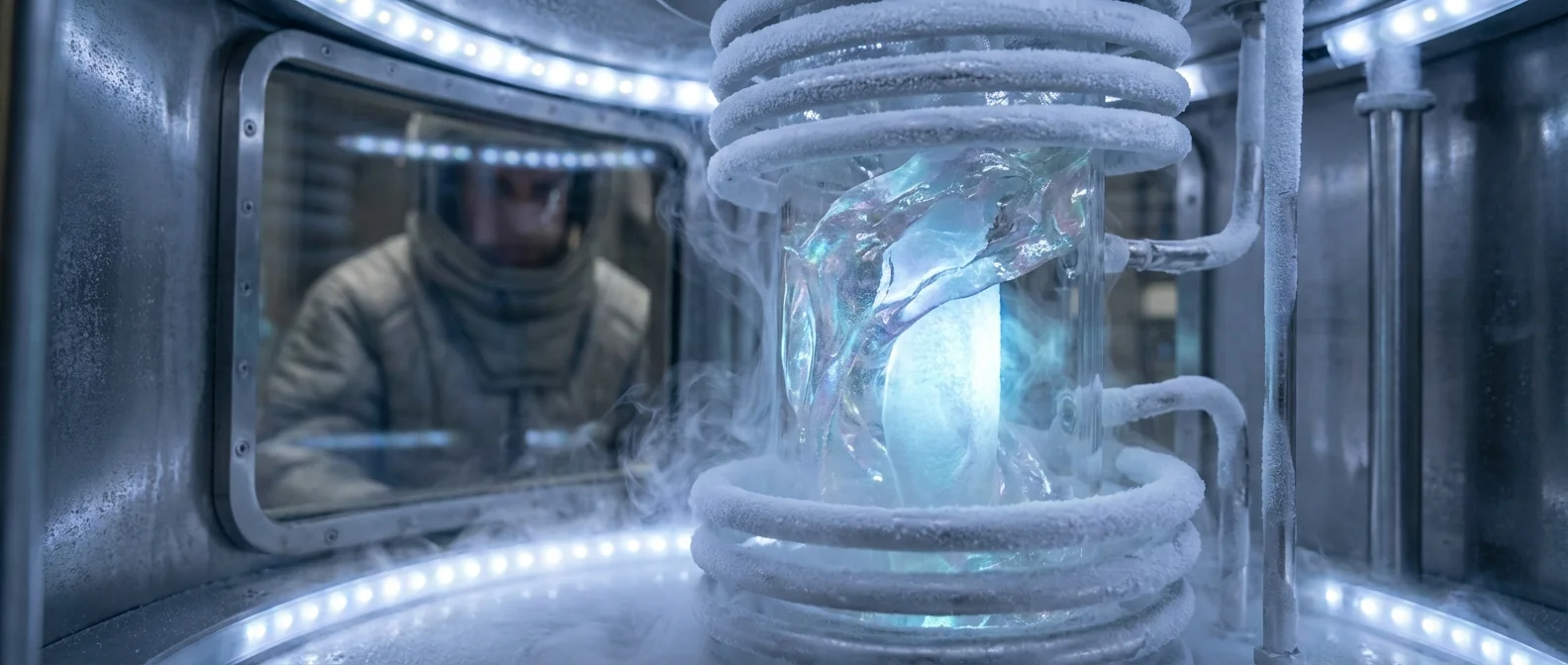
Physicists managed for the first time to observe a superfluid — a quantum fluid that flows without any friction — “freeze” and transition into an even more exotic state of matter: the supersolid. This contradictory form of matter, combining the crystalline structure of a solid with frictionless flow, had been theoretically predicted half a century ago but had never been observed through a natural phase transition — until now.
📖 Read more: Bees: 26,000 Species — First Complete Global Census
⚛️ What Are Superfluids and Supersolids?
In the everyday world, matter appears in three familiar states: solid, liquid, and gas. In the quantum world, however, exotic phases exist that defy intuition. One of these is the superfluid — a state that occurs at temperatures near absolute zero (−273.15°C), where a fluid flows with absolutely zero friction. Superfluids are not ordinary liquids: they climb the walls of containers, create eternal quantum vortices, and resist any attempt to slow them down.
The supersolid is something even stranger. It is a state of matter that should, theoretically, be impossible: particles form a regular crystalline lattice — like a solid — but simultaneously flow freely without friction, like a superfluid. This idea was proposed theoretically back in the 1970s, but its experimental confirmation proved extremely difficult. Until recently, no experiment had managed to show a superfluid naturally transitioning into a supersolid.
🔬 The Experiment: Graphene, Excitons, and Quantum Exploration
The research team, led by Cory Dean of Columbia University and Jia Li of the University of Texas at Austin, published their findings in the top scientific journal Nature in January 2026. Instead of using helium or ultracold atomic gases — the traditional methods for studying superfluidity — the team turned to an entirely different material: graphene, a sheet of carbon just one atom thick.
By stacking two extremely thin sheets of graphene on top of each other, the researchers created the right conditions for the birth of special quasiparticles called excitons. An exciton forms when an electron in one graphene layer bonds with a “hole” — a vacant electron position — in the other layer. Since electrons carry negative charge and holes behave as positive charges, the two unite into a pair. Under a strong magnetic field and at temperatures just a few degrees above absolute zero, these excitons collectively behave as a superfluid.
The key difference between this study and previous experiments is that the transition occurred spontaneously — without artificial trapping. In earlier work, such as the creation of a two-dimensional supersolid from dysprosium atoms in 2021, researchers used lasers and optical components to force particles into a crystalline formation — somewhat like pressing gelatin into an ice cube tray. In the new experiment, the transition was natural, analogous to water freezing into ice on its own.
🌀 The Paradoxical Phase Transition
What surprised even the researchers themselves was not just the transition itself, but the way it happened. According to classical models of quantum physics, superfluidity is considered the lowest-energy state — meaning it appears at the lowest temperatures. However, Dean's team observed something contrary: as the density of excitons and the temperature decreased, the superfluid stopped flowing and became an insulator — a state more resembling a solid. When the temperature was raised again, superfluidity returned as if by magic.
🔑 Why is this so paradoxical?
In everyday experience, a liquid freezes into a solid when cooled. In the quantum experiment, an insulator — resembling a “quantum solid” — melts and becomes a superfluid when heated. It is exactly the opposite of what one would expect! This reversal is strong evidence that the low-temperature phase is not an ordinary insulator, but something extraordinarily unusual: most likely a genuine supersolid.
The transition was fully reversible — like ice becoming water and then ice again — which provides further proof that this is an authentic quantum phase change and not a laboratory artifact. This reversibility is a hallmark of a genuine phase transition in physics.
🧊 Why This Changes the Game in Physics
Supersolids are not merely an academic curiosity. Their existence proves that matter can combine properties we have so far considered mutually exclusive: the crystalline order of a solid with the free, frictionless flow of a superfluid. This paradox challenges fundamental assumptions about the possible states of matter at quantum scales.
Furthermore, the use of two-dimensional materials like graphene opens impressive new possibilities. Excitons are thousands of times lighter than helium atoms, which means they could potentially form exotic quantum states at much higher temperatures than is currently achievable. This prospect could someday lead to practical applications — from new types of quantum sensors and quantum computers, to a deeper understanding of the phenomenon of superconductivity.
"For the first time, we saw a superfluid undergo a phase transition and become what appears to be a supersolid. The observation of an insulating phase that melts into a superfluid is unprecedented."
🔭 Next Steps in Quantum Exploration
Despite this historic achievement, the question of whether this particular state fully meets the definition of a supersolid remains open. "For now, we are exploring the boundaries around this insulating state, while simultaneously building new measurement tools to study it directly," said Dean. Electrical transport measurements alone are not sufficient, as insulators by definition do not carry current — entirely different characterization techniques are needed.
The research team is now examining other layered materials that could host similar quantum phases. Some of these may allow excitons to remain stable at higher temperatures and without the need for strong magnetic fields. Such a development would bring these exotic states of matter closer to technological exploitation — paving the way for quantum devices that today seem like science fiction.
This discovery, published in Nature (January 2026, DOI: 10.1038/s41586-025-09986-w), represents a milestone in condensed matter physics. After fifty years of theoretical predictions, the first natural transition from superfluid to supersolid is now a reality — and opens an entirely new chapter in the study of quantum matter and nature's deepest mysteries.
📚 Sources
- ScienceDaily — A superfluid freezes and breaks the rules of physics
- Live Science — Physicists push quantum boundaries by turning a superfluid into a supersolid
- Phys.org — Superfluids are supposed to flow indefinitely. Physicists just watched one stop moving
- New Atlas — Strange supersolid state of matter created in new dimension