🕷️ Nature's Most Impressive Material
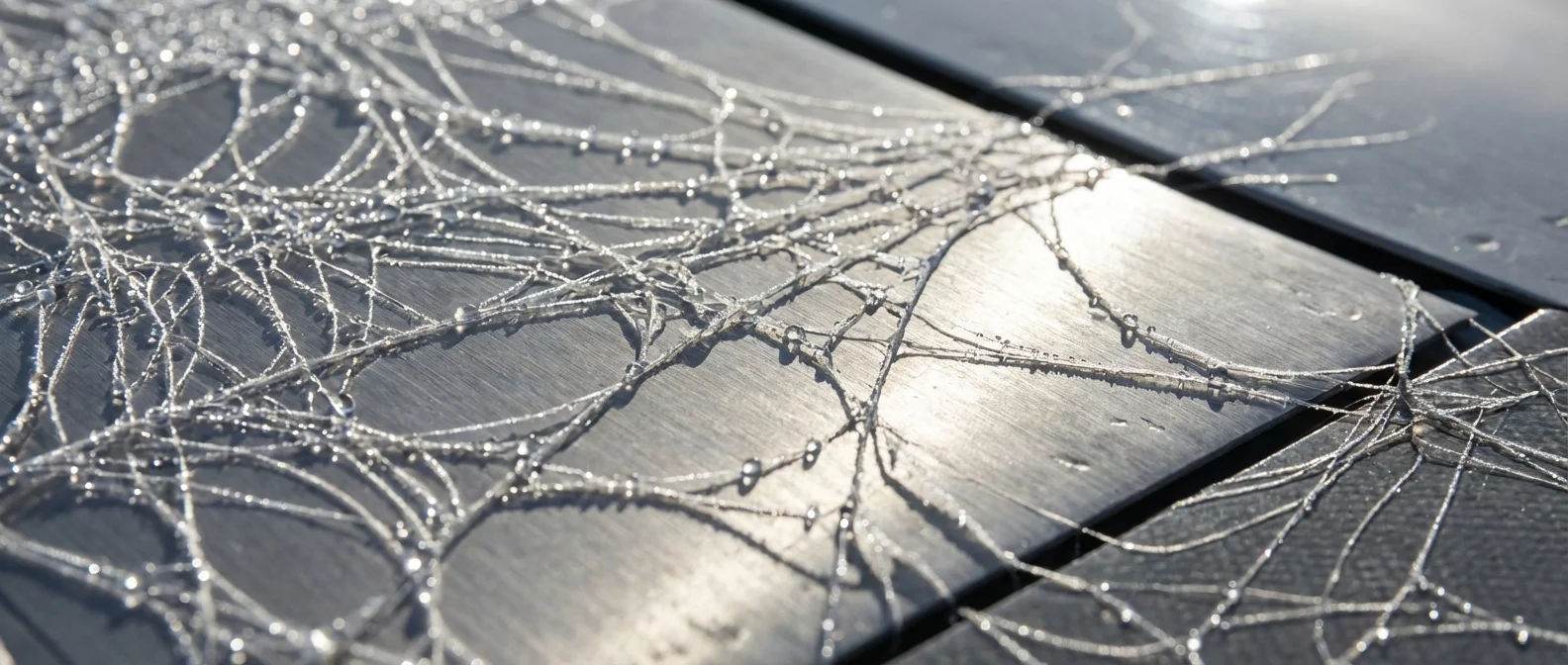
Spider silk has fascinated scientists for decades. Dragline silk — the silk that forms the central frame and radii of a web — is stronger than steel by weight and tougher than kevlar, the material used to make bulletproof vests. At the same time, it is exceptionally lightweight and elastic, absorbing enormous amounts of energy without breaking.
This unique combination of properties makes it ideal for aerospace applications: lightweight materials mean reduced fuel consumption, lower CO₂ emissions, and better performance under impact conditions. But for decades, scientists couldn't fully understand how silk acquires these superpowers — until now.
🧲 Molecular "Stickers": The Secret of Strength
In February 2026, researchers from King's College London and San Diego State University published in the Proceedings of the National Academy of Sciences (PNAS) a landmark study. For the first time, they demonstrated how the amino acids that make up silk proteins interact like molecular “stickers.”
The amino acids arginine and tyrosine interact through cation-π bonds (cation-π interactions), triggering the initial concentration of proteins. Critically, these same interactions are maintained as the fiber forms, helping create the complex nanostructure that gives silk its exceptional mechanical properties.
"The potential applications are enormous — lightweight protective clothing, aircraft components, biodegradable medical implants, even soft robotics could benefit from fibers designed based on these natural principles."
— Professor Chris Lorenz, King's College LondonThe interdisciplinary team of chemists, biophysicists, and engineers used advanced computational and experimental tools, including molecular dynamics simulations, AlphaFold3 modeling, and nuclear magnetic resonance (NMR) spectroscopy.
⚙️ How Spider Silk Works at the Molecular Level
Silk is produced in the spider's silk gland, where proteins are stored in liquid form. Upon extrusion, the proteins first condense into liquid droplets (a phenomenon known as phase separation) and then form β-sheet structures that give the fiber its final strength.
🧪 Synthetic Silk: Stronger Than the Natural Version
Engineers at Washington University in St. Louis achieved something long considered impossible: they created synthetic fibers that surpass natural silk. The team of Professor Fuzhong Zhang published their research in ACS Nano.
The researchers designed hybrid proteins that combine spider silk elements with amyloid sequences, which have a high tendency to form β-nanocrystals. These nanocrystals are the key to natural silk's strength, but previous synthetic silks failed to produce them in sufficient quantities.
🏆 Record-Breaking Results
Proteins with 128 repeating units produced fibers with gigapascal strength — stronger than common steel. Their toughness surpasses kevlar and all previous recombinant silk fibers, even exceeding some natural spider silks.
Remarkably, the fibers were not produced by the researchers themselves, but by genetically modified bacteria — factory microbes that function as biological super-fiber production plants.
"This demonstrates that we can program biology to produce materials that surpass nature's best material."
— Professor Fuzhong Zhang, Washington University🚀 Aerospace Applications
The aerospace applications are obvious. Modern aircraft already use carbon fiber composite materials, but spider silk-inspired materials could offer significant advantages:
⚖️ Lightweight
Weight reduction means less fuel and lower CO₂ emissions
🛡️ Impact Absorption
The fibers absorb enormous amounts of energy without fracturing, ideal for impacts
♻️ Biodegradability
Unlike synthetic polymers, silk is naturally biodegradable
🏥 Medicine
Implants, sutures, and tissue engineering scaffolds from biocompatible material
🧠 An Unexpected Connection to Alzheimer's
An unexpected discovery from the King's College London research is the connection to neurodegenerative diseases. The same types of cation-π interactions that give silk its strength also appear in neurotransmitter receptors and hormonal signaling.
Professor Gregory Holland explained: "The way silk proteins undergo phase separation and form β-sheet structures mirrors mechanisms we see in neurodegenerative diseases like Alzheimer's. Studying silk gives us a clean, evolutionarily optimized system to understand how this process can be controlled."
As unlikely as it sounds, studying a spider web could help us understand — and perhaps someday cure — Alzheimer's disease.
Sources: