📖 Read more: Invisible Chemical Rain Falls Across the Entire Planet
🧊 The “Snowball” Era: When Ice Reached the Equator
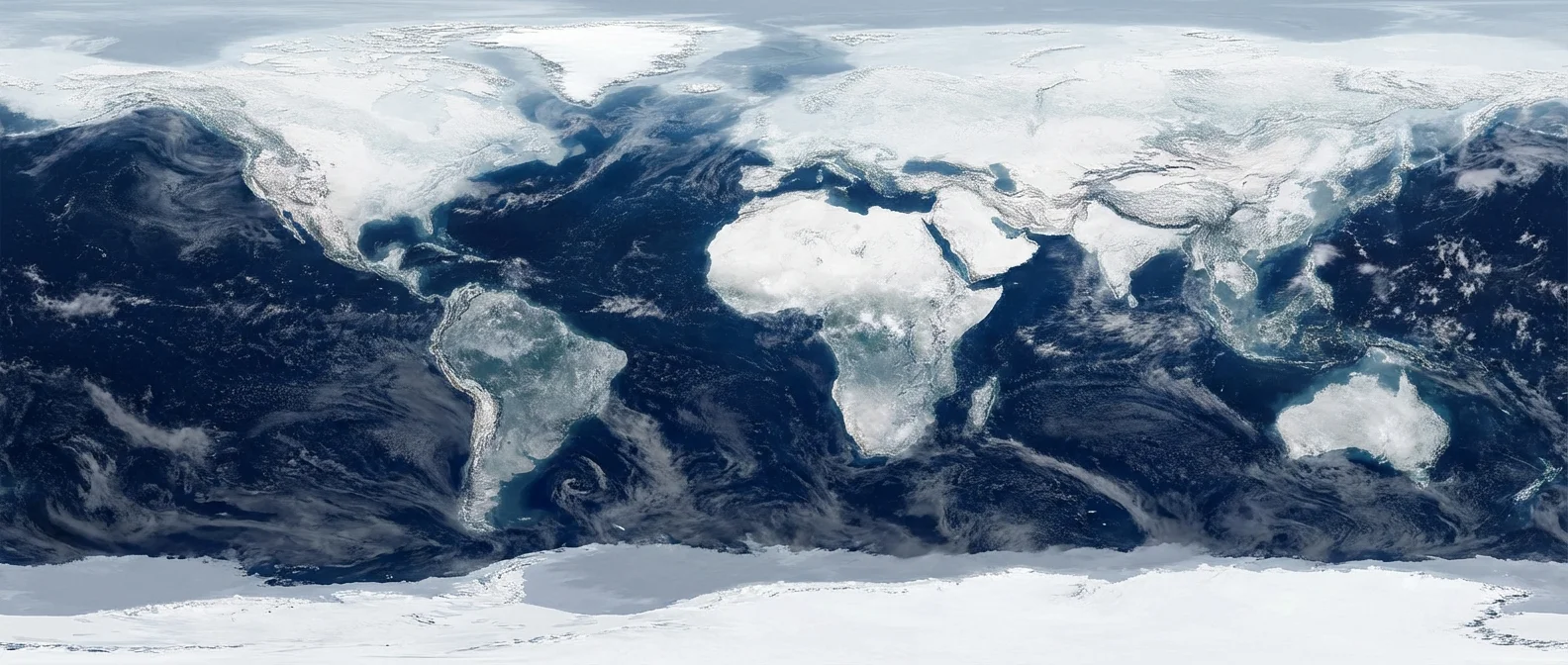
During the Cryogenian Period, between 720 and 635 million years ago, our planet went through two catastrophic glacial phases. The first, known as the Sturtian Glaciation, lasted about 57 million years (717–660 million years ago) and was the most severe. The second, the Marinoan Glaciation (650–635 million years ago), lasted 15 to 20 million years.
Massive glacial sheets spread all the way to the tropics, covering nearly the entire Earth. From space, the planet would have resembled a white sphere of ice. For decades, scientists believed the climate system had essentially “shut down” — exchanges between atmosphere and oceans had stopped, suppressing any short-term climate variation for millions of years.
However, this picture of a completely “dead” climate system was always hard to reconcile with a critical question: if the planet was fully frozen, how did life survive?
📖 Read more: Forests Glow in UV and Deer Can See It
🔬 Scottish Rocks Reveal Climate Pulses
A study published in February 2026 in the journal Earth and Planetary Science Letters provides the first direct evidence that Earth's climate never stopped “beating” — even at the deepest point of the glacial period. Researchers from the University of Southampton analyzed 2,600 individual sediment layers, known as varves, on the Garvellach Islands off the west coast of Scotland.
Each layer represents an individual year of sediment accumulation, creating a year-by-year record of climate conditions. These sediments formed during the Sturtian Glaciation — the most severe phase of Snowball Earth — within the Port Askaig geological formation. Microscopic examination showed that the layers were formed through seasonal freeze-thaw cycles, in calm deep waters beneath the ice.
When the researchers applied statistical analysis to the thickness variations of the layers, they discovered clear repeating patterns — annual seasons, solar cycles, and oscillations similar to the modern El Niño phenomenon. In other words, the planet was still “breathing” beneath the ice.
"These rocks preserve the full spectrum of climate rhythms we know today — annual seasons, solar cycles, and interannual oscillations — all were operating during Snowball Earth. It's breathtaking."
📖 Read more: Ghost Particle from a Black Hole Upends Physics
🌋 The "Slushball": Open Water Zones in the Tropics
A key question arises: how could climate fluctuations exist if the ocean was sealed beneath ice? The Southampton team ran climate simulations of a frozen Earth and the results were revelatory. If the oceans were fully sealed, most climate oscillations would have been suppressed. But if even a small portion of the ocean surface — about 15% — remained ice-free, then atmosphere-ocean interactions could resume.
Dr. Minmin Fu, Lecturer in Climate Science at Southampton who led the modeling, explained: "You don't need vast open oceans. Even limited areas of open water in the tropics can enable climate modes similar to those we see today, producing the kinds of signals recorded in the rocks."
These findings reinforce the theory that Snowball Earth was not always completely frozen. Instead, it may have been interrupted by “slushball” phases or more extensive “waterbelt” states, where pockets of open ocean appeared — especially near the equator, where geothermal activity and volcanic rifts could maintain warmer conditions.
🌊 Geothermal Refuges for Life
Geothermal rifts on the ocean floor, volcanic activity, and the geothermal temperature gradient meant that the ocean floor never froze completely. Hydrothermal vents continued to emit warm fluids rich in minerals, creating micro-ecosystems that operated independently of sunlight — providing “refuges for life” in the depths of the dark ocean.
📖 Read more: Impossible Glass-Plastic Hybrid Created
🧬 How Life Survived on the Frozen Planet
The survival of life during Snowball Earth remains one of paleontology's greatest mysteries. The fossil record clearly shows that complex organisms existed before and after the glacial periods — something impossible if the planet had been fully and permanently frozen.
Black shales in the Nantuo geological formation of southern China preserve traces of macroscopic photosynthetic organisms — likely algae — that lived during the Marinoan glaciation. Photosynthesis requires sunlight and open water, a fact that dramatically strengthens the “slushball” theory. Analysis of iron and nitrogen isotopes in the shales revealed an active aerobic nitrogen cycle near the surface — a sign that the ocean was not completely cut off from the atmosphere.
A 2025 study in Nature Communications by MIT researchers further bolstered this theory. Fatima Husain and her team examined small meltwater ponds on the McMurdo Ice Shelf in Antarctica — modern analogs of Snowball Earth conditions. There they found remarkable biodiversity: cyanobacteria, algae, and even microscopic eukaryotic animals. “No two ponds were alike,” said Husain. "We found diverse assemblages of eukaryotic organisms from all major groups in every pond we studied."
These modern “refuges” may closely resemble the open water zones that existed 700 million years ago — small oases of life in an otherwise frozen landscape.
📖 Read more: Methane Surged After 2020: The Cause Is Surprising
🌍 What This Means for Our Planet — and Beyond
The discovery that Earth's climate never fully stopped has profound implications beyond ancient history. It shows that even under the most extreme conditions, the planet's climate system has an inherent tendency to oscillate — as long as it's given the slightest opportunity. This raises serious questions about the sensitivity and resilience of today's climate to external disturbances.
At the same time, the findings have enormous significance for astrobiology. Frozen worlds like Jupiter's Europa or Saturn's Enceladus may, according to the new data, harbor zones of liquid water beneath their ice — and, perhaps, forms of life. The very same hydrothermal vents that kept life “alive” on ancient Earth may be operating today in oceans hidden beneath extraterrestrial ice.
As Professor Gernon concluded: "This work helps us understand how resilient — and how sensitive — the climate system really is. It shows that even under the most extreme conditions Earth has ever experienced, the system could be set in motion again. This has profound implications for how planets respond to major disturbances — including our own in the future."
📚 Sources
- ScienceDaily - Snowball Earth Was Not Completely Frozen, New Study Reveals (2026)
- ScienceAlert - New Clues Emerge on How Life Survived 'Snowball Earth' (2025)
- ScienceAlert - 'Snowball Earth' May Not Have Been An Endless Frozen Wasteland (2023)
- Live Science - Golden Spike Showing Snowball Earth Transition in Scottish Rocks (2024)