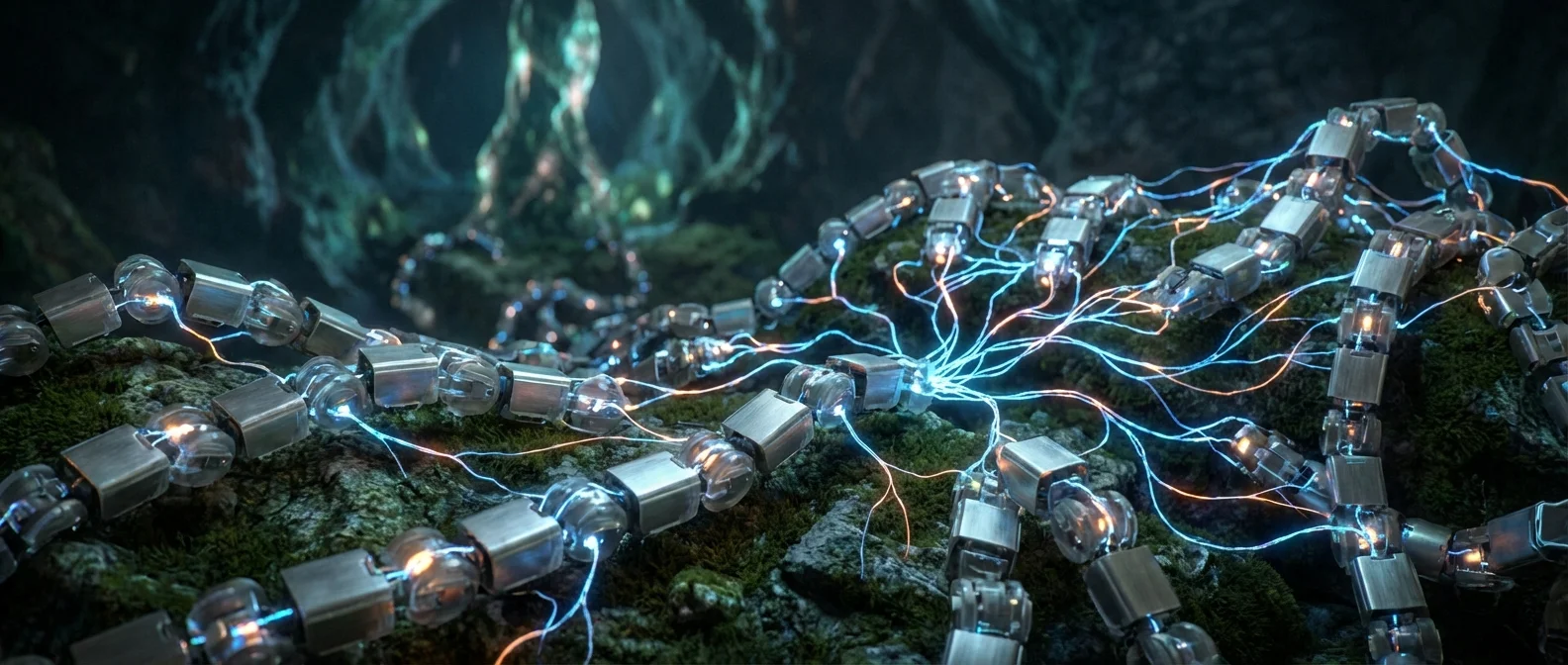
What if robots could share their energy, sensors, and communications like the cells of a living organism? Researchers at EPFL in Switzerland proved that this is not only feasible — it fundamentally changes the way we design robotic systems for extreme conditions. The study was published in Science Robotics.
📖 Read more: Bionic Insect Eye Sees, Smells, and Guides Robots
🧱 The Mori3: A Robot That Shares Everything
The Mori3 is a modular robot inspired by origami, made up of triangular units (modules) that connect to each other. Each module has its own sensors, processor, battery, and motors. What makes it unique is its ability to share all resources among units: energy, sensor data, and communication signals.
The team of Professor Jamie Paik at EPFL's Reconfigurable Robotics Laboratory, with lead author Kevin Holdcroft, discovered something groundbreaking: to achieve true resilience, all resources must be shared. Sharing only energy or only sensors is not enough.
The Key: Total Resource Sharing
Resilience increases dramatically only when energy, sensing, and communication are shared simultaneously. With just 1-2 resources, the system remains fragile. With all of them, it becomes nearly indestructible — just like a living organism.
📖 Read more: Hidden Geometry Bends Electrons Like Gravity
📖 Read more: Jellyfish Sleep Like Us and Even Take Siestas
🔄 Reviving “Dead” Modules
The most impressive achievement: when a module “dies” — losing energy, sensors, communication — neighboring modules can fully revive it. They send it power, transfer data, and restore its environmental awareness. This way, the Mori3 managed to navigate rough terrain even with a completely inactive module.
This is strongly reminiscent of biological systems: cells transfer nutrients to their neighbors, trees transmit chemical warnings about threats, and birds in a flock share sensory information about dangers. The Mori3 replicates these patterns in mechanical form.
📖 Read more: Microplastics Found in Antarctica's Only Native Insect
🌍 Applications in Extreme Conditions
Why does this matter? In environments where repair is impossible — planetary exploration, the ocean floor, disaster zones — a robot that can keep functioning even with failures is invaluable. No current robot can be repaired on Mars if one of its motors breaks down.
The EPFL team is already planning to extend the technology to robot swarms that can temporarily connect to each other via docking to transfer energy and information — just like ants that exchange food mouth to mouth.
The principle is simple but profound: if you want robots that survive like living organisms, you need to design them like living organisms — with total resource sharing, not partial.