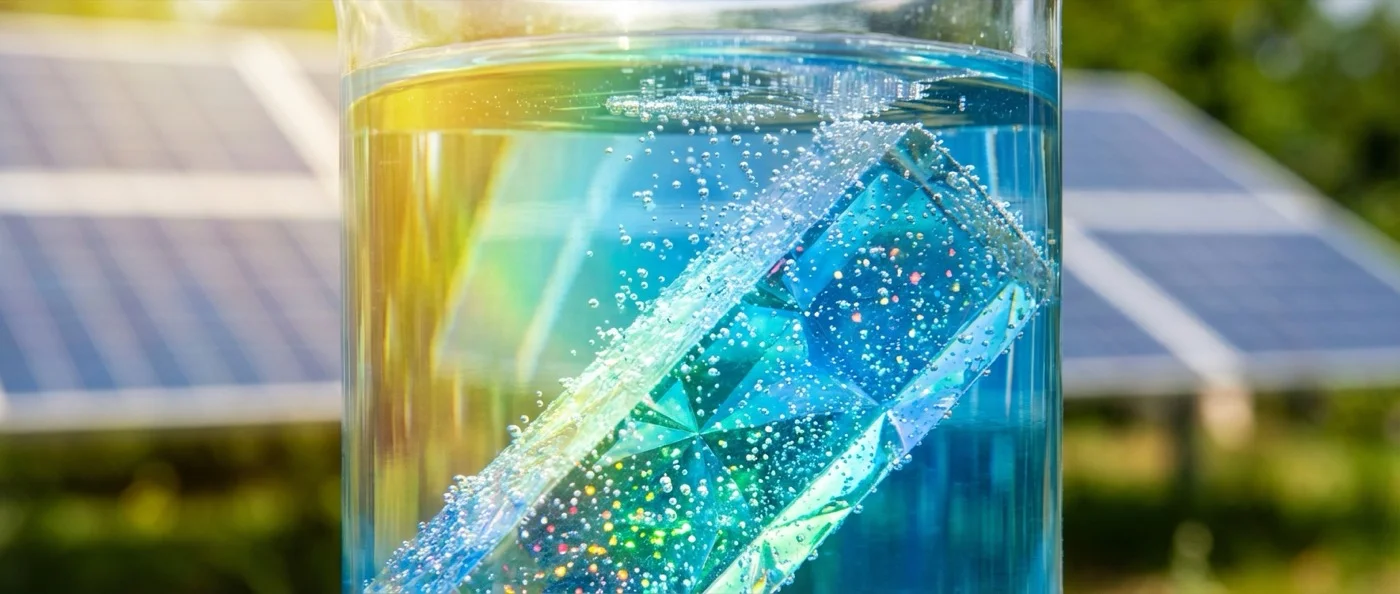
The quest for clean hydrogen from sunlight is entering a new era thanks to quantum-engineered materials that are shattering efficiency records. Researchers using 2D nanoplatelets and tandem photocatalytic cells are achieving dramatically improved solar-to-hydrogen conversion — paving the way toward efficiency targets that once seemed impossible.
📖 Read more: 2D Magnetism: Electric Control Opens the Door to Spintronics
Why Green Hydrogen Changes Everything
Hydrogen promises to become the cornerstone of a zero-emission economy. With an energy density three times that of gasoline by weight, it offers compelling possibilities in sectors like aviation, heavy industry, and renewable energy storage. Yet today, over 95% of the world's hydrogen is produced from fossil fuels via steam reforming — a process that emits up to 12 kg of CO₂ for every kilogram of hydrogen.
Photocatalytic water splitting — the direct conversion of sunlight and water into hydrogen without electrolysis — represents the holy grail of clean energy. Unlike photovoltaics that generate electricity to then power electrolyzers, photocatalytic systems integrate the entire splitting process into a single device — eliminating DC/AC conversion and power transmission losses.
2D Nanoplatelets: The Quantum Surface Revolution
In January 2026, a research team led by Marjeta Maček Kržmanc and Professor Jeffrey C.S. Wu of National Taiwan University published a groundbreaking study in the Chemical Engineering Journal on two-dimensional (2D) heterostructural nanoplatelets that are changing the landscape of green hydrogen production.
The team created epitaxial SrTiO₃/Bi₄Ti₃O₁₂ heterostructures — two semiconductors bonded at the atomic scale forming a “Z-scheme” charge transfer mechanism. This approach, inspired by natural photosynthesis, allows electrons to follow an optimal path between the two materials — drastically reducing charge recombination rates while maintaining high redox capability.
The key discovery lies in precise control of nanoplatelet roughness during hydrothermal synthesis. Rougher platelets, with greater specific surface area, offer dramatically more active catalytic sites — a factor that proved even more important than heterojunction formation itself.
The results were striking: H₂ generation rates up to 2,950 μmol·g⁻¹·h⁻¹ — significantly higher than previous 2D photocatalytic systems. The quantum efficiency of the photocatalytic transformation exceeded 40%, marking a new milestone for titanate-based materials.
📖 Read more: The World's First Triple Superconductor Discovered
Artificial Photosynthesis: From Lab to the Real World
Meanwhile, researchers worldwide are breaking records in solar-to-hydrogen (STH) efficiency with tandem photoelectrochemical cells. At the Australian National University (ANU), Dr. Siva Karuturi developed a perovskite-silicon cell that achieved 17.6% STH efficiency — using relatively inexpensive semiconductors.
"Significant cost benefits could be achieved through the use of the solar-to-hydrogen approach," explains Dr. Karuturi, "as it avoids the need for added power and network infrastructure necessary when hydrogen is instead produced using an electrolyser. And by avoiding the need to convert solar power from DC to AC power and back again, the direct conversion can achieve a higher overall efficiency."
At the University of Michigan, Zetian Mi and Peng Zhou presented in Nature an artificial photosynthesis device ten times more efficient and one hundred times smaller than previous designs. Their semiconductor — indium gallium nitride nanostructures grown on silicon — withstands concentrated sunlight equivalent to 160 suns and, rather than degrading, actually improves its efficiency over time.
The device achieved 9% efficiency under lab conditions, 7% with tap water, and 6.2% in outdoor testing with natural sunlight. Perhaps most exciting: it works equally well with seawater — a tremendous advantage given freshwater scarcity.
Quantum Confinement and the Road to 25%
The common denominator across these breakthroughs is quantum confinement. As materials shrink to the nanoscale — particularly in 2D form — quantum mechanics reshapes their electronic properties. Bandgaps become tunable, allowing researchers to “tune” semiconductors to absorb precisely the wavelengths of sunlight they need.
The US Department of Energy (DOE) has set an ultimate target of 25% STH efficiency for photoelectrochemical systems and 10% for photocatalytic ones — values corresponding to a competitive hydrogen cost around $2.10/kg. With current records at 17.6% (ANU) and the dramatic improvement in H₂ production rates from 2D nanoplatelets, the target is no longer purely theoretical.
Progress has been exponential: a decade ago, no affordable system exceeded 10% STH. Now, perovskite tandem systems are approaching 20%, while quantum-engineered photocatalysts demonstrate quantum efficiencies above 40% — meaning nearly half of absorbed photons are converted into chemical energy.
Challenges and the Future
Despite the optimism, significant hurdles remain. Long-term stability of nanostructured materials under real-world conditions, scaling from lab to industrial production, and the need to replace rare catalytic metals (like platinum) with cheaper materials remain open questions. However, the Michigan semiconductor's self-healing behavior — improving rather than degrading under intense light — suggests that the nature of quantum materials still holds surprises.