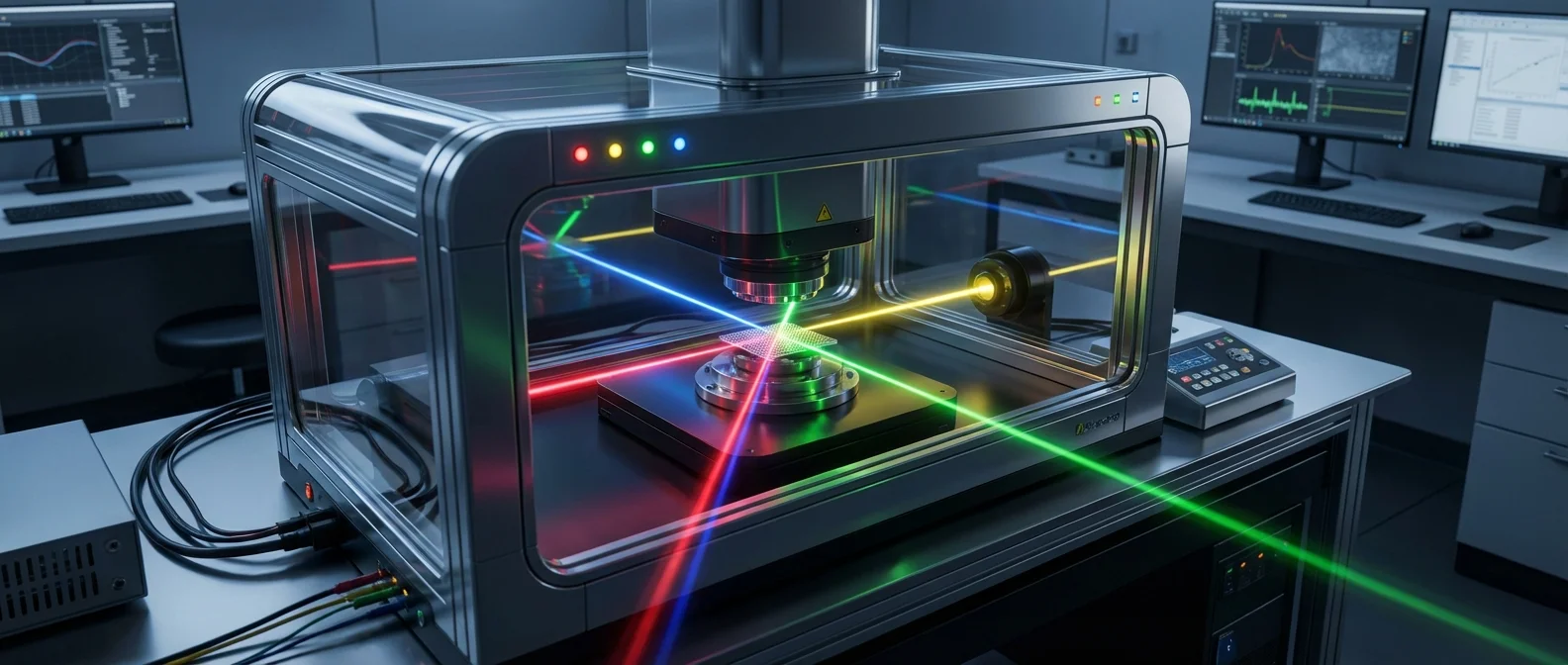
You look at a sample and see not only its shape, but also the electrical currents, heat, and magnetism inside it — all at once. “You almost feel like you have a superpower,” says Matthijs Rog, a PhD candidate at Leiden University. His team has just built a microscope that does exactly that — and it could change the way quantum computers are developed.
📖 Read more: Nasal Vaccine Targets COVID, Flu, and Pneumonia at Once
🔬 What Makes This Microscope Unique
Until now, if a physicist wanted to simultaneously study the temperature, magnetism, structure, and electrical properties of a quantum material, they needed four separate machines. Four magnifications, four protocols, four chances for error.
The “Tortilla” microscope — as the team affectionately calls it, with the technical name Tapping Mode SQUID-on-Tip (TM-SOT) — changes this approach. A single scan reveals all four properties, with resolution of just a few nanometers. A nanometer is one millionth of a millimeter — consider that a human hair is about 80,000 nanometers wide.
"This microscope removes the experimental barriers that have long limited the study of quantum materials," says Kaveh Lahabi, head of the research team. "This isn't an idealistic technique — it works on the systems we actually want to understand."
⚛️ Why Quantum Materials Are So Challenging
Quantum materials are materials whose properties can only be explained through quantum mechanics. A classic example is superconducting materials, which carry electrical current with zero resistance. Normally, quantum phenomena appear at the scale of individual atoms. But quantum materials behave quantum-mechanically at millimeter scales — nobody knows why.
The difficulty lies in the complexity. Each material contains billions of particles, all with quantum behavior. “This complexity is very difficult to capture in a theory,” Rog explains. "That's why it's so wonderful that we can use this microscope to simply look for ourselves at how these materials behave."
What the TM-SOT Measures
In a single scan: temperature (heat distribution), magnetism (magnetic fields), structure (nanoscale topography), and electrical properties (current flow). All at a resolution of just a few nanometers.
🔧 From Rough Surfaces to Real Quantum Chips
Most microscopes work well only with very flat samples — which limits their usefulness, since many interesting phenomena appear at the edges of materials or at the boundaries between two quantum materials.
"Our microscope has no problem with that — it can examine a rough chip just as easily as a flat crystal," says Rog. For the first time, physicists can examine integrated quantum chips — the ones actually used in quantum computers.
🛠️ Handmade Construction
Rog and Lahabi started in 2021, using spare parts from the university building's attic. They quickly realized the requirements were so specialized that they had to design and build nearly every component themselves.
With the help of Christiaan Pen and Peter van Veldhuizen, they built every piece: “Every wire was soldered by us, every screw was placed by hand,” says Rog.
🚀 The QuantaMap Start-up
QuantaMap, founded by Lahabi at the House of Quantum Leiden, is bringing the microscope to market. "One of the biggest obstacles in quantum computers is that when chips don't work — which happens often — there's no way to find which component failed," explains CEO Johannes Jobst.
The new microscope solves this problem: it detects defects by showing where conductivity fails, where temperature rises, where magnetism changes. The study was published in Nano Letters.
"Whatever quantum material we place under this microscope, I'm certain we'll discover something new," predicts Rog. “Now we can start tackling the real mysteries.”