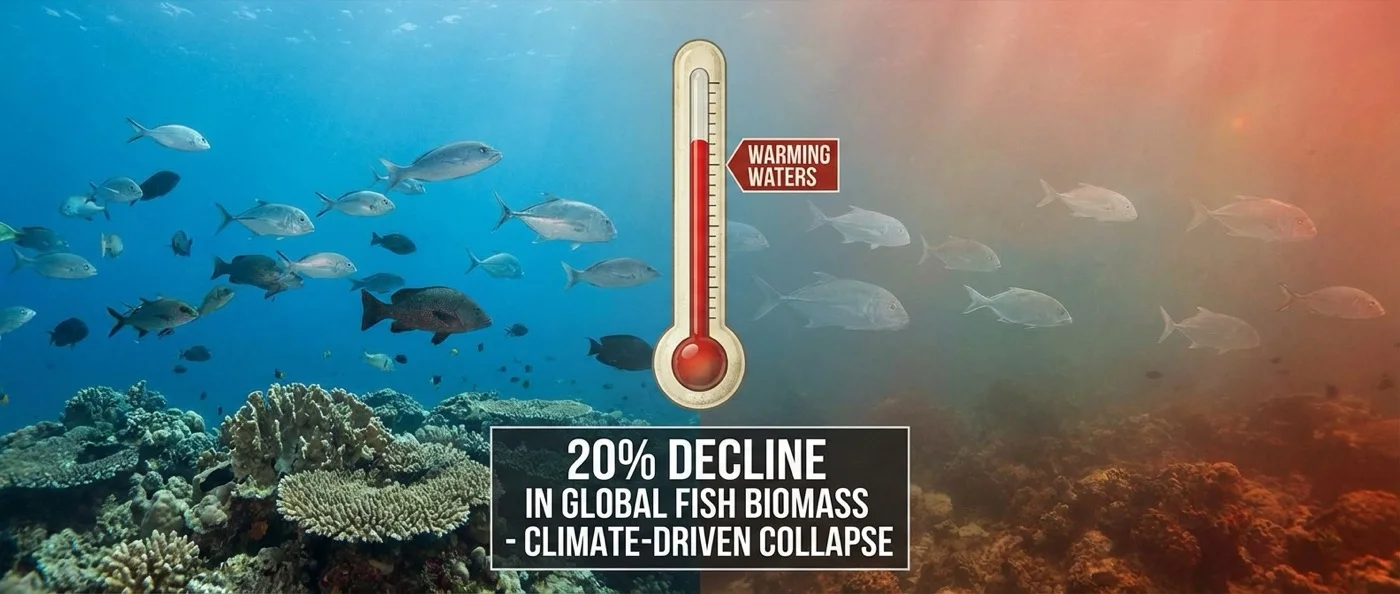
The oceans feed over 3 billion people — but rising temperatures threaten to dramatically reduce fish stocks by the end of the century. Three recent studies reveal a complex web of interactions: warming “suffocates” nutrients, fish are shrinking, the food chain is breaking apart — and the consequences extend all the way to the carbon cycle.
📖 Read more: Hundreds of New Species on the Pacific Ocean Floor
🌊 Ocean Impacts Set to Double by 2050
The most comprehensive forecast was published in September 2025 in the leading journal Science. Marine ecologist Ben Halpern, director of the National Center for Ecological Analysis and Synthesis (NCEAS) at the University of California, Santa Barbara, and his team built a comprehensive model of human impacts on the oceans — and the results are staggering.
"Our cumulative impact on the oceans, which is already substantial, is going to double by 2050 — in just 25 years," Halpern said. The two dominant factors? Ocean warming and biomass loss from fisheries. The study found that 41% of marine environments are already severely impacted.
Tropical and polar regions face the fastest changes, while coastal zones — where people derive the greatest value — will bear the heaviest blow. According to the study, the level of impacts “may exceed the capacity of ecosystems to cope with environmental change.”
🐟 Why Fish Are Shrinking — Evidence from the Pacific
An equally alarming question is answered by a study from the University of Tokyo, published in Fish and Fisheries (February 2024). Professor Shin-ichi Ito and researcher Lin Zhen analyzed weight and biomass data for 13 fish species in the western North Pacific — a region that accounts for nearly one-quarter of the global fish catch.
The results revealed two periods of weight decline: in the 1980s (due to sardine population growth → food competition) and in the 2010s, where the primary culprit was climate change. The mechanism is clear:
🔑 How Warming Shrinks Fish
Rising temperatures create stratification: the warm upper layer “locks” nutrients down deep. Large plankton are replaced by smaller, less nutritious species — such as jellyfish. Phytoplankton blooms shift in timing, falling out of sync with fish life cycles. Result: less food → smaller fish → reduced biomass.
"With higher temperatures, the ocean's upper layer becomes more stratified," Ito explained. "Larger plankton are replaced with smaller plankton and less nutritious gelatinous species, such as jellyfish." He emphasized that conditions fish face today are “much more severe than decades ago.”
🌡️ When Upwelling Fails — The Panama Case
A dramatic example of these changes was recorded in September 2025. For the first time in 40 years, the seasonal upwelling of cold waters in the Gulf of Panama did not occur. The study, published in PNAS by the Smithsonian Tropical Research Institute, revealed that weakened trade winds — likely due to climate disruption — were the cause.
Upwelling drives nutrient-rich, cold water to the surface, fueling plankton and sustaining entire fishing ecosystems. Without it, food chains collapse, corals lose their protection from thermal stress, and local fishing communities are directly affected.
📖 Read more: Sea Turtles Lay Fewer Eggs Due to Climate Change
🔄 The Carbon Cycle Connection
Declining fish populations aren't just about food — they affect the carbon cycle itself. In July 2025, researchers at the University of Miami (Rosenstiel School) published a striking discovery in the Journal of Experimental Biology: mesopelagic fish, which make up as much as 94% of global fish biomass, excrete carbonate minerals — functioning as the ocean's “chemical engineers.”
Martin Grosell, the study's lead author, used deep-dwelling blackbelly rosefish to demonstrate that carbonate production (ichthyocarbonate) is consistent regardless of depth and pressure. "Mesopelagic fish aren't just prey; they're chemical engineers of the ocean," Grosell emphasized.
If the biomass of these fish declines due to warming, the ocean's ability to sequester carbon will also be compromised — creating a vicious cycle: fewer fish → less carbon sequestration → more warming → even fewer fish.
🍽️ Who's Affected — Food Security
Marine fisheries provide the primary protein source for over 3 billion people, predominantly in developing countries. According to the Halpern study, many countries dependent on the ocean for food, employment, and income “will face substantial increases in pressures.”
The western North Pacific — the most productive marine region — accounted for nearly one-quarter of the world's total fish catch in 2019. The Tokyo study shows that fish there are already shrinking. Meanwhile, the disappearance of upwelling in tropical regions like Panama signals that even the most stable oceanic phenomena can collapse.
⚠️ The Most Vulnerable Ecosystems
Tropical seas: rapidly rising temperatures, vanishing upwelling, coral bleaching.
Polar seas: already high impact levels, expected to face even greater pressure.
Coastal zones: where people derive the most value — will be hit hardest.
Salt marshes and mangroves: fish nursery habitats under extreme pressure.
🛡️ What Can Be Done
The researchers emphasize that the situation is serious but not irreversible. The Halpern study proposes two key levers for action: first, policies to reduce climate change, and second, strengthening fisheries management — given that warming and overfishing are the two dominant drivers.
Ito added that fish stocks must now be managed differently, taking climate conditions into account: "If we cannot stop global warming, the quality of fish may decline. So, we need to take action so that we can enjoy a healthy ocean and delicious fish."
📌 Sources:
ScienceDaily — Oceans could reach a dangerous tipping point by 2050 (Sep. 2025)
Halpern et al., Science 2025 — UC Santa Barbara / NCEAS
ScienceDaily — Climate change shrinking fish (Feb. 2024)
Zhen & Ito, Fish and Fisheries 2024 — University of Tokyo
ScienceDaily — Panama's ocean lifeline vanishes for the first time in 40 years (Sep. 2025)
O'Dea et al., PNAS 2025 — Smithsonian Tropical Research Institute