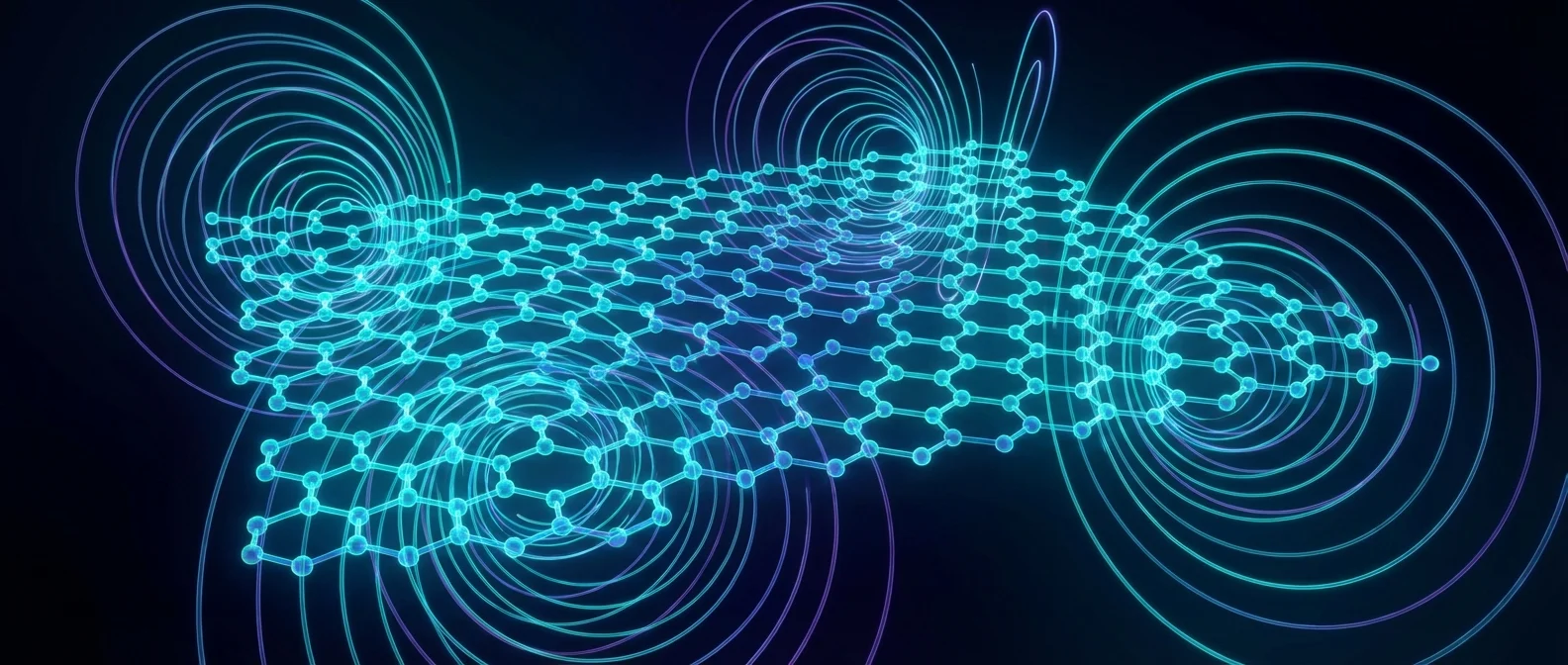
For decades, physicists knew of two fundamental types of magnetism: ferromagnetism and antiferromagnetism. Now, an international team of researchers has experimentally proven the existence of a third type: altermagnetism. The discovery, published in Nature, paves the way for the next generation of computers.
📖 Read more: 2D Magnetism: Electric Control Opens the Door to Spintronics
🧲 The Two Types We Knew
In ferromagnetism, atomic spins align in the same direction, producing a strong magnetic field — think of refrigerator magnets. Their spins are easy to manipulate, but reversing them is slow.
In antiferromagnetism, the spins of neighboring atoms alternate (up/down), canceling out the magnetic field. Spin reversal is extremely fast, but manipulating them is exceptionally difficult. Each type had advantages and disadvantages — until now.
📖 Read more: Keto Diet Restores Exercise Benefits in Type 2 Diabetes
⚡ Altermagnetism: The Best of Both Worlds
Altermagnetism combines the advantages of both. As in antiferromagnets, there is no net magnetization — the spins alternate and cancel out. However, there is a critical difference: atoms with opposite spins are not mirror images of each other — they are rotated by 90° within the crystal lattice.
This rotational symmetry creates something unexpected: strong spin polarization in the energy bands, even though there is no net magnetization. In other words, the electrons “know” which spin they have, but the material won't stick to a fridge. “You can have your cake and eat it too,” says Jairo Sinova from the University of Mainz.
The Experimental Proof
Juraj Kempaský's team at the Paul Scherrer Institute in Switzerland used angle-resolved photoemission spectroscopy (ARPES) on a crystal of manganese telluride (MnTe) and observed a spin splitting of approximately 100 meV in the valence bands — without net magnetization. This was the “smoking gun” of altermagnetism.
📊 How Significant Is This Discovery
The theory of altermagnetism was proposed in 2021-2022 by Libor Šmejkal, Jairo Sinova, and Tomas Jungwirth. Experimental confirmation came in February 2024, and the scale is impressive: over 200 materials are predicted to be altermagnetic — twice as many as known ferromagnets.
"It's one of those theoretical constructs that are indisputable. And yet it had never been discussed before," says Igor Mazin from George Mason University.
📖 Read more: 100 Trillion Bonds: First Mechanical Polymer Breaks Physics
💻 Applications in Spintronics
Spintronics uses the spin of electrons instead of their charge for storing and processing information. Altermagnetism makes it practical: spin reversal up to 1,000 times faster than ferromagnetic memories, manipulation using only electric currents (without magnetic fields), and energy savings of up to 5 orders of magnitude compared to conventional electronics.
Furthermore, altermagnets are compatible with superconductors — something impossible with ferromagnets — opening the door to topological quantum phenomena and materials we couldn't even imagine before.
"It broadens our understanding of the ways matter can behave," says Paul McClarty from the Léon Brillouin Laboratory. “I think this is the starting point of an entirely new field,” adds Suyoung Lee from Seoul National University.