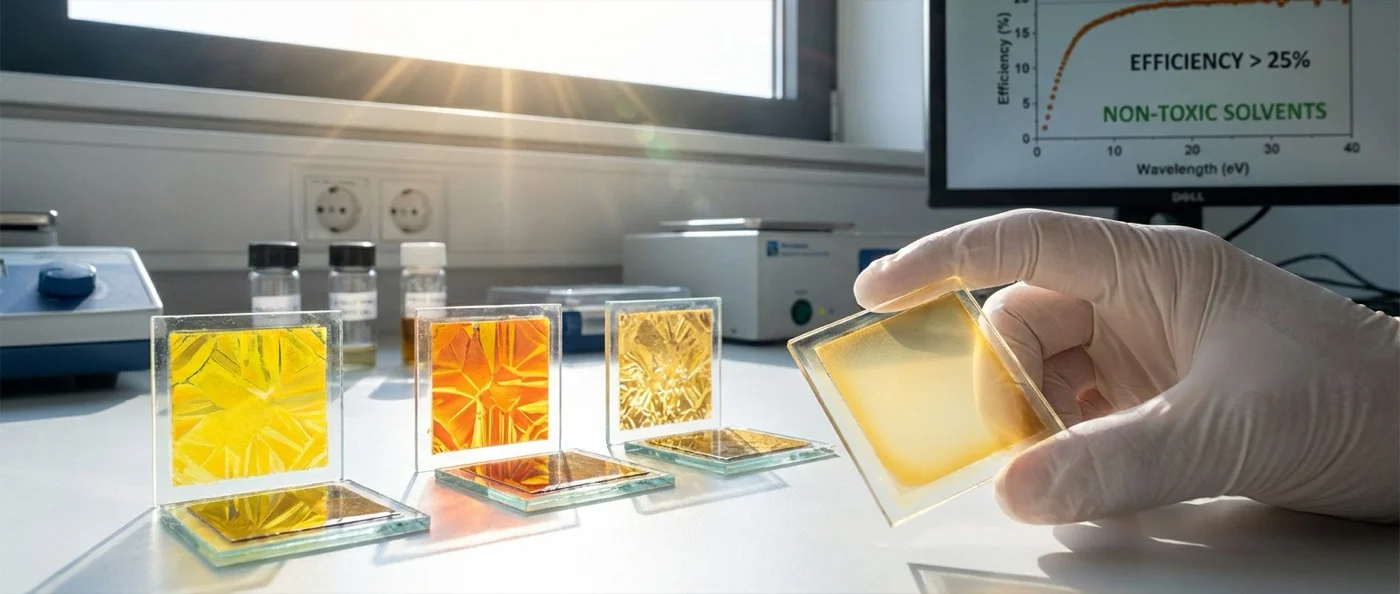
Perovskite solar cells are considered the “successor” to silicon in photovoltaic technology — but manufacturing them requires toxic organic solvents. Two new studies, in Nature Materials and Science, demonstrate that vacuum deposition without solvents can now compete with traditional methods — paving the way for industrial production.
📖 Read more: 3D-Printed Swallowable Robot Examines Gut Without Surgery
☀️ Why Vacuum Deposition Changes Everything
Today's highest-performing perovskite cells are made from solution “inks” — a process that uses toxic organic solvents like DMF (dimethylformamide). In contrast, many industrial thin-film products (from OLED displays to optical coatings) are produced by vacuum deposition — a clean, solvent-free process that can coat large areas very uniformly.
However, when perovskite films are fabricated entirely by vacuum, the crystals form in less-than-ideal ways — leaving the films more defect-prone and significantly unstable. That was the problem — until now.
📖 Read more: mRNA Reveals Hidden Cell Protection Mechanism
🔬 The HKUST Solution: Crystal-Facet Direction
Researchers at The Hong Kong University of Science and Technology (HKUST), in collaboration with the University of Oxford, developed a multi-source co-evaporation recipe that dramatically enhances crystal quality. By introducing lead chloride (PbCl₂) as a “co-source” during thermal co-evaporation, they direct how perovskite crystals grow.
The result: a highly ordered wide-bandgap perovskite film (1.67 eV) with many grains aligned in a (100) “face-up” orientation — meaning more crystalline, more resistant to light and heat degradation, with better optoelectronic properties.
"By engineering the evaporation process to control crystal orientation, we have achieved extended thermal and photostability on par with state-of-the-art solution-processed counterparts, but with all the inherent advantages of a dry, industry-compatible vacuum technique."
— Dr. Shen Xinyi, HKUST, First Author🏭 NUS: Industrial Scale With Record Durability
Separately, researchers at the National University of Singapore (NUS) published in Science a vapor-deposition method that achieves, for the first time, high-quality perovskite growth on industrial micrometer-textured silicon wafers — the very same used in commercial production.
They designed a specialized molecule that binds to the silicon surface and enhances the uniform adsorption of organic molecules during deposition — allowing the perovskite film to grow smoothly with the correct chemical balance.
📊 NUS Results
Their perovskite-silicon tandem cells achieved over 30% power conversion efficiency with stability exceeding 2,000 hours. The T₉₀ lifetime (time until performance drops to 90%) surpassed 1,400 hours at 85°C — one of the most demanding aging tests in the solar energy industry.
📖 Read more: Gut Bacteria 'Sense' Their Environment
🌍 Field Tests in Italy
The HKUST team didn't stop at the lab. In field testing in Italy, their fully vacuum-deposited tandem cells retained approximately 80% of their initial performance after 8 months of real-world operation — a major step toward stable commercial tandem cells.
📖 Read more: Insulin Without Needles: The Gel That Changes Everything
⚡ Why This Matters to All of Us
Vacuum deposition isn't just a “cleaner” method — it is directly compatible with existing industrial thin-film deposition infrastructure. This means no new factories are needed, just adaptation of existing ones.
"This co-evaporation method transforms vacuum deposition from a compromised alternative into a frontrunner for producing high-performance, stable perovskite solar cells, offering a clear pathway from the lab to the factory floor."
— Prof. Lin Yen-Hung, HKUSTWith both studies published nearly simultaneously in top journals, vacuum deposition now has both the theoretical foundation (HKUST/Oxford) and the industrial proof (NUS) — paving the way for green, solvent-free, mass production of next-generation photovoltaics.