Imagine a coating on food packaging that changes color when something starts to spoil. Or a bandage that turns red if a wound becomes infected. This idea no longer belongs to science fiction — three groundbreaking studies are bringing nanopigment sensors closer than ever to everyday reality.
📖 Read more: Nanolaser on Chip Cuts Computer Energy 50%
\ud83d\udd2c Nanocrystals That “See” Forces
In the most impressive breakthrough, Jim Schuck's team at Columbia Engineering published in Nature (January 2025) the first all-optical nanoscale force sensors: luminescent nanocrystals that change intensity and/or color when pressure is applied. They require no wires or electrical connections — they are read remotely using infrared light alone.
The technology is based on the photon avalanche effect: the absorption of a single photon triggers a chain reaction that ultimately results in the emission of many photons. The nanocrystals, doped with thulium ions (a rare earth element), are 100 times more sensitive than any previous nanoparticle of the same class, and operate across a dynamic range spanning four orders of magnitude — 10 to 100 times larger than any previous optical nanosensor.
📖 Read more: 3D Printing with Sound Creates Micro-Devices
\ud83c\udfa8 A Crystal That Detects Pollutants
Meanwhile, at Japan's Shibaura Institute of Technology, Professor Akiko Hori's team developed a hybrid charge transfer crystal that changes color reversibly — from greenish-blue to red-violet — when it comes into contact with naphthalene, an environmentally regulated substance. The work, published in Chemistry – A European Journal (May 2025), is based on a pyrazinacene molecule that links electron-donor groups (triphenylamine) with electron-acceptor groups (cyano groups).
Most impressive: the color change is fully reversible. Heating the violet crystals to 180 \u00b0C causes naphthalene to separate, restoring the original greenish-blue color. This means the same sensor can be reused multiple times, detecting trace amounts of naphthalene in freshwater and seawater through a simple color change.
Photon Avalanche
Thulium nanocrystals change color under force. 100\u00d7 more sensitive, 4 orders of magnitude range. Columbia / Nature.
Reversible Crystal
Pyrazinacene shifts greenish-blue\u2192violet with naphthalene. Fully reversible at 180 \u00b0C. Shibaura / Chemistry Eur. J.
Dual-Mode Display-Sensor
Europium/viologen in clay switch light + color at just \u22122 V. Eco-friendly. Chiba University / J. Mater. Chem. C.
📖 Read more: New Scan Shows the Human Body in 3D and Color
\ud83d\udda5\ufe0f Clay, Europium, and the Display of the Future
The third pioneering study comes from Chiba University in Japan. The team of Professors Norihisa Kobayashi and Kazuki Nakamura embedded europium(III) complexes and viologen derivatives in a layered clay matrix (smectite). The result: a dual-mode device that simultaneously controls luminescence and color with a voltage of just \u22122.0 V.
The publication in the Journal of Materials Chemistry C (February 2025) emphasizes that using natural clays instead of synthetic materials offers an eco-friendly alternative. The technology could lead to low-energy displays, pH sensors, and smart food packaging labels — changing color in response to the chemical state of the environment.
\ud83d\udca1 Why Does This Matter?
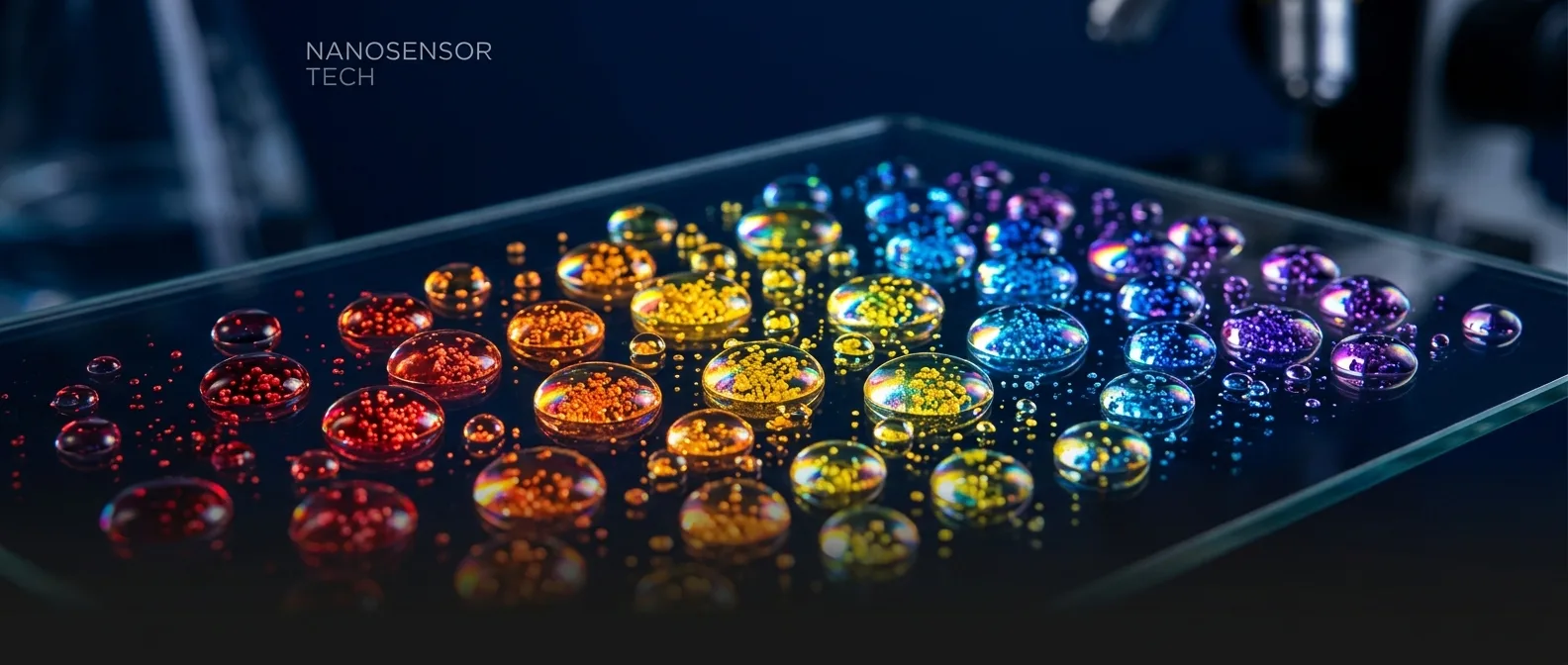
These three technologies share a common principle: color change becomes the sensor. Instead of complex electronics, a simple nanomaterial that changes color can replace expensive laboratory instruments. Applications: food freshness monitoring, wound pH detection, water pollution biosensors, flexible displays, and robotics.
📖 Read more: Insulin Without Needles: The Gel That Changes Everything
\ud83d\ude80 The Future: From Lab to Everyday Life
The Columbia team is already planning to integrate their nanosensors into biological systems — such as developing embryos and cell migrations. The goal: self-calibrating nanocrystals that function as standalone sensors. In Japan, the Shibaura team is working on nonporous adaptive crystals for selective molecular recognition, while Chiba targets commercial dual-mode display applications.
The convergence of three different approaches — photon avalanche, hybrid charge transfer, and electrochemical clay systems — marks a new era in colorimetric nanosensors. Color change, once a simple material property, is becoming a detection platform with applications spanning from medicine to robotics and the food industry.
\ud83d\udcda Sources
1. ScienceDaily — “A tour de force: Engineers discover new 'all-optical' nanoscale sensors of force” (January 1, 2025)
https://www.sciencedaily.com/releases/2025/01/250101132015.htm
Fardian-Melamed et al., Nature 2025 — Columbia Engineering
2. ScienceDaily — “A novel hybrid charge transfer crystal with reversible color-changing property” (May 16, 2025)
https://www.sciencedaily.com/releases/2025/05/250515132456.htm
Nakada et al., Chemistry – A European Journal 2025 — Shibaura Inst. of Technology
3. ScienceDaily — "Shaping future of displays: Clay/europium-based technology offers dual-mode versatility" (February 3, 2025)
https://www.sciencedaily.com/releases/2025/02/250203142359.htm
Cao et al., J. Mater. Chem. C 2025 — Chiba University