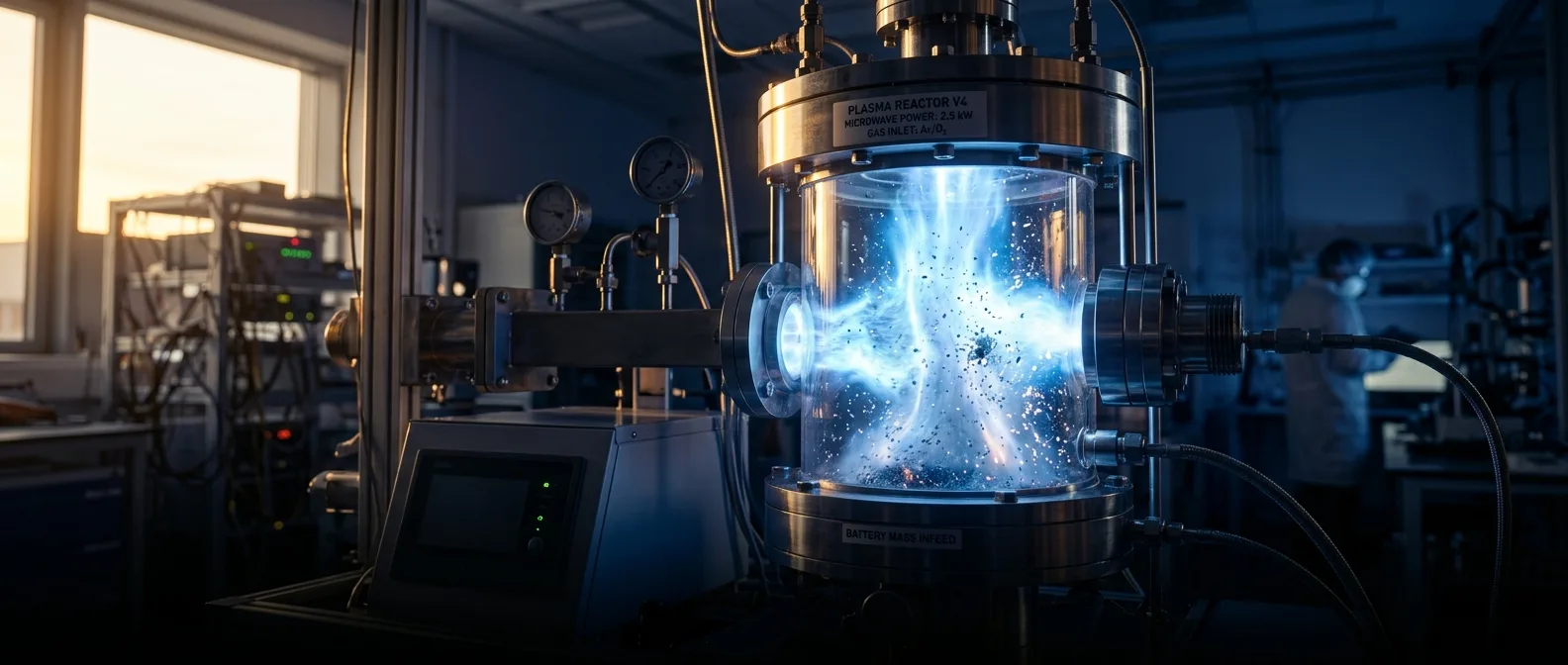
Fifteen minutes in activated gas and a drop of citric acid. That is all it takes to extract 95% of the metals from old lithium batteries — including the elusive graphite that usually ends up in the trash. Researchers at Rice University are testing a method that could completely change battery recycling in 2026.
There is very little time before old batteries become a problem. With electric vehicles flooding the market, lithium stocks declining, and prices hitting the ceiling, recycling is no longer a choice — it is survival.
The problem? Only 10% of batteries are recycled today. And those that go through the process lose their most important component.
📖 Read more: 190-Million-Year-Old 'Sword Dragon' Found in Dorset
🔬 Plasma Versus Chemicals — The New Strategy
"With plasma pretreatment, nearly 95% of metals, including lithium, can be recovered using nothing more aggressive than lemon juice acid," explained Gautam Chandrasekhar, a doctoral student who participated in the research.
The method published in Nature Communications works in reverse compared to conventional systems. Instead of putting the "black mass" — the shredded material from old batteries — into aggressive chemicals and high temperatures, you expose it to microwave plasma for 15 minutes.
It changes everything. And it seems almost simple.
📖 Read more: 2D Magnetism: Electric Control Opens the Door to Spintronics
⚡ Graphite: The Material We Throw Away
This is where the magic happens. Graphite makes up 22% of a lithium battery's weight but is rarely recycled. In traditional processes, it is burned, crushed, or rendered useless by aggressive chemicals.
"This is one of the most important things about battery recycling: As the largest component by volume in lithium-ion batteries, graphite remains nearly irreplaceable as an anode in widely used commercial battery applications," says Sohini Bhattacharyya, a researcher and author of the study.
Microwave plasma cleans and repairs graphite by removing residues and structural damage that accumulate during battery use.
How Microwave Plasma Works
Plasma is essentially activated gas — atoms that have lost electrons and move wildly. When you expose the black mass to this environment, metallic compounds change structure and become easier to extract.
After the plasma step, the materials are processed with citric acid at room temperature. No high heat, no industrial chemicals. Lithium is additionally recovered with water — child's play.
📊 Advantages Over Conventional Methods
Today's industrial processes are energy-intensive and primarily target cathode materials. They leave other components aside — and for good reason. It is difficult to recover them without destroying them.
The industrial battery recycling processes used today have very low metal extraction efficiency and focus primarily on the cathode
Xiang Zhang, assistant research professor
The Rice method is different. It does not focus on just one part of the battery but on everything. Tests showed that recovered graphite maintains its electrochemical performance when reintroduced into a new battery.
Economic Benefits
The technology has already been patented and early economic analyses show it can surpass current industrial processes. Especially because it recovers graphite in a usable form — something that until now was nearly impossible.
Advantages of the New Method
- Recovery of 95% of metals including lithium
- Graphite in a reusable state
- Low temperatures and mild chemicals
- Ability to integrate into existing systems
- Reduced environmental footprint
📖 Read more: 3D-Printed Swallowable Robot Examines Gut Without Surgery
🌍 The Big Supply Chain Problem
The critical metals used in batteries are limited and unevenly distributed globally. This makes supply chains vulnerable to geopolitical tensions and sudden supply disruptions.
At the same time, most used batteries are not recycled and end up in landfills where they can leak hazardous chemicals. A paradoxical situation arises: we throw away materials worth thousands of euros while simultaneously importing them from the other side of the planet.
"Recycling used batteries is the most practical solution for addressing this strained supply chain, but studies show that this happens with less than 10% of battery waste," notes Chandrasekhar.
📖 Read more: 3D Printing with Sound Creates Micro-Devices
🎯 What Changes in 2026?
The Rice researchers' method aims to bridge this gap. It was designed as a pretreatment step that can be integrated into existing recycling systems to improve efficiency and reduce the environmental footprint.
"We hypothesized that using microwave plasma to break apart the metal oxide particles as a pretreatment step would make their hydrometallurgical recovery in weaker acids easier," explains Bhattacharyya.
Circular Economy
Transforming waste into high-value raw materials
Energy Savings
Reduced energy consumption compared to conventional methods
Environmental Protection
Avoiding hazardous chemicals and reducing emissions
"This is an innovative methodology for recovering all critical minerals from battery black mass with minimal use of chemicals and energy," emphasizes Pulickel Ajayan, who led the research team.
📖 Read more: 40,000-Year-Old Signals: The Precursor to Writing Is Proven
🔍 Practical Challenges and Limitations
Scaling from laboratory level to industrial production requires significant technical adaptations. Scaling the process to a level that handles millions of batteries annually will require substantial investments and technological adjustments.
Additionally, the efficiency of microwave plasma may vary depending on the battery type and its state of degradation. Batteries that have undergone significant wear or have been exposed to extreme conditions may require different processing parameters.
Cost and Return on Investment
The cost of installing microwave generators and plasma systems is still high. However, the ability to recover materials that would otherwise be lost — especially graphite — can justify the investment in the long term.
Early estimates show that the return on investment will largely depend on the market price of recovered materials and government subsidies for green technologies.
🏭 The Future of Battery Recycling
The Rice method is not the only one trying to solve the problem. Companies like Tesla and BMW are investing in their own recycling solutions, while startups like Redwood Materials and Li-Cycle are developing alternative approaches.
What differentiates the research method is its emphasis on graphite recovery — something most commercial solutions ignore. If proven economically viable at large scale, it could become the standard for the next generation of recycling facilities.
Key Players in Battery Recycling
- Redwood Materials: Specializes in battery circular economy
- Li-Cycle: Hub and spoke approach with hydrometallurgy
- Tesla: Closed-loop recycling at Gigafactories
- BMW: Partnerships with recycling companies for EV batteries
European legislation requires car manufacturers to recycle at least 65% of battery weight by 2025 and 70% by 2030. These requirements will provide additional incentive for adopting advanced technologies like microwave plasma.
The first cost estimates will determine whether the method can compete with existing processes. The final decision will depend on the market price of recovered graphite and the cost of installing microwave systems.
Sources: