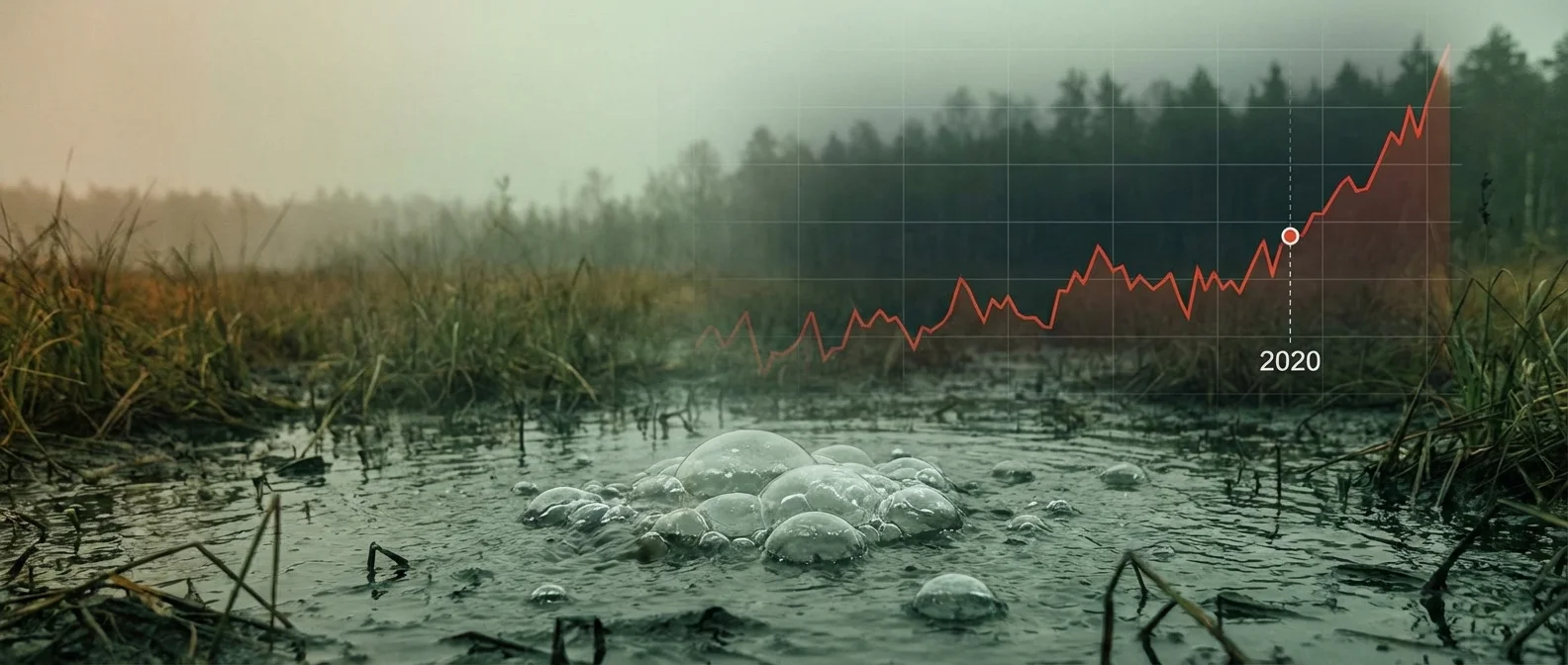
Atmospheric methane levels surged at an unprecedented rate after 2020, but the cause turned out to be entirely different from what scientists expected. Instead of fossil fuels, the main culprit was nature itself — tropical wetlands, rivers, and rice paddies, combined with an unexpected chemical change in the atmosphere directly linked to the COVID-19 pandemic.
📖 Read more: Oceans Rising Faster Than Ever: Laser Satellite Proves It
🌡️ Record Methane: The Alarming Numbers
Data from the National Oceanic and Atmospheric Administration (NOAA) leave no room for doubt. Atmospheric methane increased by 55 parts per billion (ppb) between 2019 and 2023, reaching 1,921 ppb — the highest level ever recorded in human history. For comparison, before the Industrial Revolution, methane levels were just 700 ppb.
The fastest increase occurred in 2021, when methane rose by nearly 18 ppb in just one year — an increase 84% larger than that of 2019. During the 2000s, the annual increase was approximately 6.1 million tons of methane. By 2020, that number had surged to 42 million tons, and growth rates have since remained higher than any previous year. No one expected such a steep escalation — and the search for the cause led to surprises.
🔬 The Surprising Cause: Chemistry, Not Industry
An international team of researchers led by Philippe Ciais of the University of Versailles Saint-Quentin-en-Yvelines, publishing their findings in the journal Science in February 2026, revealed that the primary factor behind the surge was not increased burning of fossil fuels or industrial natural gas leaks. It was something far more alarming: the atmosphere itself temporarily lost its ability to “clean up” methane.
The primary natural mechanism for breaking down methane is hydroxyl radicals (OH) — extremely reactive molecules that chemically react with methane and decompose it. During the COVID-19 pandemic, lockdowns drastically reduced air pollution, particularly nitrogen oxides (NOₓ) from vehicles, factories, and power plants. While this appeared beneficial for air quality, it had an unexpected side effect: without enough NOₓ, the production of OH radicals dropped dramatically, and the atmosphere became less effective at naturally breaking down methane.
According to the study, this decline in OH radicals accounts for approximately 80–85% of the variability in the rate of methane accumulation during the critical years of 2020–2021. In simple terms: the pandemic “cleaned” the air of pollutants, but in doing so inadvertently removed the mechanism that kept methane in check. This was a paradox that no climate model had predicted.
🌿 Tropical Wetlands: The Silent Amplifier
Alongside the chemical change in the atmosphere, a prolonged La Niña phase between 2020 and 2023 brought excessive rainfall to large tropical regions. These conditions created an ideal environment for methanogenic microorganisms — microbes that decompose organic matter under anaerobic (oxygen-free) conditions and produce methane as a byproduct.
The largest emission increases were recorded in tropical Africa and Southeast Asia, regions with vast expanses of flooded soils. A notable increase was also observed in Arctic wetlands and lakes, as warmer temperatures enhanced microbial activity even in these cold zones. Conversely, methane emissions from South American wetlands dropped dramatically in 2023, during an extreme drought linked to the El Niño phenomenon — demonstrating how sensitive this system is to climate extremes.
Tropical wetlands — the Amazon, Nile, and Congo basins — emit approximately 200 million metric tons of methane annually. As the planet warms, the production and decomposition of biomass increases, and with it, emissions rise — in a troubling vicious cycle.
⚠️ The Methane Vicious Cycle
Rising temperatures boost methane emissions from wetlands → methane intensifies the greenhouse effect → temperatures rise further. This positive feedback loop is one of the most alarming dynamics in the climate cycle, as it cannot be controlled through human intervention at natural sources.
📖 Read more: Fossils: Sea Monsters Returned After the Great Extinction
🛰️ Satellites: Eyes Above the Wetlands
Understanding these complex processes would not have been possible without modern satellite technology. The Sentinel-5P satellite from the European Copernicus programme, equipped with the TROPOMI spectrometer, provides daily data on atmospheric composition, enabling scientists to pinpoint methane sources with unprecedented accuracy on a global scale.
Meanwhile, researchers at the University of Michigan utilized a satellite constellation originally designed by NASA for studying hurricanes — the CYGNSS system. Rather than measuring methane directly, CYGNSS detects how GPS signals are reflected off the Earth's surface, distinguishing dry land from flooded areas. In this way, they created detailed maps of tropical flooding on daily and monthly scales, revealing how water distribution affects methane emissions.
"Chemical fingerprinting" — isotopic analysis of the C-12 to C-13 ratio in atmospheric methane — clearly confirms that microbial sources (wetlands, inland waters, rice paddies, livestock) are responsible for the majority of the recent increase. Fossil fuels and biomass fires played only a secondary role.
📊 What This Means for Climate Goals
The situation poses serious challenges for international climate policy. In 2021, more than 150 nations signed the Global Methane Pledge, committing to reduce emissions by 30% by 2030. However, current atmospheric methane levels correspond to climate scenarios with temperature increases of up to 3°C by 2100 — far above the target.
To keep global temperatures below 2°C — the central goal of the Paris Agreement — methane emissions must be reduced by nearly 45% by 2050, according to the Intergovernmental Panel on Climate Change (IPCC). Methane is already responsible for approximately 0.5°C of warming out of the total 1.2°C increase relative to pre-industrial levels.
"Our findings clarify why atmospheric methane increased so rapidly. They also show that future trends will depend not only on emissions control, but also on climate-driven changes in natural and managed methane sources."
⚖️ Can We Fight Back?
Despite the alarming data, there are concrete solutions. The oil and natural gas industry could reduce its emissions by 40% at no net cost, according to the International Energy Agency (IEA). In agriculture, feed additives can significantly reduce methane emissions from ruminant animals — cattle, sheep, goats — while mid-season drainage of rice paddies can deliver quick results. Capturing methane from landfills for energy production is already an established practice in many European countries.
Yet the most alarming finding of the new study is not about human-caused emissions — it is that nature itself is responding to global warming in a way that accelerates the climate problem. We cannot “turn off the tap” of tropical wetlands, nor control microbial activity across millions of square kilometers of swampy terrain. Therefore, the only realistic solution is to drastically accelerate the reduction of every human-caused source of methane.
The study, published in the journal Science in February 2026, represents the most comprehensive global methane budget to date, covering data through 2023. Its results underscore a difficult truth: the climate crisis contains self-reinforcing traps that are not easily controlled — and the window for action is closing dangerously fast.
📚 Sources
- ScienceDaily — Methane spiked after 2020 and the cause was unexpected
- ScienceDaily — Atmospheric methane increase during pandemic due primarily to wetland flooding
- Phys.org — Satellites reveal tropical wetland flooding did not cause methane surge
- Live Science — Greenhouse gas 80 times more potent than CO₂ is rising fast
- ScienceAlert — Methane Pollution Just Reached New Heights