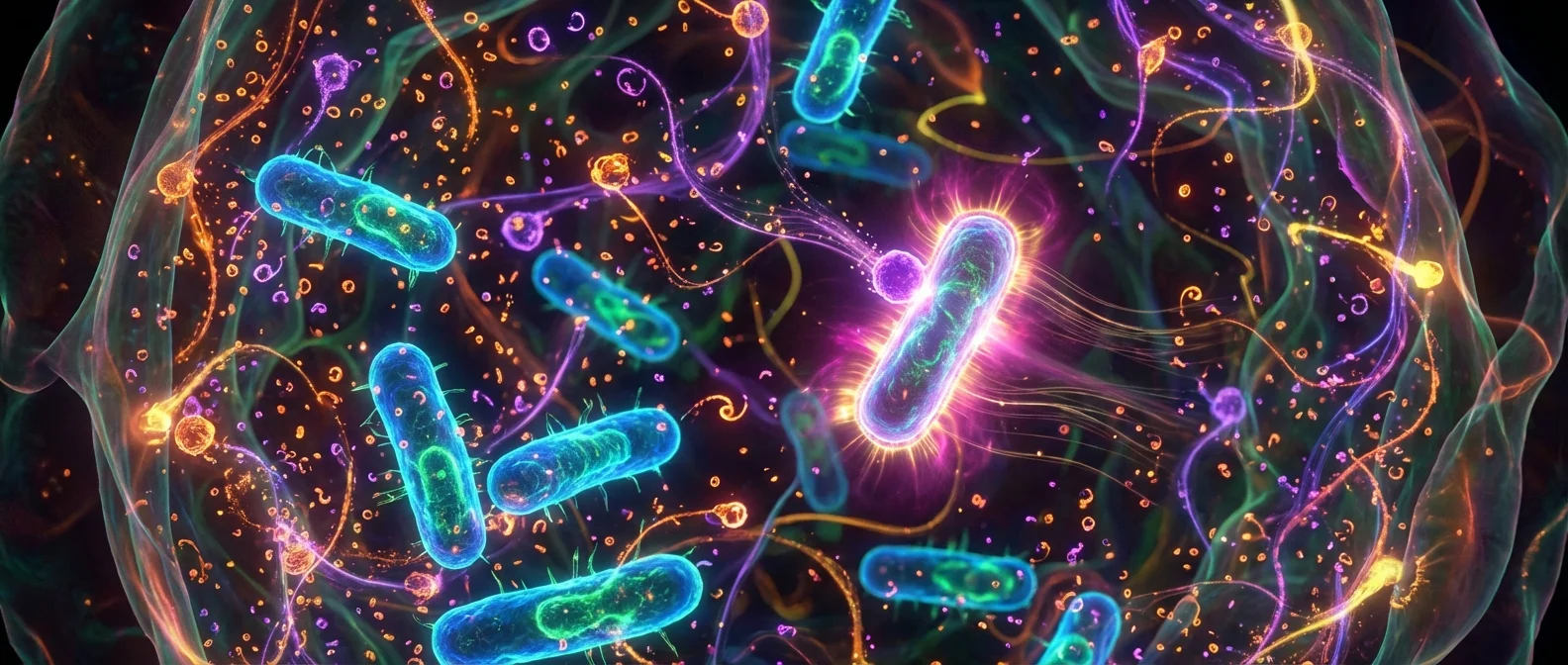
We've known for years that gut bacteria play a role in our health. But how exactly do they “sense” their environment? Researchers at the Max Planck Institute for Terrestrial Microbiology just revealed that gut bacteria possess a remarkably broad range of chemosensory receptors — molecular sensors that recognize carbohydrates, lipids, proteins, DNA, and amines. The study was published in PNAS.
📖 Read more: 3D-Printed Swallowable Robot Examines Gut Without Surgery
🦠 What They Discovered
The team of Professor Victor Sourjik, director of the Max Planck Institute in Marburg, Germany, focused on Clostridia — motile bacteria found in large numbers in the human gut, known for their contribution to intestinal health. With lead author Dr. Wenhao Xu, the team conducted the first systematic analysis of the sensory preferences of non-model bacteria that colonize a specific ecological niche.
The results were striking. The chemosensory receptors of Clostridia recognize a remarkably broad range of metabolic substances: breakdown products of carbohydrates, lipids, proteins, DNA, and amines. They don't just “eat” whatever they find — they actively detect and navigate toward specific nutrients.
📖 Read more: Bacteria Invade Cancer Cells and Destroy Them from Within
🔬 Lactic Acid and Formic Acid: The Key Indicators
Among all the substances detected by the bacteria, two stood out: lactic acid and formic acid. These were the most frequent stimuli — clearly particularly important sources of nutrition for gut bacterial growth.
This reveals a fascinating mechanism: cross-feeding. Some bacteria produce lactic and formic acid as metabolic by-products, and other species use them as food. This chain of mutual feeding stabilizes the entire gut ecosystem — a true “economy” at a microscopic scale.
New Sensors
The team discovered previously unknown sensor groups specific to lactic acid, dicarboxylic acids, uracil (a building block of RNA), and short-chain fatty acids (SCFAs). They also deciphered the crystal structure of a dual sensor that responds simultaneously to uracil and acetic acid.
📖 Read more: RNA Nanostars Create Artificial Compartments Inside Bacteria
🧬 Evolutionary Adaptation
An unexpected discovery was that receptor specialization can change relatively easily during evolution. This explains how bacteria adapt their sensory capabilities to new environments — a kind of microbial “reprogramming” that occurs over evolutionary time.
"These sensors appear to be important for interactions between bacteria in the gut and could play a crucial role in the healthy human microbiome," says Dr. Xu.
📖 Read more: 5,000-Year-Old Cave Bacteria Resists Modern Antibiotics
💡 Why It Matters
"Our research has significantly expanded the understanding of the sensory capabilities of beneficial gut bacteria," says Sourjik. "To our knowledge, this is the first systematic analysis of sensory preferences of non-model bacteria that colonize a specific ecological niche."
Understanding how bacteria “sense” their environment opens the door to practical applications: “smart” probiotics that activate only under specific conditions, targeted therapies for intestinal diseases, and a better understanding of the gut-brain axis that affects mood, stress, and overall health.