📖 Read more: Bacteria Invade Cancer Cells and Destroy Them from Within
👻 What Are Neutrinos — The “Ghost Particles”
Neutrinos belong to the leptons — a family of fundamental particles in the Standard Model of physics. They were theoretically predicted by Wolfgang Pauli in 1930 and experimentally discovered in 1956 by Clyde Cowan and Frederick Reines. There are three neutrino "flavors": electron, muon, and tau, each associated with its corresponding charged lepton.
What makes neutrinos so special — and so difficult to detect — is that they interact exclusively through the weak nuclear force and gravity. They carry no electric charge, do not interact with electromagnetism, and do not participate in the strong nuclear force. This means they can pass through entire stars and planets with virtually no interaction.
Solar Neutrinos
The Sun produces billions of neutrinos every second through nuclear fusion. Approximately 65 billion solar neutrinos pass through every square centimeter of the Earth each second.
Supernova Neutrinos
During the collapse of a massive star, 99% of the energy is released in the form of neutrinos. SN 1987A was the first supernova from which neutrinos were detected.
Cosmic Neutrinos
Ultra-high-energy neutrinos originate from the most violent phenomena in the universe: active galactic nuclei, blazars, and now — black holes.
🕳️ Black Holes: The Most Extreme Structures in the Universe
Black holes are regions of spacetime where gravity is so strong that nothing — not even light — can escape beyond the event horizon. They form primarily from the gravitational collapse of massive stars (stellar black holes) or are found at the centers of galaxies (supermassive black holes).
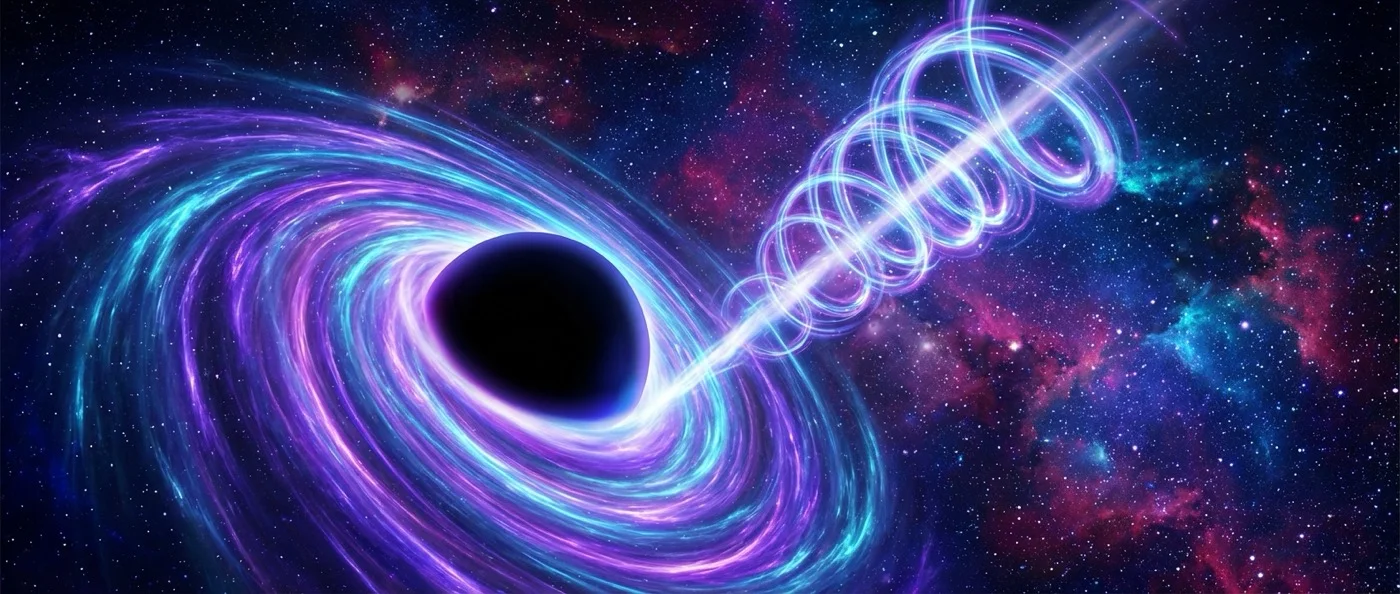
Although no particle can escape from within the event horizon, the processes outside it — in the so-called accretion disk — produce enormous amounts of energy. Matter falling toward the black hole heats up to hundreds of millions of degrees, emitting radiation, particles — and neutrinos.
The Neutrino Production Mechanism
In the relativistic jets launched perpendicular to the accretion disk, particles are accelerated to energies far exceeding what any ground-based accelerator can achieve. During the interactions of these particles, pions (π mesons) are produced, which decay into ultra-high-energy neutrinos.
📖 Read more: Arctic Ocean Noise Surges 15x From Human Activity
🔭 How the Particle Was Detected
Detecting neutrinos is a technological feat. Given the extremely low probability of their interaction with matter, detectors must be enormous in size and deeply buried underground or under ice to block out cosmic noise.
Major Neutrino Detectors
The IceCube detector at the South Pole was the one that recorded the critical event. When an ultra-high-energy neutrino interacts (rarely) with a water molecule in the ice, it produces a charged particle that moves faster than light within the ice, emitting Cherenkov radiation — a distinctive blue glow. By analyzing the pattern of this radiation, physicists can calculate the energy, direction, and type of the neutrino.
📖 Read more: Scientists Created Time Crystal from Styrofoam Material
🌌 Why This Discovery Upends Physics
The detection of a neutrino from a black hole with such extraordinarily high energy raises serious questions:
GZK Limit
According to the theoretical Greisen–Zatsepin–Kuzmin limit, ultra-high-energy particles should lose energy by interacting with the Cosmic Microwave Background. How did this neutrino make it here?
New Physics?
The energy of the detected neutrino exceeds expected models. This may indicate unknown acceleration mechanisms or even new physics beyond the Standard Model.
Source Identification
For the first time, a neutrino of such energy could be directly linked to a specific black hole, opening a new era in “neutrino astronomy.”
"Neutrinos are the messengers that can reveal the secrets of the most violent phenomena in the universe. Unlike photons, they are not absorbed or deflected — they reach us untouched, carrying information from the depths of spacetime."
🔬 The Importance of “Multi-Messenger Astronomy”
This discovery falls within the emerging field of multi-messenger astronomy. Traditionally, astronomers studied the universe solely through electromagnetic radiation (light, radio waves, X-rays). Today, we can combine:
- Gravitational waves — detected by LIGO/Virgo (since 2015)
- Neutrinos — detected by IceCube, Super-K, KM3NeT
- Cosmic rays — high-energy particles from space
- Electromagnetic radiation — across the entire spectrum, from radio waves to gamma rays
Linking the neutrino to a specific black hole represents a triumph of this approach. Simultaneous observation across electromagnetic wavelengths confirmed that the black hole was in a phase of intense activity at the estimated time of the neutrino's emission.
📖 Read more: AI Identifies Which Dinosaur Left a Footprint
🚀 What This Means for the Future of Physics
This discovery opens multiple research directions:
Dark Matter
If high-energy neutrinos are produced in ways the Standard Model cannot explain, they may be linked to dark matter particles or “heavy” neutrinos (sterile neutrinos).
Quantum Gravity
Studying neutrinos from black holes may reveal traces of quantum gravity phenomena — the “holy grail” of modern theoretical physics.
📝 Conclusions
The detection of an ultra-high-energy neutrino from a black hole is a historic milestone in particle astrophysics. It confirms that black holes are powerful natural “particle accelerators” and opens new chapters in the study of both high-energy astrophysics and fundamental physics.
As new detectors — such as IceCube-Gen2 and KM3NeT — come online, “neutrino astronomy” promises to reveal the secrets of the universe that were hidden behind dark clouds of dust and radiation — secrets that only the “ghost particles” can carry to us.