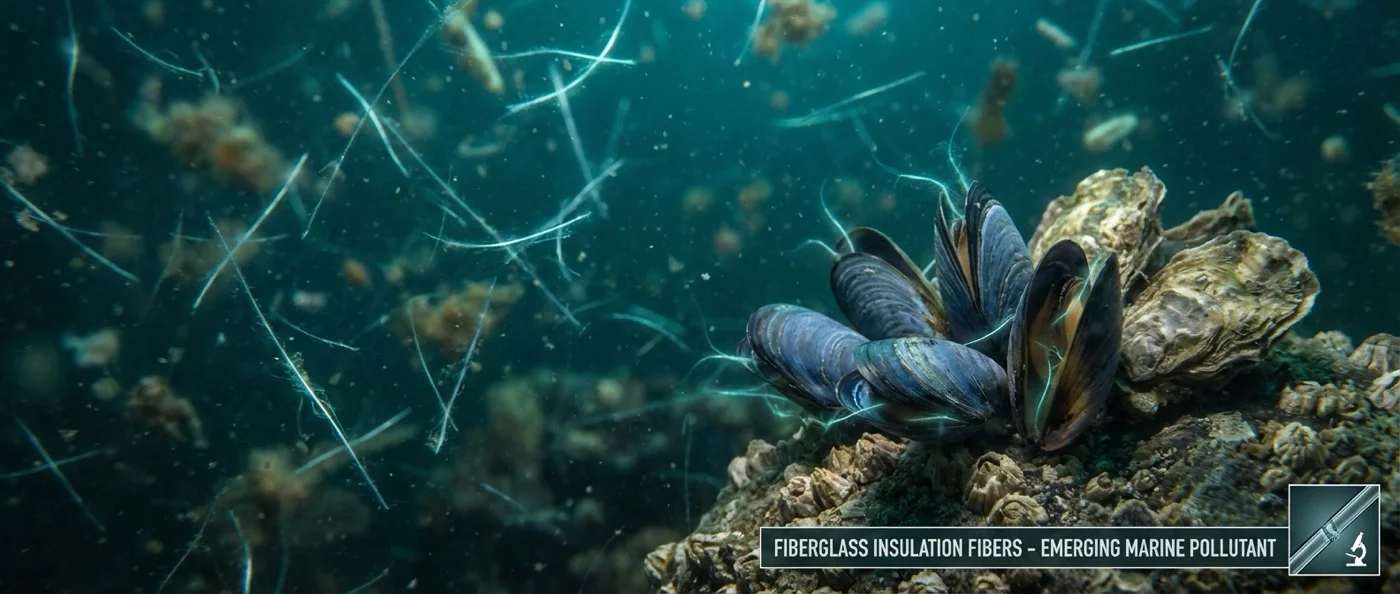
In the Cowichan Estuary on Vancouver Island, Canada, thousands of birds migrate every year. Indigenous communities have been harvesting clams, sea urchins, and crabs here for generations. Now, researchers have discovered something alarming: the mud beneath their feet is riddled with microscopic fiberglass needles — a pollutant nobody had thought to look for until now.
📖 Read more: Historic Coral Bleaching Record: Over 50% Damaged
🔍 What the Researchers Found
The study, published in Marine Pollution Bulletin in February 2026, was conducted by scientists from Simon Fraser University in collaboration with the Cowichan Estuary Restoration and Conservation Association (CERCA). Between 2020 and 2024, the team collected samples from 26 sites across the estuary — a 400-hectare intertidal ecosystem internationally recognized as an important bird habitat.
The results were striking: fiberglass fibers were found at 96% of sediment sampling sites. In the biofilm — the thin surface layer of algae and microorganisms, just 3-5 millimeters thick, that fuels migratory shorebirds — fiberglass particles were also present.
"Fiberglass particles are silica-based glass fibers, often reinforced with plastic, and we are just in the infancy of understanding their potential toxicity for animals and people."
— Juan José Alava, Marine Eco-toxicologist, Simon Fraser University🚢 How Fiberglass Ends Up in the Ocean
The main source isn't some factory. It's boats. Vessels are built with fiberglass-reinforced plastic (FRP) — thin glass fibers embedded in plastic resins. When boats are sanded, repaired, abandoned, or left to deteriorate, these fibers break down into microscopic, needle-like fragments that end up in the sediments.
Abandoned boats and decaying marine infrastructure serve as a constant, uncontrolled source of contamination — similar to how shipwrecks contribute to microplastic pollution. The study also documented that fiberglass is denser than saltwater, so it doesn't float — it sinks and accumulates in the sediments, precisely where shellfish, mussels, and other invertebrates live and feed.
⚠️ Why It's Called a 'Forever Pollutant'
Fiberglass is extremely durable and degrades very slowly, especially when reinforced with plastic. Unlike organic materials that biodegrade, glass fibers persist in the environment almost indefinitely — which is why the study classifies it as a “forever pollutant” in the ocean.
📖 Read more: Invisible Chemical Rain Falls Across the Entire Planet
🐦 The Threat to Ecosystems
The Cowichan Estuary is no ordinary place. It is vital to the Cowichan Tribes First Nations, who have been harvesting clams, geoducks, crabs, poultry, herring roe, sea urchins, and salmon here for centuries. It is also an internationally recognized important bird area, with thousands of shorebirds that depend on the biofilm as a food source.
The problem isn't theoretical. Fiberglass particles are found in the very layers where animals feed. What we don't yet know — and what concerns the researchers most — is whether these particles bioaccumulate through the food chain: from invertebrates, to fish, to birds, and ultimately to humans.
"Just knowing these particles exist in an estuary that supports birds and shellfish — and is central to Indigenous food security — is enough to justify precautionary measures. We don't need to wait until we learn every toxicity threshold to act."
— Juan José Alava, SFU📖 Read more: Japanese Drug Mic-628 Cuts Jet Lag Recovery Time in Half
📋 What the Study Recommends
The researchers didn't stop at documenting the problem — they proposed concrete measures:
- Stricter controls on boatyards: Limiting sanding and cutting dust that enters coastal waters
- End-of-life boat regulations: Mandatory recycling and safe dismantling of damaged fiberglass vessels
- Stormwater management: Improved filtration at industrial coastal facilities
- Eco-friendly materials: Investment in “green chemistry” for alternative boatbuilding materials
🌍 A Problem Bigger Than Canada
The Cowichan Estuary study may reflect a much broader reality. Fiberglass is used extensively in boats, wind turbines, automobiles, construction, and industrial equipment worldwide. If contamination is this widespread in a well-protected Canadian estuary, what's happening in harbors, industrial coastlines, and developing countries without environmental oversight?
This is one of the first baseline assessments of coastal fiberglass pollution in Canada. Researchers must now answer the critical question: how far do these particles travel up the food chain?
Sources: