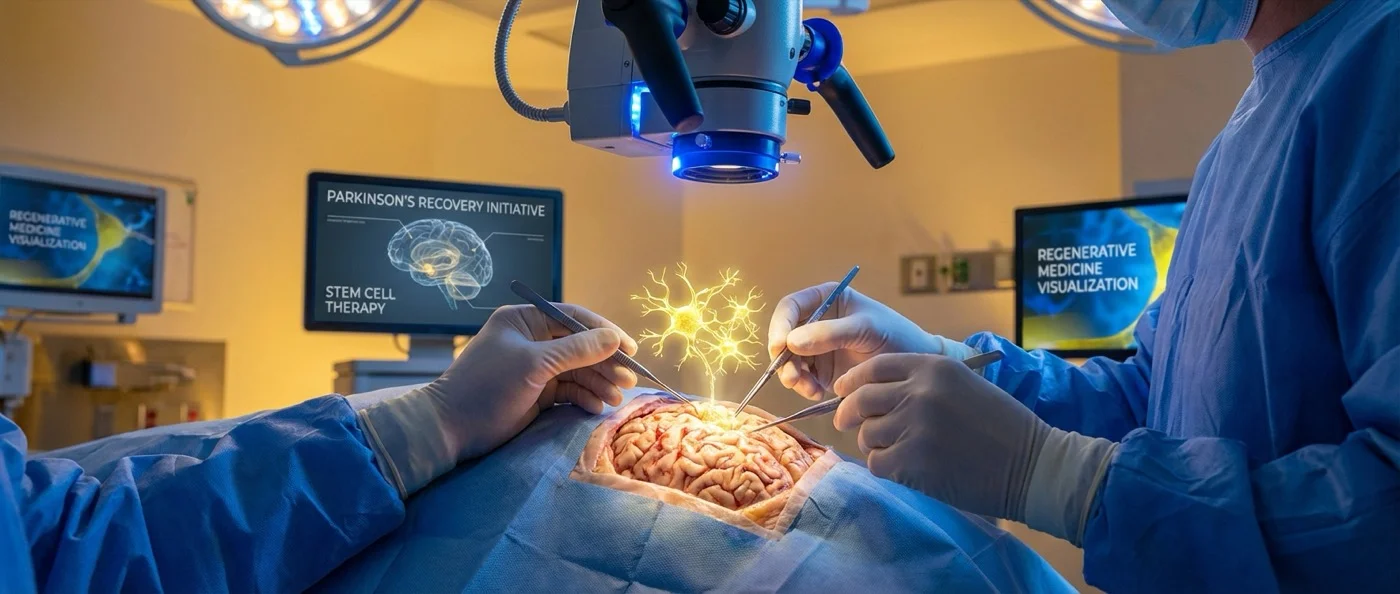
For the first time in history, surgeons at Keck Medicine of USC have implanted dopamine-producing stem cells directly into the brains of Parkinson's disease patients — a therapy that aims not to mask symptoms, but to genuinely restore the brain's lost cellular machinery.
The Core Problem in Parkinson's Disease
Parkinson's disease affects roughly 10 million people worldwide, and its underlying cause is well-established: a progressive loss of dopamine-producing neurons in a region of the brain called the substantia nigra. Dopamine is an essential neurotransmitter that controls movement, balance, and coordination. When these neurons die, patients develop the disease's characteristic tremors, rigidity, and difficulty walking.
Current treatments — most famously levodopa, a dopamine precursor drug — provide symptom relief, but they do not stop or reverse the neuronal loss. Over time, the drugs become less effective and dosing windows narrow. Most patients and neurologists have long awaited a therapy that could replace the lost neurons, not just compensate chemically for their absence.
iPSC Technology: Reprogramming Adult Cells Into Neurons
The new approach relies on induced pluripotent stem cells (iPSCs), a Nobel Prize-winning technology developed by Shinya Yamanaka in 2006. iPSCs are created by taking ordinary adult cells — typically skin or blood cells — and reprogramming them back into a stem cell-like state. From there, they can be directed to differentiate into virtually any cell type in the body, including the dopamine-producing neurons lost to Parkinson's disease.
The therapy being tested, called RNDP-001, was developed by Kenai Therapeutics. It uses iPSC-derived midbrain dopamine neurons — the specific subtype that is lost in Parkinson's — and has received FDA Fast-Track designation, meaning the agency considers it a potentially serious advance and has committed to expedited review.
The REPLACE™ Clinical Trial
The Phase 1 trial, officially registered as NCT06687837, is called the REPLACE™ trial. It is enrolling 12 participants with moderate-to-moderately-severe Parkinson's disease at three sites across the United States, with Keck Medicine of USC serving as one of the trial centers.
Lead investigators at Keck Medicine are Dr. Brian Lee, MD, PhD, a neurosurgeon, and Dr. Xenos Mason, MD, a neurologist. The surgical procedure involves creating a small opening in the skull — under MRI guidance — and precisely implanting the stem cell-derived neurons into the basal ganglia, the brain region responsible for coordinating voluntary movement and the area most affected by Parkinson's.
"We are optimistic that this treatment could not only slow the progression of Parkinson's, but potentially restore lost function, offering a new hope to patients who have limited options."
— Dr. Brian Lee, MD, PhD, Keck Medicine of USCWhat Happens After Surgery?
Following the transplant, each patient will be monitored closely for 12 to 15 months, with follow-up continuing for up to five years. Researchers will be looking for signs that the transplanted neurons have survived, integrated into the brain's existing circuitry, and begun producing dopamine.
Phase 1 trials primarily assess safety — whether the procedure is tolerable, whether the cells cause inflammation or immune rejection, and whether there are unexpected side effects. But the trial is also designed to capture early signals of clinical benefit: do patients move better? Do their tremors diminish?
Key Advantages Over Previous Approaches
Earlier attempts at cell transplantation for Parkinson's — conducted in the 1990s using fetal brain tissue — showed some promising results but were inconsistent and raised ethical concerns. The iPSC approach solves several of those problems:
- Renewable supply: iPSCs can be cultured in large quantities in the lab, unlike fetal tissue
- Controlled quality: The differentiation into dopamine neurons can be standardized and verified before transplantation
- Ethical clarity: No fetal tissue is needed; cells come from adult donors
- Potential autologous use: Future versions may use a patient's own cells, eliminating immune rejection risk
The Road Ahead
Phase 1 is a safety and tolerability study. If RNDP-001 clears this stage successfully, it will advance to Phase 2 trials that evaluate efficacy in larger patient groups. If all goes well, this therapy could fundamentally change how Parkinson's is treated — shifting from management to potential restoration.
Summary
- First clinical trial implanting iPSC-derived dopamine neurons directly into Parkinson's patients' brains
- Therapy: RNDP-001 by Kenai Therapeutics; FDA Fast-Track designation
- Trial: Phase 1 REPLACE™ (NCT06687837) — 12 participants at 3 US sites
- Procedure: MRI-guided implantation into basal ganglia via small skull opening
- Lead investigators: Dr. Brian Lee MD PhD (neurosurgeon) + Dr. Xenos Mason MD (neurologist), Keck Medicine of USC
- Monitoring: 12-15 months post-transplant; up to 5-year follow-up
- Goal: replace lost dopamine neurons — not just mask symptoms
- Source: Keck Medicine of USC / University of Southern California Health Sciences, Feb 20, 2026