📖 Read more: Bacterial Sugar: A New Weapon Against Superbugs
🧬 What Is DNA Origami
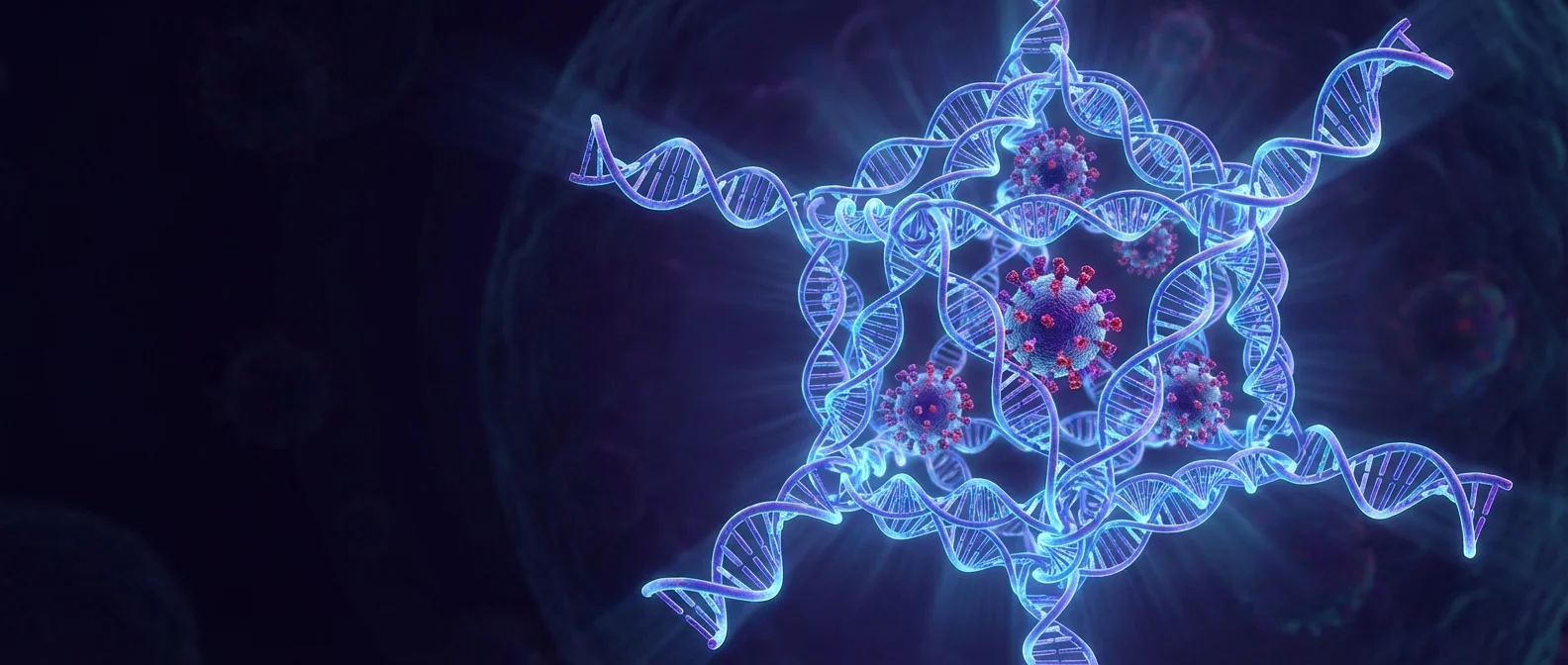
DNA origami is a nanotechnology technique invented in 2006 by Paul Rothemund at Caltech. The basic idea is simple yet elegant: long DNA molecules are “folded” into three-dimensional structures with nanometer precision, much like Japanese paper origami. Thanks to its programmable nature, DNA can be designed to create virtually any three-dimensional shape.
In 2016, Professor Mark Bathe's lab at MIT developed an algorithm that automatically designs three-dimensional virus-like structures using DNA origami. This method gives absolute control over the structure of synthetic DNA, allowing researchers to place various molecules — such as viral antigens — at precise positions.
"The DNA structure is like a pegboard where antigens can be placed at any position. These virus-like particles allowed us to reveal fundamental principles of immune cell recognition for the first time."
— Professor Mark Bathe, MIT🔬 The First Discovery: Vaccine Design Rules (2020)
The first major discovery came in 2020, when Professors Bathe and Darrell Irvine published a study in Nature Nanotechnology. The team constructed icosahedral DNA particles — similar in size and shape to a real virus — and placed 30 copies of a modified HIV gp120 protein on their surface.
The results overturned a widespread assumption. Researchers discovered that maximum antigen density does not produce the maximum immune response. Instead, greater spacing between antigens led to stronger B-cell activation.
📏 The Importance of Spacing
When antigens bind to B-cell receptors, the activated receptors interact with each other within the cell, enhancing the immune response. However, if the antigens are too close together, this interaction decreases. Optimal spacing is key to effective vaccines.
🛡️ Immunologically “Invisible” Scaffold (2024)
In January 2024, the MIT team went a step further. In a study published in Nature Communications, the researchers replaced the HIV antigen with the SARS-CoV-2 spike protein and tested the vaccine in mice.
The critical discovery: the DNA scaffold was “immunologically invisible.” The mice produced high levels of antibodies against the spike protein, but zero antibodies against the DNA scaffold — something that does not happen with vaccines based on protein scaffolds.
⚠️ Why This Problem Matters
Most particle-based vaccines use protein scaffolds, such as ferritin. However, these proteins trigger the immune system to produce antibodies against both the target antigen and the scaffold itself. This creates two serious problems:
🎯 Misdirection
The immune system gets “distracted” from the real target, producing antibodies against the scaffold instead of the virus
🔄 Platform Dependency
If the same scaffold is used for a second vaccine (e.g., for the flu), the immune system “remembers” the scaffold and effectiveness decreases
💉 Multiple Antigens
With DNA origami, antigens from different viruses can be placed on the same particle
⏰ Long-Term Protection
Activated B-cells can survive for decades, providing long-lasting immunity
"The DNA nanoparticle is immunogenically silent. If you use a protein platform, you get equally high antibody responses against both the platform and the antigen — and that can complicate repeated use."
— Daniel Lingwood, Ragon Institute / Harvard Medical School🦠 Applications Against HIV
HIV remains one of the most difficult vaccine targets. It mutates rapidly, constantly changing its surface proteins. This means antibodies produced against one strain may not recognize others. The ultimate goal is to generate broadly neutralizing antibodies — antibodies capable of targeting multiple strains simultaneously.
The DNA origami platform offers unique advantages in this fight. Because the scaffold does not trigger an immune response, the full power of the immune system is focused on the viral antigens. Additionally, the ability to place multiple antigens on the same particle paves the way for vaccines that simultaneously target different variants of the virus.
Researchers are now examining whether a DNA scaffold bearing multiple different viral antigens can induce broadly neutralizing antibodies against SARS-CoV-2 and related viruses, as well as against HIV.
🔮 The Outlook
DNA origami vaccine technology is still in early research stages, but the results are very promising. Particle-based vaccines have already been successfully developed for hepatitis B virus and HPV (human papillomavirus), while a particle-based vaccine against SARS-CoV-2 has been approved in South Korea.
The DNA origami platform could change the way we design vaccines. The ability to rapidly swap antigens, the immunological “invisibility” of the scaffold, and precise control over spatial arrangement make this method ideal for viruses that resist conventional vaccine approaches — such as HIV, influenza, and future coronaviruses.
Sources: