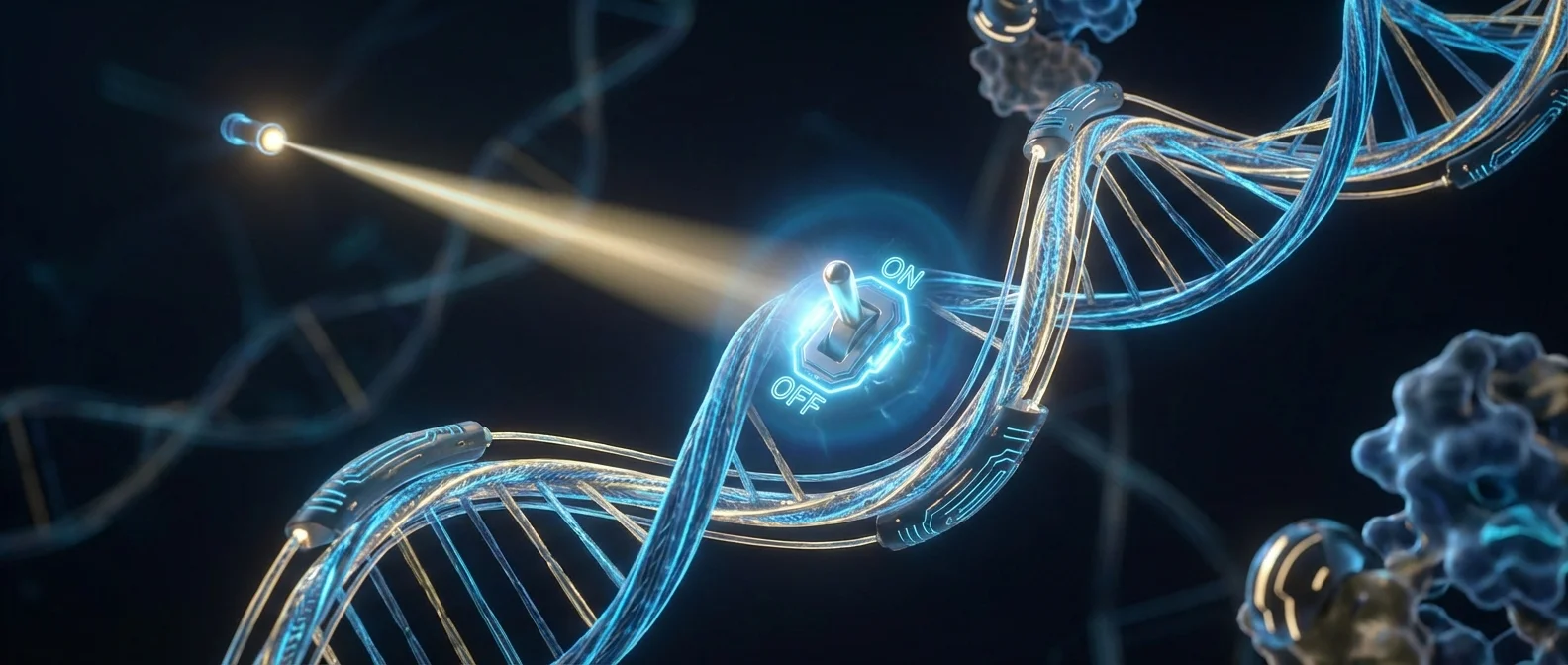
Imagine being able to “turn on” and “turn off” a DNA molecule like flipping a light switch. It sounds like science fiction, but researchers at Tohoku University in Japan have just achieved it — and the applications could change everything, from targeted drug delivery inside cells to creating nanomachines from biological materials.
🔬 From Information Storage to Engineering Tool
DNA — deoxyribonucleic acid — is primarily known as the “code of life,” the molecule that stores and transmits the genetic information of every living organism. For decades, this was the main function scientists attributed to it: a passive archive. But in recent years, a fundamental shift in perspective is transforming how we view DNA.
Rather than treating it merely as a data repository, researchers have begun harnessing its three-dimensional structure as a “scaffold” — a molecular framework on which chemical reagents can be placed at precise positions. DNA's remarkable ability to self-organize through the complementarity of its bases (adenine pairs with thymine, cytosine with guanine) allows scientists to “program” structures with nanometer precision.
This transition — from passive information carrier to active participant in chemical reactions — opens an entirely new field: DNA nanotechnology. And the latest discovery by the Japanese researchers may be the most impressive step yet.
💡 The Switch: Thioguanosine and Light
The team at the Institute of Multidisciplinary Research for Advanced Materials (IMRAM) at Tohoku University, led by Kazumitsu Onizuka, developed a technology that uses an artificial nucleic acid, thioguanosine (TG), to create controlled “bridges” between two DNA strands. The study was published in the journal Communications Chemistry by Nature.
The mechanism works as follows: thioguanosine is placed at specific, non-complementary positions within the DNA double helix. When exposed to light or mild chemical oxidants, the modified bases react with each other and form disulfide bonds — essentially “locking” the two strands together. The reverse reaction, reduction, breaks these bonds and releases the strands.
What makes this system groundbreaking is not just its ability to connect and disconnect. It's that the entire process occurs without any alteration to the natural structure of the double helix. The DNA remains functional, intact, as if nothing happened.
How the Molecular Switch Works
Thioguanosine is placed at strategic positions in the DNA double helix. With light or mild oxidation, disulfide bonds form that “lock” the strands together. With reduction, the bonds break and the strands are released — without damaging the DNA structure. A perfect reversible mechanism.
🧪 Why This Is So Important
"There are many things that make this crosslinked DNA unique, such as its high thermal stability and the fact that the crosslinks can be easily connected and disconnected," explains Kazumitsu Onizuka. "We have great control over how the DNA is linked, which allows us to consistently produce a desired outcome in chemical reactions."
The significance of this discovery extends far beyond the narrow confines of nucleic acid chemistry. In the world of nanotechnology, control over molecular structures at the nanometer scale is the holy grail. Until now, most DNA crosslinking techniques were irreversible — once you joined the strands, you couldn't separate them again without destroying the structure. Alternatively, they were reversible but thermally unstable, rendering them useless for practical applications.
Thioguanosine solves this problem thanks to an unprecedented electron transfer mechanism within the double helix. The team discovered an entirely new photoinduced reactivity in thioguanosine — a reaction that nobody knew was possible before this study.
🏥 Applications: From Nanomachines to Targeted Drugs
The possibilities opened by this technology are impressive, and they extend well beyond the laboratory. The researchers identify three main areas of application:
Targeted drug delivery. Imagine microscopic DNA structures carrying a drug through the body. When they reach the right spot — a cancer cell, an inflamed tissue — they are activated by an external signal (light or chemical stimulus) and release their cargo exactly where it's needed. The reversible nature of the switch means that the release can be controlled with unprecedented precision.
Programmable nanostructures. The DNA origami technique — creating three-dimensional structures from DNA — gains a new dimension. DNA nanomaterials can now change shape on demand, opening and closing like molecular “doors” or “cages.”
Next-generation biosensors. DNA structures that respond to specific chemical stimuli can be used as sensors. The reversible switch means these sensors can be “reset” and reused, instead of being single-use.
🔗 The Role of Disulfide Bonds
The chemistry behind the switch is elegant in its simplicity. Disulfide bonds (S-S) are a type of covalent bond that nature uses extensively — for example, they determine the shape of many proteins. In the Tohoku researchers' system, two thioguanosines are placed close to each other at non-complementary positions within the double-stranded DNA. Their proximity, combined with the structural order of the double helix, favors the formation of a disulfide bond when the appropriate stimulus is applied.
What surprises chemists is that the reaction can be triggered both photochemically (with light irradiation) and chemically (with mild oxidizing agents). The two modes of activation give researchers flexibility depending on the application environment: light for in vitro experiments where access is easy, chemical oxidation for in vivo conditions inside cells.
🧬 A New Era in Nucleic Acid Chemistry
The work of Osman, Onizuka, and their collaborators is not just about an impressive experiment. It establishes clear design principles and reveals new reaction mechanisms that could be applied to many systems beyond this one. The introduction of thioguanosine-based crosslinking, guided by proximity and activated by light, provides a versatile platform for dynamic and reversible DNA modification.
It's worth noting that the idea of controlling DNA with light is not entirely new. As early as 2020, biochemists at the University of Münster in Germany had developed a strategy using so-called “photocaging groups” that can be enzymatically transferred onto DNA. The team, under the guidance of Professor Andrea Rentmeister, used protein engineering — a technique for which the Nobel Prize was awarded in 2018 — to modify enzymes so they could “switch on” and “switch off” DNA functions.
The difference with Tohoku's new approach is that it relies entirely on chemical modifications within the DNA itself, without the need for enzymatic mechanisms. This makes it more controllable, more predictable, and potentially easier to scale up for industrial applications.
🚀 What It Means for the Future
Reversible DNA crosslinking technology is still in its early stages, but the directions it opens are clear. Next-generation bionanomaterials — structures that respond to stimuli inside cells, release drugs on demand, or change shape according to needs — are no longer merely theoretical. The Tohoku team proved it: you can build a DNA that switches on and off like a switch, and remains biologically intact.
Perhaps the most exciting aspect is the possibility of full control. Unlike many biotechnological techniques that work one-way — meaning they activate once and can't be reversed — the DNA switch offers bidirectional control. You can activate it, deactivate it, and reactivate it. This property resembles an electronic circuit more than a biological experiment — and perhaps this very convergence between biology and engineering will define the nanotechnology of the future.
The research, published as "Chemical and photoinduced interstrand crosslinking of oligo DNA duplexes containing 2′-deoxythioguanosines" in Communications Chemistry, serves as the cornerstone for a new category of controlled DNA nanostructures — structures that don't merely await commands, but can execute complex functions with nanometer precision.