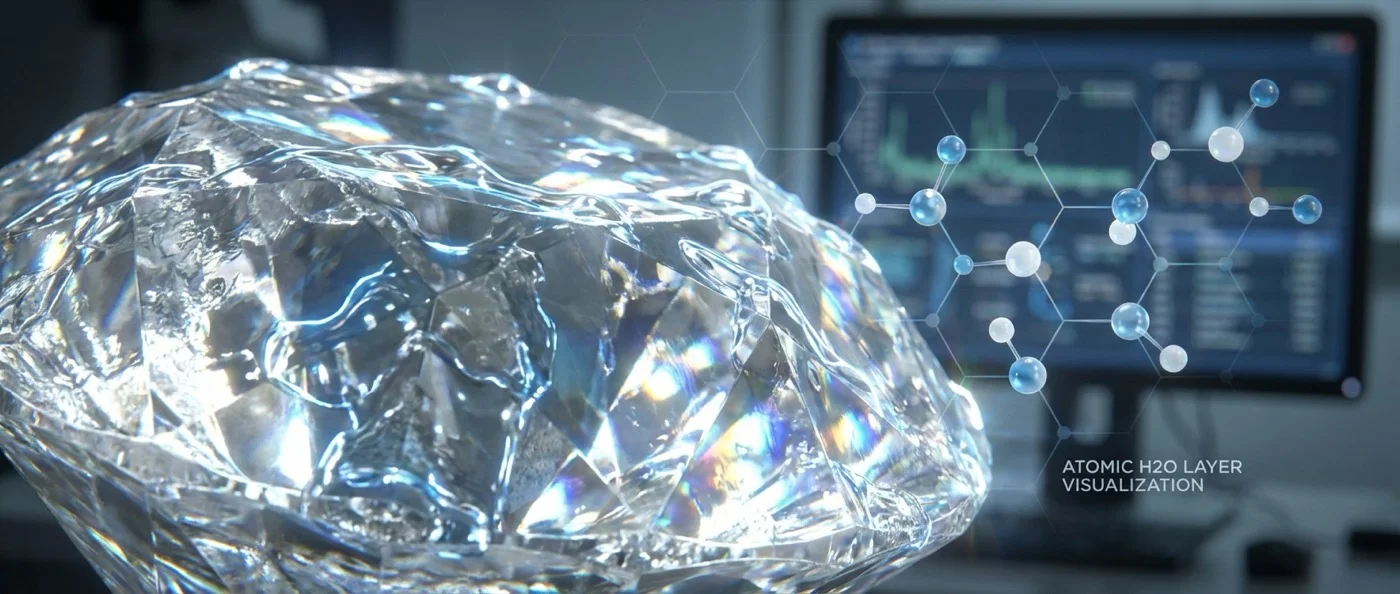
Diamonds have always been the epitome of purity — hard, impenetrable, unchanging. A team of physicists in China just upended this picture: even at room temperature, the surface of every natural diamond is coated in an ultra-thin layer of water, just a few molecules thick, that behaves like ice.
📖 Read more: DNA On-Off Switch: A New Era of Nanotechnology
💎 A Discovery That Changes the Game
The research, published in Physical Review Letters in February 2026, revealed something nobody expected: water molecules don't just stick to the diamond's surface — they form a structured, “frozen” layer at the nanoscale. This happens under normal ambient conditions, without cryogenic temperatures or special handling.
Professor Fazhan Shi's team at the University of Science and Technology of China (USTC) used quantum sensors based on atomic-scale diamond defects to “see” what no microscope could before.
🔬 NV Centers: Quantum “Eyes” Inside Diamond
The discovery was made possible by an elegantly simple technique. “Nitrogen-vacancy centers” (NV centers) are atomic defects in the diamond lattice: spots where two neighboring carbon atoms are replaced by a nitrogen atom and a vacant site. These defects, once considered mere imperfections, turn out to be exceptional quantum sensors.
Their energy levels are hypersensitive to temperature, magnetic fields, and electric fields. This allowed the researchers to detect the subtle magnetic signals emitted by molecules at the surface — something impossible with conventional tools.
"Interfacial water governs critical phenomena, from protein folding in biological systems to surface catalysis. Yet, observing these fragile layers in their native state without disturbance has been a persistent challenge."
— Fazhan Shi, University of Science and Technology of China❄️ How “Ice” Forms at Room Temperature
The key lies in what are called “dangling bonds” — unpaired electrons on the diamond surface that act as microscopic anchors. These bonds attract water molecules and lock them in place, creating a structure resembling ice but persisting at room temperature.
This “frozen” structure isn't static, though. Shi's team discovered something even more intriguing: airborne organic molecules compete with water molecules for the same dangling bonds. When they win, they disrupt the ice-like structure.
⚡ Competitive Dynamics
Two types of molecules “battle” for position on the diamond surface: water molecules, which form a structured ice-like layer, and airborne organic molecules, which destroy that structure when they claim the bonding sites. This competitive process occurs continuously on every diamond.
"Interestingly, we observed a competitive dynamic: airborne organic molecules vie for these anchoring sites. When they occupy the bonds, they disrupt the water's rigid layer structure."
— Fazhan Shi, USTC🧪 The “Dissection” Method
The team developed a new “dissection method” leveraging NV centers: by analyzing magnetic resonance spectra at different isotopic ratios, they managed to separate water signals from those of organic contaminants. For the first time, they could independently measure the quantity, dynamic behavior, and interactions of water molecules under normal conditions.
🚀 Why It Matters: Applications in Nanotechnology
The discovery goes far beyond academic curiosity. Understanding how water behaves at the nanoscale on solid surfaces is critical for multiple fields:
- 2D materials: Graphene and similar materials interact with water at their interfaces — understanding this interaction could improve their properties
- Catalysis: Many chemical reactions start precisely at the solid-liquid interface — an invisible water layer here changes everything
- Quantum devices: NV sensors are used in quantum computing — the “noise” created by this water layer was previously unexplained
- MEMS: Microelectromechanical devices operating at the nanoscale are directly affected by thin moisture layers
"By revealing the mechanism behind this 'ice-like' formation—specifically the role of dangling bonds—we open new avenues for engineering surface properties in nanomaterials and quantum devices."
— Fazhan Shi, USTC🔮 What Comes Next
The results show that NV centers are an even more powerful probe of nanoscale interfacial dynamics than previously realized. Future studies could shed light on phenomena like wetting and electrochemistry, leading to new generations of high-performance catalysts, 2D materials, and quantum sensors.
The study, with Zhijie Li as first author, was published in Physical Review Letters (DOI: 10.1103/bkqn-c3n4).
Sources: