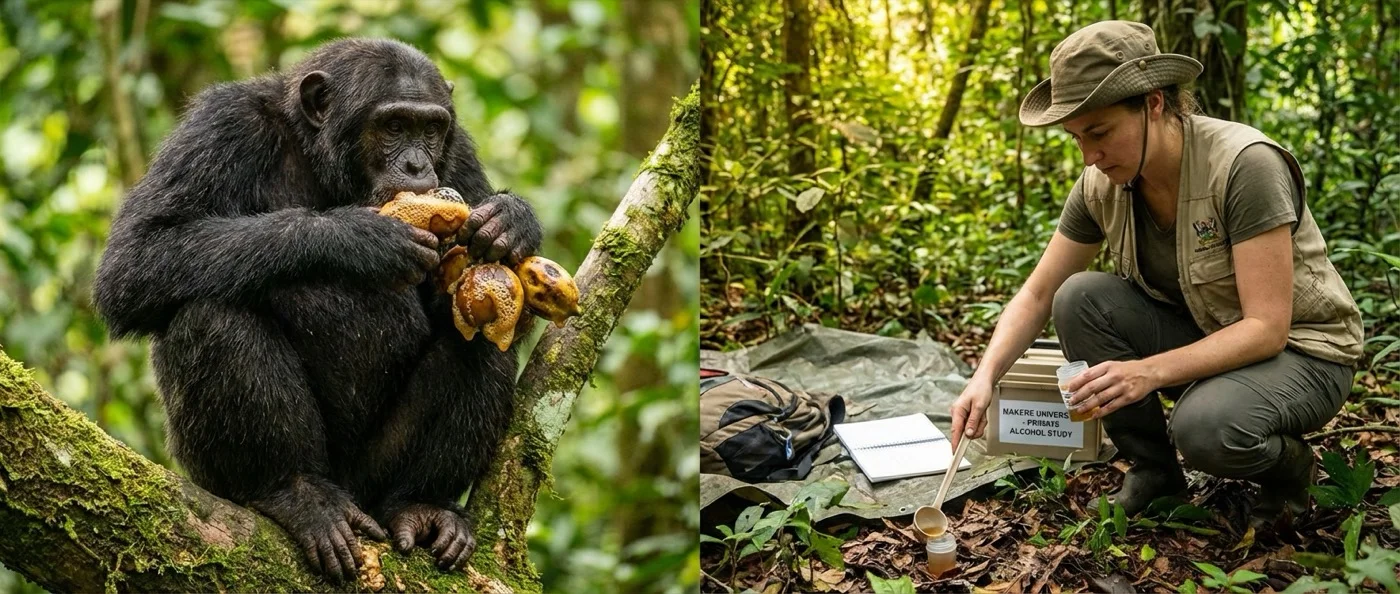
In the tropical forests of Guinea-Bissau, chimpanzees gather around raffia palm trees and drink fermented palm wine with an alcohol content of 3-7% ABV. A series of studies from the University of Exeter demonstrates that this behavior is not accidental — it is systematic, social, and repetitive. And it may reveal the ancient roots of humanity's relationship with alcohol.
📖 Read more: Centenarian Blood Reveals 5 Longevity Proteins
🍷 Palm Wine and Social Drinking
In Guinea-Bissau's Cantanhez National Park, researchers led by Dr. Kimberley Hockings of the University of Exeter set up motion-activated cameras and recorded over 2,400 hours of observations between 2019 and 2025. They monitored 63 chimpanzees in forested areas between Dulombi and Cantanhez, who selectively visited raffia palm trees — the same trees from which local communities produce palm wine.
Male chimpanzees were the most frequent visitors, and dominant individuals visited the trees more often than younger ones. Fermentation samples collected contained alcohol at concentrations ranging from 3% to 7% ABV — comparable to beer or light wine.
🍌 Chimpanzees Share Fermented Fruits
In April 2025, Hockings' team published in Current Biology the first photographic evidence of chimpanzees eating and sharing fermented African breadfruit containing 0.61% ABV. While that percentage seems low, 60-85% of their diet consists of fruit — so small amounts of alcohol across many foods can add up to significant consumption.
A separate study from August 2025, led by biologist Aleksey Maro of UC Berkeley (published in Science Advances), analyzed over 200 fruits from ~20 trees favored by chimpanzees in eastern and western Africa. The data shows that each chimpanzee consumes an average of 14 grams of alcohol per day — equivalent to two US standard drinks.
"Chimps don't share food all the time, so this behavior with fermented fruit might be important. We need to find out more about whether they deliberately seek out ethanolic fruits and how they metabolize it — but this behavior could be the early evolutionary stages of 'feasting.'"
— Dr. Kimberley Hockings, University of Exeter📖 Read more: Elephant Whiskers: Embodied Intelligence of Touch
🧬 The 'Drunken Monkey' Hypothesis
Twenty-five years ago, biologist Robert Dudley (co-author of the Berkeley study) proposed the “drunken monkey hypothesis” — suggesting that human alcohol consumption has ancient evolutionary roots. According to this theory, consuming fermented fruit may have provided a survival advantage: alcohol in a fruit signaled high energy content and ripeness.
The hypothesis was dramatically strengthened by genetic analyses showing that alcohol-breakdown proteins (ADH4 enzymes) already existed in the common ancestor of humans, chimpanzees, gorillas, and bonobos — 10 million years ago. At that time, African forests began to shrink and apes descended from the trees. Fermented fruits on the ground may have given them a nutritional edge.
🔬 Intoxication or Nutrition?
According to Dudley, even though chimpanzees metabolize alcohol like humans, they may consume low concentrations because of the large volume of food they eat (up to 4 kg of fruit per day) — their stomachs fill up before alcohol reaches intoxicating levels. However, some of the 63 observed chimpanzees did show signs of intoxication: swaying, slower movements, and lying on the ground.
📖 Read more: Fiberglass: The New Invisible Pollutant Flooding Our Seas
🧠 What This Means for Human Evolution
The ability to metabolize alcohol is not a human invention — it's an inheritance from a common ancestor 10 million years old. This fundamentally changes the biomedical understanding of early alcohol use. In humans, alcohol consumption triggers the release of dopamine and endorphins — feelings of euphoria and relaxation. Communal drinking, through traditions like feasting, strengthens social bonds.
If chimpanzees do something similar — sharing fermented fruits as a social ritual — then the human tradition of “feasting” may have roots deep in our evolutionary history.
"Alcohol consumption is not learned behavior in these animals — it's part of their natural behavioral repertoire. This discovery fundamentally changes our biomedical understanding of the origins of the human-alcohol relationship."
— Dr. Kimberley Hockings, University of Exeter📌 The Significance of the Discovery
The series of studies — funded by the ERC under EU Horizon (GA 946606) and the Royal Society UK — shifts the conversation. Alcohol consumption didn't begin with agriculture or brewing. It started millions of years ago, in African forests, with fermented fruits falling to the ground. Our closest relatives aren't doing it by accident — they appear to deliberately select the most alcoholic fruits.
This opens new questions about the biology of addiction, the relationship between metabolism and evolution, and the role of alcohol in shaping social structures — both in primates and in humans.