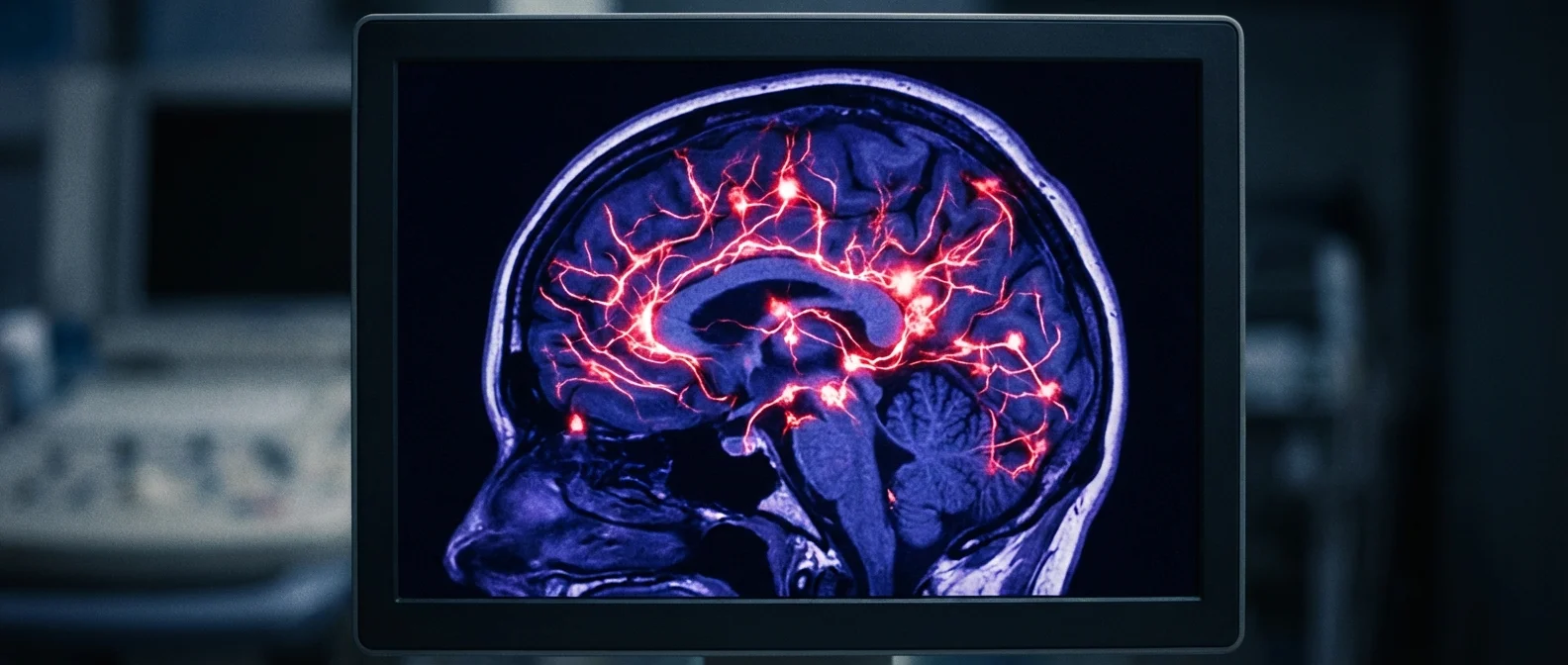
For decades, Parkinson's disease was considered primarily a movement disorder related to the basal ganglia of the brain. A new study published in Nature fundamentally changes this view. Researchers from China's Changping Laboratory and Washington University School of Medicine discovered that the disease stems from the dysfunction of a recently identified brain network — the somato-cognitive action network (SCAN).
🔍 The SCAN Network: A New Look at the Brain
SCAN (somato-cognitive action network) was first described in 2023 in Nature by Nico Dosenbach and colleagues. It is a network within the motor cortex that translates planned actions into physical movement and monitors somatic feedback signals. It is essentially the “bridge” between thought and action.
The new study, with Jianxun Ren as first author and Hesheng Liu and Nico Dosenbach as senior authors, analyzed brain imaging from over 800 participants across multiple research centers in the US and China. The findings were clear: in Parkinson's patients, SCAN exhibited hyperconnectivity with the subcortex — the region that controls emotion, memory, and movement.
Why This Changes Everything
SCAN-subcortex hyperconnectivity doesn't just explain tremor and rigidity. It also explains the non-motor symptoms that plague patients: sleep disturbances, cognitive decline, digestive problems, and loss of motivation. For the first time, a unified model connects the full spectrum of the disease.
🧠 Beyond the Basal Ganglia
"For decades, Parkinson's disease was mainly associated with motor deficits and the basal ganglia," explains Hesheng Liu. "Our work shows that the disease is rooted in a much broader network dysfunction. SCAN is hyperconnected with key Parkinson's-related regions, and this abnormal wiring disrupts not just movement but also cognitive and somatic functions."
This means the traditional approach — treat dopamine, treat Parkinson's — was oversimplified. The disease doesn't just involve one neurotransmitter or one region, but an entire network of interconnected circuits.
💊 Therapeutic Applications
The most striking finding relates to treatment. The team examined four different therapeutic approaches: deep brain stimulation (DBS), transcranial magnetic stimulation (TMS), focused ultrasound, and pharmacotherapy. In every case, treatments worked better when they reduced hyperconnectivity between SCAN and subcortex.
In a clinical trial with 36 patients, targeted TMS over the SCAN network achieved a response rate of 56% (10 out of 18 patients) after two weeks of treatment. The control group, which received stimulation to neighboring but non-SCAN areas, achieved only 22% (4 out of 18). The difference amounts to 2.5 times greater efficacy with SCAN targeting.
🔮 The Future of Treatment
"This work demonstrates that Parkinson's is a SCAN disorder, and the data strongly suggest that if you target SCAN in a personalized, precise way, you can treat Parkinson's more successfully than was previously possible," says Dosenbach. "Altering activity within SCAN could slow or reverse disease progression — not just treat symptoms."
Unlike deep brain stimulation, which requires surgery, targeted TMS is non-invasive — opening the door to earlier treatment, even in initial stages of the disease. Dosenbach is already planning clinical trials through Turing Medical, a startup he co-founded, testing non-invasive electrode strips over SCAN regions.
With over 10 million people worldwide living with Parkinson's — 1 million in the US alone — this discovery is not just about basic science. If anything will truly change how we combat this disease, it's the understanding that we're not fighting a single “region” but an entire network.