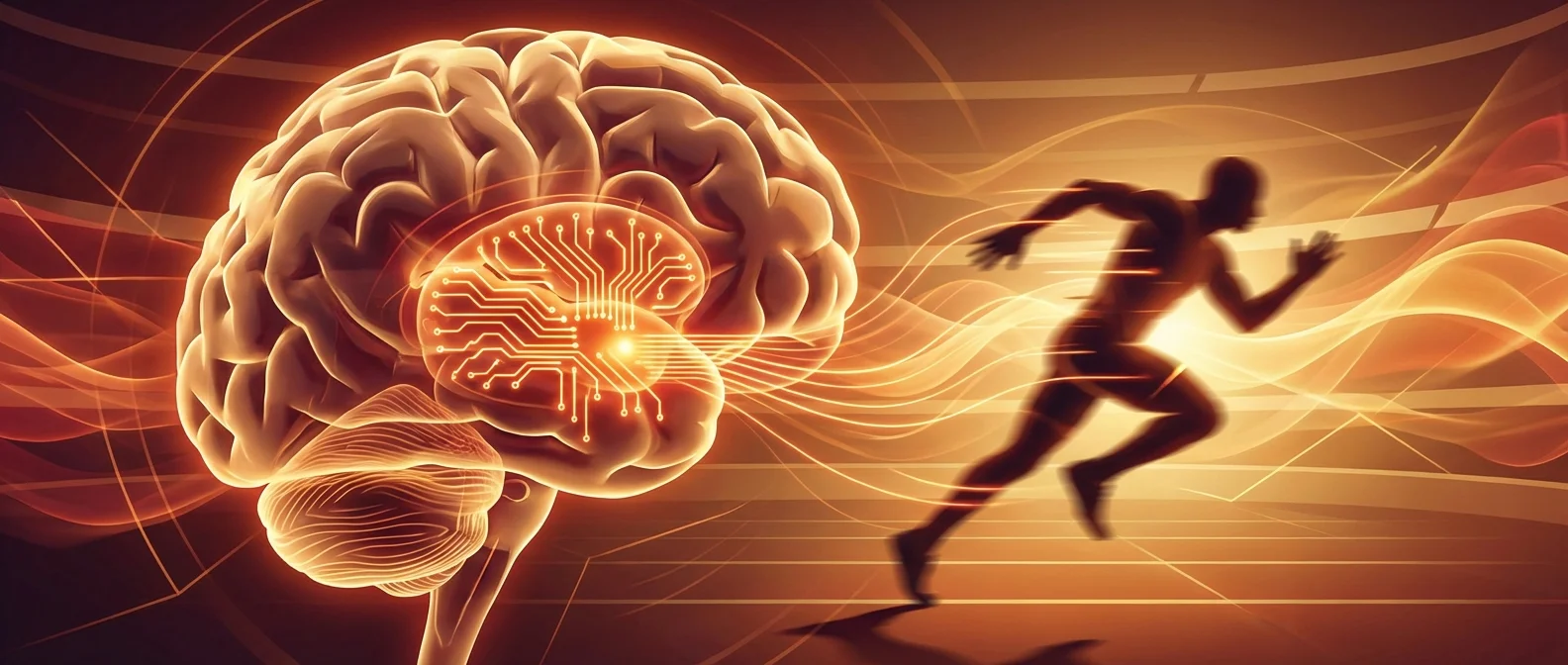
Why do some athletes keep going when their muscles scream “stop”? Neuroscientists at Southeast University in China found the answer: a specific brain circuit that directly connects thought to muscle, controlling how much we can endure during exercise. The study was published in Nature.
📖 Read more: Keto Diet Restores Exercise Benefits in Type 2 Diabetes
🧠 The ACC → DMH → Muscle Circuit
Zheng-Dong Zhao's team mapped a neural pathway that starts from the anterior cingulate cortex (ACC) — a region linked to motivation and decision-making — passes through the dorsomedial hypothalamus (DMH), and ends at skeletal muscles via the sympathetic nervous system.
In other words, there is a direct line from “willpower” to “physical ability.” The ACC sends glutamatergic signals to the DMH, which regulates blood flow, muscle tone, and the metabolic readiness of muscles during exercise.
📖 Read more: The Brain Works Like AI More Than We Thought
🔬 The Experiments
The team used two advanced techniques in mice. With optogenetics (activating specific neurons with light), the mice ran 30% longer on treadmills and running wheels before exhaustion. With chemogenetics (DREADDs — designer receptors that silence neurons), endurance collapsed — a 50% decrease, regardless of the animals' muscle condition.
This is critical: the mice's muscles were in excellent condition. The decline was not due to physical weakness, but to the absence of the brain signal to “keep going.”
💡 The Role of Dopamine
The circuit is regulated by dopamine from the ventral tegmental area (VTA). Dopamine enhances the activity of ACC neurons, increasing the motivation to exercise. When the researchers blocked dopamine receptors in the ACC, endurance decreased significantly. When they boosted it, endurance increased.
This explains something athletes know from experience: “mental strength” is not abstract. It is biochemical — measurable, specific, and potentially modifiable.
Health Applications
The discovery opens doors for patients with Chronic Fatigue Syndrome (CFS/ME) and fatigue linked to depression. If ACC-DMH dysfunction causes pathological fatigue, then therapies targeting this circuit — pharmaceutical or neurostimulation — could restore physical endurance. This also explains why exercise is so difficult during depression, where the ACC-dopamine system is known to be disrupted.
This research changes the way we view athletics. The phrase “it's all in your head” is no longer a metaphor. It's literal — a circuit in your head decides when your legs will stop.