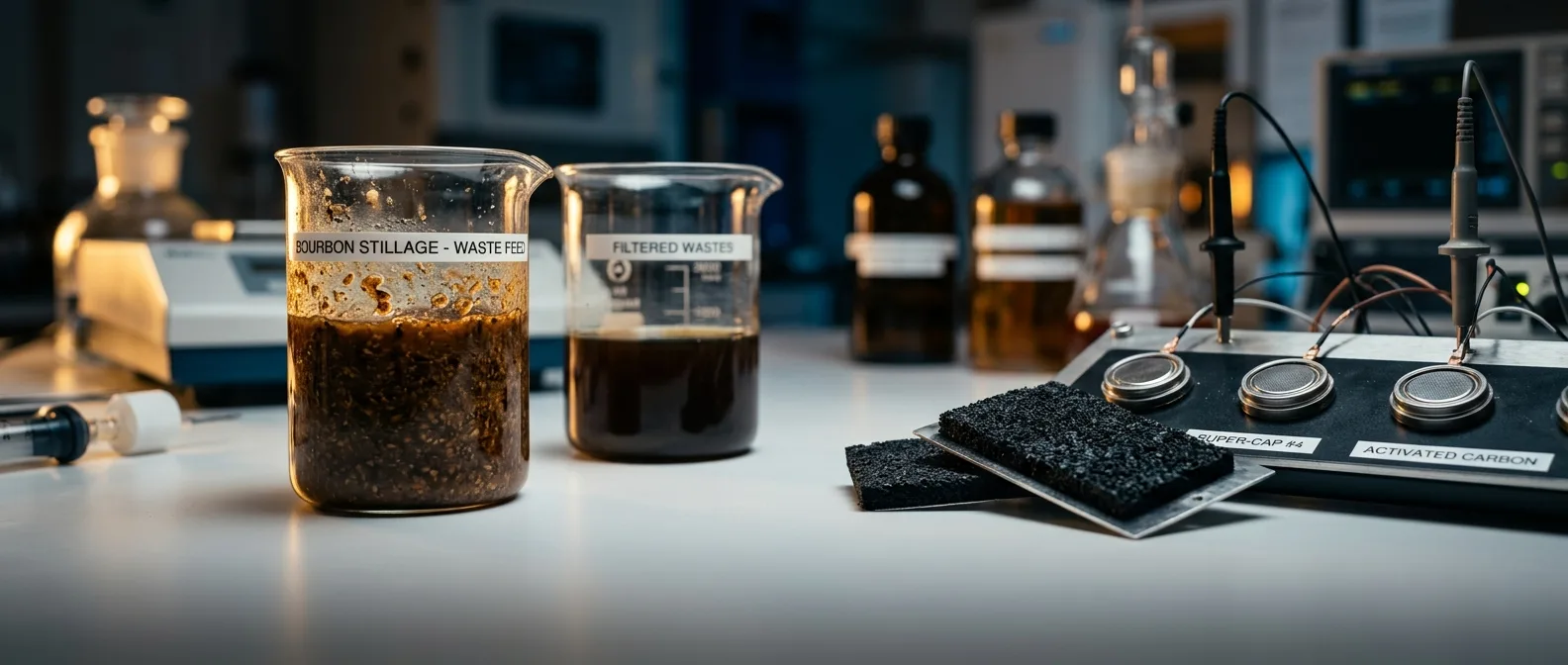
Six barrels of mash waste for every barrel of bourbon. That's the math that stunned University of Kentucky chemist Josiel Barrios Cossio when he learned about stillage — the soggy, grain-heavy leftovers from whiskey production. Now his team has cracked the code on turning this industrial headache into supercapacitor electrodes that pack 25 times more energy than conventional designs.
Kentucky churns out 95% of the world's bourbon, but the golden nectar comes with a massive waste problem. Stillage is heavy, wet, and expensive to transport or dry. Most distilleries turn it into animal feed, but that barely scratches the surface of what's available. The University of Kentucky team saw opportunity where others saw burden.
📖 Read more: Spider Silk Gives Superpowers to Aircraft
🔬 From Barrel to Battery
The breakthrough uses hydrothermal carbonization — pressure-cooking the stillage waste under extreme conditions. Barrios Cossio's team loads wet stillage into a 10-liter reactor, cranks up the heat and pressure, and extracts a fine black powder that becomes the foundation for two distinct carbon materials.
Heat that powder to 200°C and you get hard carbon — a disordered structure perfect for trapping lithium ions. Add potassium hydroxide and blast it to 800°C, and you create activated carbon with massive internal surface area. Both materials work as supercapacitor electrodes, but with completely different strengths.
Performance peaks when you combine them. The Kentucky team built hybrid lithium-ion supercapacitors using one electrode of each type — hard carbon for battery-like energy storage, activated carbon for capacitor-like rapid charging. The result smashes conventional supercapacitor performance.
The Chemistry Behind the Transformation
Stillage isn't just random agricultural waste. It's a specific blend of corn, rye, and barley that creates a unique "grain profile" never before explored for electrode production. This combination delivers carbon materials with properties that single-grain sources can't match.
The hydrothermal process breaks down cellulose and lignin in the grain mixture, creating carbon structures with precisely the right porosity and surface chemistry for energy storage. Temperature and pressure control everything — too low and you don't get enough carbonization, too high and you destroy the beneficial microstructure.
Technical Specifications
- Hydrothermal carbonization temperature: 180-200°C
- Pressure: Autogenous (from water vapor)
- Final activation temperature: 800°C
- Activating agent: Potassium hydroxide (KOH)
⚡ Supercapacitors That Shatter Limits
The measurements show clear results. Standard double-layer supercapacitors made with the activated carbon electrodes delivered 48 Wh/kg — competitive with commercial units. But the hybrid lithium-ion supercapacitors hit energy densities 25 times higher than conventional supercapacitors while maintaining rapid charge times.
This bridges a critical gap in energy storage. Batteries store lots of energy but charge slowly. Capacitors charge instantly but hold less energy. Hybrid supercapacitors promise the best of both worlds — and the Kentucky team's stillage-derived materials deliver on that promise.
The breakthrough matters because grid-scale energy storage needs devices that can respond in milliseconds to stabilize power fluctuations from renewable sources. When a cloud blocks a solar farm, you need instant power injection to maintain grid stability. Traditional batteries are too slow; conventional supercapacitors lack the energy capacity.
Performance Metrics That Matter
The team tested their devices through hundreds of charge-discharge cycles without significant performance degradation. Supercapacitors typically handle hundreds of thousands of cycles — a massive advantage over lithium-ion batteries that fade after a few thousand cycles.
Power density measurements showed the hybrid devices could deliver energy bursts comparable to conventional supercapacitors while storing dramatically more total energy. This combination opens applications from electric vehicle regenerative braking to grid frequency regulation.
📖 Read more: Alzheimer's Starts 20 Years Early With Declining Blood Flow
📊 Building Industry Partnerships
Getting stillage samples required more than academic credentials. The research team had to build trust with distilleries across Kentucky, Illinois, and Canada. "We had to convince them to let us into their facilities to get samples and 'do something fun with it,'" Barrios Cossio explains.
This approach connects academic research directly with local industry problems. Professor Marcelo Guzman, who leads the team, emphasizes the connection: "This project allowed us to connect a real problem with industries at the state level — and that was amazing."
The collaboration model could become a template for other agricultural waste-to-energy projects. Every region has agricultural byproducts that could potentially become energy storage materials through similar processing techniques.
Scaling Beyond Kentucky
While Kentucky dominates bourbon production, similar grain-based alcoholic beverages worldwide generate comparable waste streams. Beer brewing, wine production, and other distilled spirits create organic waste that could potentially follow the same transformation pathway.
The team collaborates with Andrea Balducci's group at Friedrich Schiller University in Germany, bringing international expertise to the project. This cross-border partnership signals global interest in the technology and potential for worldwide application.
⚡ Technical Challenges and Opportunities
Hydrothermal carbonization isn't new — researchers have used it with corn fiber and other agricultural wastes. But stillage presents unique characteristics due to its grain mixture composition. The combination of corn, rye, and barley creates carbon materials with properties that single-source feedstocks can't achieve.
The process requires careful optimization. Temperature, pressure, and timing must be precisely controlled to achieve the right carbon structure. Too little processing leaves unreacted organic matter; too much destroys the beneficial microporosity needed for high-performance electrodes.
Quality control becomes critical for commercial viability. Stillage composition varies between distilleries and even between batches from the same facility. The team must develop processing protocols that consistently produce high-quality electrode materials despite feedstock variations.
Environmental Impact
Reduces bourbon waste streams by 600-1000% through value-added conversion
Energy Performance
25x better performance than conventional supercapacitors
Industrial Application
Direct utilization of existing industrial waste streams
Competing with Lithium-Ion Technology
The stillage-derived supercapacitors don't directly compete with lithium-ion batteries in all applications. Their advantage lies in charging speed and cycle life — they can charge and discharge hundreds of thousands of times without significant performance loss.
This makes them ideal for applications requiring rapid response — grid stabilization when renewable energy output fluctuates, regenerative braking in electric vehicles, or power smoothing in industrial equipment. They complement rather than replace battery technology.
🎯 Economic Prospects
The economics look promising on paper. Distilleries spend significant money managing stillage — either drying it for animal feed or transporting it wet to disposal sites. Converting waste into valuable materials creates dual benefits: reduced waste management costs and new revenue streams.
But questions remain about processing costs. Hydrothermal carbonization requires specialized equipment and energy input. The team's next phase includes detailed economic analysis to prove commercial viability beyond laboratory demonstrations.
Market timing favors the technology. The global supercapacitor market is projected to reach $7 billion by 2030, driven by energy storage and electric vehicle applications. Simultaneously, waste management regulations are tightening, creating incentives for innovative recycling solutions.
The 2026 Supercapacitor Market
Energy storage needs are exploding as renewable energy deployment accelerates. Grid operators need fast-responding storage to balance supply and demand fluctuations. Electric vehicles need rapid charging capabilities. Industrial equipment needs power smoothing for motor drives and automation systems.
If stillage-derived supercapacitors prove commercially viable, they could fuel an entirely new industry connecting Kentucky's distilling tradition with modern energy transition needs. The technology demonstrates how solutions to major technological challenges might hide in unexpected places.
Who would have imagined that part of the energy puzzle's answer could be found at the bottom of a bourbon barrel?
"For every final volume of bourbon that's produced, you get 6 to 10 times that amount of stillage as waste. So it's a big deal."
— Josiel Barrios Cossio, University of Kentucky
Next Steps and Commercialization
The researchers presented their findings at the ACS Spring 2026 meeting in Atlanta this March — a major platform that signals the technology's maturity. But moving from laboratory demonstrations to commercial production requires significant additional work.
Life cycle analysis and economic sustainability studies top the priority list. The team must prove that converting distillery waste into energy storage devices is economically viable and environmentally beneficial at industrial scale.
The long-term vision is ambitious: developing larger-scale supercapacitors that could help stabilize electrical grids as more renewable energy sources come online. If successful, bourbon waste could become a key component in the clean energy transition.
The research connects traditional American industry with cutting-edge energy technology. Kentucky's bourbon heritage, built over centuries, might help power the grid of the future. That's a story worth raising a glass to.