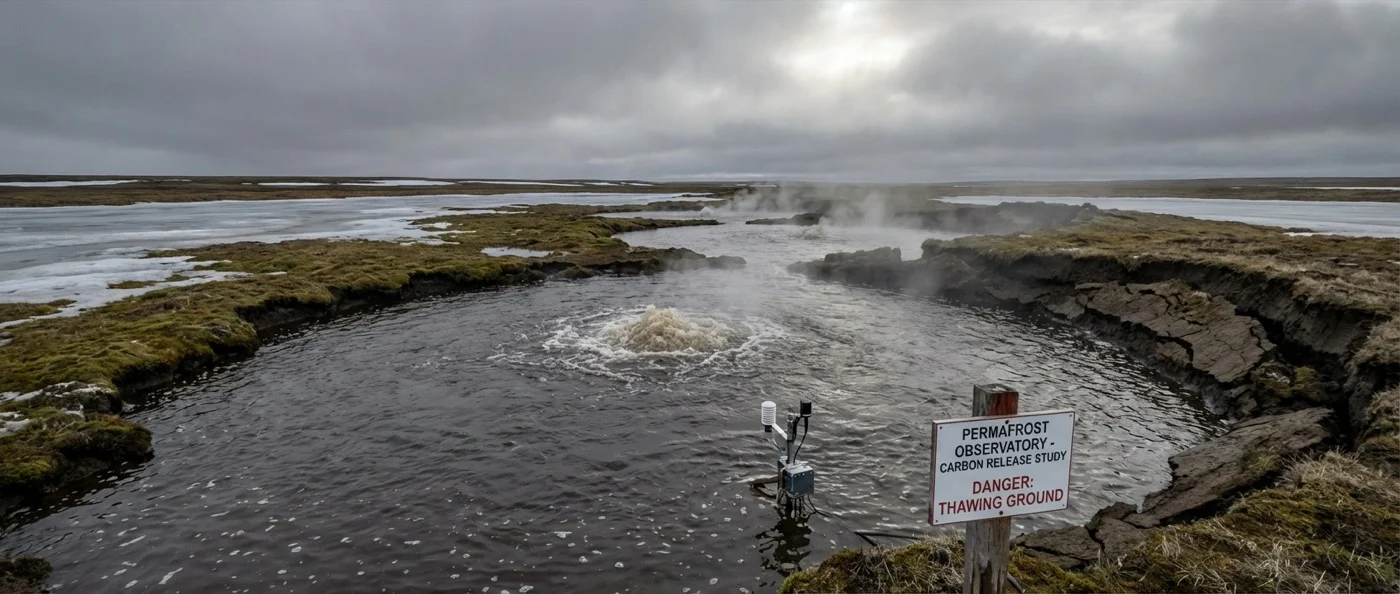
Scientists at ETH Zurich have discovered something deeply alarming about the Congo Basin's blackwater lakes: they are releasing ancient carbon into the atmosphere — carbon that was locked away in peat for thousands of years and was never supposed to be part of the modern carbon cycle.
📖 Read more: Methane Surged After 2020: The Cause Is Surprising
The Congo Basin's Hidden Carbon Vault
The Congo Basin is one of the world's last great carbon sinks. Its vast peatlands — a type of wetland where partially decomposed plant material accumulates over millennia — store an estimated 100 gigatonnes of carbon. This represents roughly one-third of all tropical peatland carbon on Earth, despite covering just 0.3% of the planet's land surface.
For decades, scientists assumed this ancient carbon was safely locked away: too deep, too waterlogged, and too isolated to be released. The new study, published in Nature Geoscience (DOI: 10.1038/s41561-026-01924-3), shatters that assumption.
What the Researchers Found
Led by Travis Drake at ETH Zurich as part of the TropSEDs project, with senior Professor Johan Six and collaborators including Professor Jordon Hemingway and Matti Barthel, the team studied two of Central Africa's largest lakes: Lac Mai Ndombe (Africa's largest blackwater lake — four times the size of Lake Constance) and Lac Tumba.
Using radiocarbon dating — measuring the ratio of carbon-14 to carbon-12 in the CO₂ emitted by the lakes — the team was able to determine, for the first time, the age of the carbon being released. The result was startling: up to 40% of the CO₂ emitted by these lakes comes from peat that is thousands of years old. This is ancient carbon — not freshly decomposed plant material from last year's leaf fall.
"This ancient peat carbon is now entering the atmosphere — that's a shift we didn't expect to be happening at this scale right now."
— Travis Drake, Lead Author, ETH ZurichThe Mystery: How Does Ancient Peat Reach the Lakes?
"Blackwater lakes" get their name from the dark tannins dissolved in the water — a signature of organic-rich environments. The lakes are fed by rivers draining heavily peated catchments. But the precise mechanism by which ancient, deep peat carbon moves from the peatland into the lake and then into the atmosphere is still not fully understood.
The researchers know that carbon is moving — the radiocarbon evidence is unambiguous — but the pathway (groundwater flow, seasonal flooding, microbial mobilization, or other mechanisms) remains an active area of investigation. Understanding this mechanism is critical for building accurate climate models of the region.
📖 Read more: Oceans Rising Faster Than Ever: Laser Satellite Proves It
A Second Study: Water Levels and Methane
A parallel study, published in the Journal of Geophysical Research, adds another dimension to the picture: water levels dramatically control how much methane the lakes emit. When water levels are high, methane produced in deep sediments is consumed by methane-oxidizing microbes before it reaches the surface, limiting atmospheric release. When water levels drop, methane can escape more easily.
This finding matters enormously for climate projections: as the Congo Basin faces increasing drought stress from climate change, falling water levels could switch these lakes from moderate methane emitters to much more potent ones.
Climate Change as an Accelerant
The researchers emphasize that what they are observing is likely to get worse. As global temperatures rise, the Congo Basin is experiencing more intense dry seasons. Drier peat means:
- Oxygen penetration deeper into peat layers
- Faster aerobic decomposition of ancient organic matter
- More carbon mobilized into rivers and lakes
- More CO₂ eventually reaching the atmosphere
In other words, climate change could be unlocking a carbon vault that was sealed for thousands of years — creating a compounding feedback loop.
Human Pressures: Deforestation and Population Growth
The threat is not only climatic. The Democratic Republic of Congo's population is projected to nearly triple by 2050, putting enormous pressure on land and forests. Deforestation and drainage of peatland for agriculture could dramatically accelerate the release of this ancient carbon — turning one of Earth's greatest carbon stores into a major emissions source.
The collaboration, funded by the Swiss National Science Foundation and involving researchers from the University of Louvain (Belgium) and local DRC scientists, is one of the first to quantify the ancient carbon signal in this region — a baseline that will be essential for tracking change over time.
Summary
- Congo Basin peatlands store ~100 gigatonnes of carbon (33% of all tropical peatland carbon)
- Blackwater lakes (Lac Mai Ndombe + Lac Tumba) are emitting CO₂ from carbon thousands of years old
- Up to 40% of emitted CO₂ is ancient peat carbon — confirmed via radiocarbon dating
- Mechanism unknown — how ancient peat carbon reaches the lakes is still under investigation
- Second study: declining water levels → more methane emission (less microbial oxidation)
- Climate change risk: drying peat → faster decomposition → more ancient carbon released
- DRC population triple by 2050: deforestation = additional threat
- Published in Nature Geoscience, Feb 24, 2026 — ETH Zurich TropSEDs project