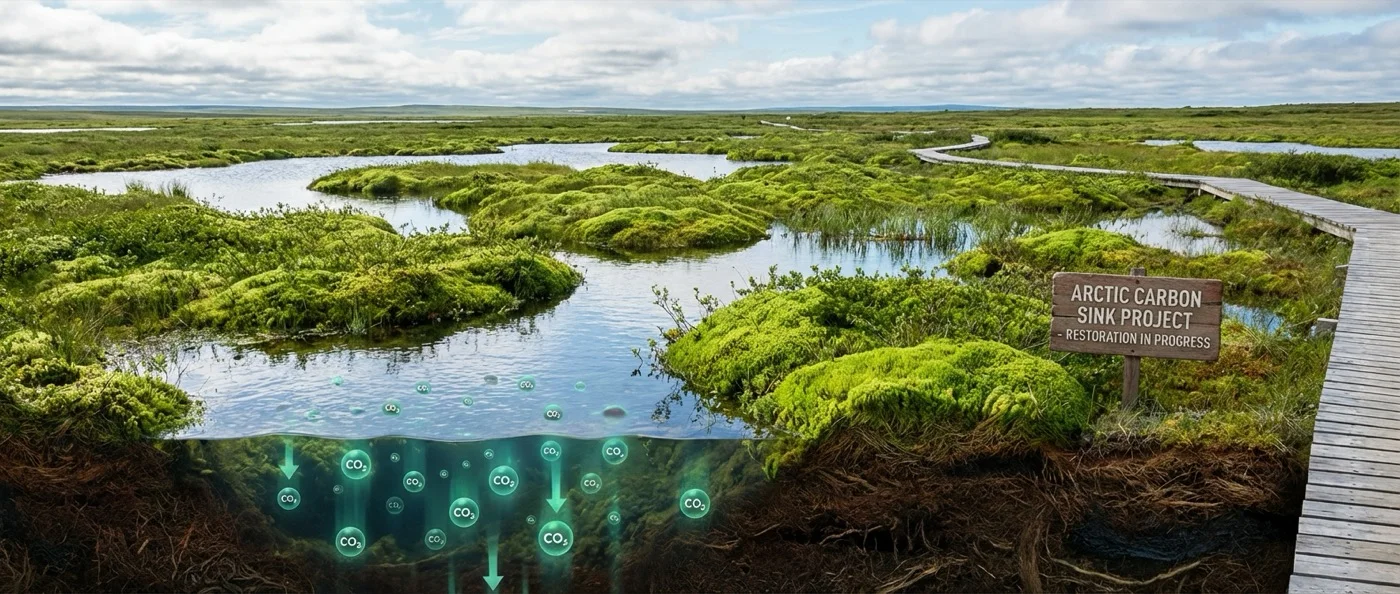
Beneath the damp fields of Arctic Norway, a vast reservoir of carbon sits quietly locked in ancient peat. For thousands of years, the waterlogged, low-oxygen conditions of natural peatlands prevented dead plant material from fully decomposing — layer after layer built up, turning the soil into one of Earth's densest carbon stores per unit area.
But across Europe and the Nordic region, large areas of peatland have been drained for agriculture since the 1600s. When you drain a peatland, you let oxygen rush into the soil. Microbial activity accelerates. The preserved organic matter starts breaking down, and the carbon accumulated over centuries is released as carbon dioxide. A carbon vault becomes a carbon vent.
Now, a two-year field study led by Junbin Zhao at the Norwegian Institute of Bioeconomy Research (NIBIO) demonstrates that this process can be substantially reversed — by simply raising the groundwater level. The results, published in Global Change Biology (DOI: 10.1111/gcb.70599), show that under higher water levels, Arctic farmland can flip from a net CO₂ source to a net CO₂ sink.
📖 Read more: Methane Surged After 2020: The Cause Is Surprising
The World's Most Understudied Peatlands
Scientists have spent decades studying how water table management affects greenhouse gas emissions in peatlands across Central and Western Europe. But the northernmost agricultural peatlands — those in Scandinavia's Arctic and sub-Arctic zones — have received far less attention. These areas have distinctively cold temperatures, very short growing seasons, and, crucially, extremely long daylight hours during summer.
"From studies in warmer regions, we know that raising the groundwater level in drained and cultivated peatlands often reduces CO₂ emissions, because the peat decomposes more slowly," Zhao explains. "At the same time, wetter and low-oxygen conditions can increase methane, since the microbes that produce methane thrive when there is almost no oxygen in the soil."
Methane and nitrous oxide are both much more potent greenhouse gases than CO₂. This means the overall greenhouse gas balance of a rewetted peatland is complex: reducing CO₂issions may not improve the climate picture if it simultaneously increases methane production. The only way to know is to measure all three gases simultaneously, continuously, throughout the whole season.
Two Years in the Pasvik Valley
Zhao and co-authors Cornelya F.C. Klütsch, Hanna Silvennoinen, Carla Stadler, David Kniha, Runar Kjær, Svein Wara, and Mikhail Mastepanov set up a detailed field experiment at NIBIO's Svanhovd research station in the Pasvik Valley of Northern Norway during 2022 and 2023. Automated measurement chambers recorded CO₂, methane, and nitrous oxide multiple times per day throughout each growing season.
The experiment included five plots representing a range of typical management conditions found in a drained agricultural field: different groundwater levels, different amounts of fertilizer, and different numbers of harvests per season. The team focused on three core questions: Can rewetting make an Arctic peatland climate-neutral? Does water level affect soil CO₂ emissions more than plant uptake? And how do fertilization and harvesting affect the total balance?
The Results: More Water, Less Carbon in the Air
When the Pasvik peatland was heavily drained, it released large amounts of CO₂, comparable to cultivated peatlands much farther south. But when the groundwater table was raised to between 25 and 50 centimeters below the surface, emissions dropped sharply.
"At these higher water levels, methane and nitrous oxide emissions were also low, giving a much better overall gas balance. Under such conditions, the field even absorbed slightly more CO₂ than it released," Zhao reports.
The continuous, round-the-clock measurement was critical. It captured brief but intense emission spikes and natural daily fluctuations that are typically missed by conventional periodic sampling. Without this resolution, previous studies may have systematically underestimated either peak emission events or periods of net carbon uptake.
📖 Read more: Oceans Rising Faster Than Ever: Laser Satellite Proves It
Why Arctic Light Amplifies the Effect
Raising the water table makes soil wetter and reduces oxygen around plant roots. Plants become somewhat less active and absorb less CO₂ as a result. Yet even so, overall CO₂ emissions decline — because wetter soil conditions lower the light threshold at which the ecosystem shifts from net emitter to net absorber.
"When this threshold is reached earlier in the day, you get more hours with net carbon uptake," Zhao explains. In the Arctic, where summer nights are bright or almost completely lit, this effect is dramatically amplified. Many extra hours of net carbon absorption per day are possible — a benefit that simply doesn't exist at lower latitudes where nights are dark.
Temperature is the counterweight. Once soil temperatures exceed about 12°C, microbial activity intensifies and both CO₂ and methane emissions spike. "The beneficial effect of high water levels is greatest in cool climates — and future warming could gradually reduce this benefit," Zhao cautions. In practice, water level management must be calibrated alongside local temperature trends.
Fertilization, Harvesting, and Long-Term Carbon Storage
More fertilizer produced more grass biomass, but caused no measurable change in CO₂ or methane emissions in the experiment. Harvesting, however, had a clear impact: cutting grass and removing it from the field takes carbon directly out of the system.
"If harvesting is very frequent, more carbon can be taken out than is built up again over time. The peat layer may gradually lose carbon even when water levels are kept high," Zhao warns. The implication is that short-term climate benefits from rewetting can be offset by management choices that gradually draw down the soil's carbon stock, potentially also degrading soil quality long-term.
One emerging solution is paludiculture — cultivating wetland-adapted plant species that can produce biomass without requiring the field to be kept dry. Such plants tolerate high water tables naturally, allowing both agricultural production and carbon sequestration to coexist.
Local Variation Matters for Climate Accounting
A noteworthy finding was significant spatial heterogeneity within a single field: some plots absorbed CO₂ while neighboring sections released substantial amounts. This variation has serious implications for how national greenhouse gas inventories are calculated. A single “emission factor” for cultivated peatlands will miss this complexity and potentially distort both policy targets and carbon accounting.
"The results from our study show a clear need for more detailed measurements and more precise water-level management in practice, especially where soils and farming conditions vary significantly between locations," Zhao concludes.
A Climate Tool That Already Exists
The most compelling message from this research is perhaps its simplicity: no new technology is required to convert Arctic farmland from carbon source to carbon sink. The lever is the water table — raising it by a few dozen centimeters is enough. The challenge is institutional and economic: agricultural drainage is deeply embedded in current farming systems, and rewetting reduces yields.
But in an era when every viable climate mitigation tool matters, the ability to flip vast areas of northern peatland into carbon sinks with a relatively minor hydrological adjustment deserves serious attention from both policymakers and farmers. The Arctic is warming at more than twice the global average rate. How its soils respond — and how we manage them — will help determine whether northern land becomes part of the climate solution or part of the problem.