📖 Read more: Nanolaser on Chip Cuts Computer Energy 50%
🔊 From Light to Sound: A New Era in 3D Printing
Three-dimensional printing — or additive manufacturing, as engineers call it — has been one of the most dynamic fields in technology for years. From plastic prototypes to titanium aircraft components, the capabilities of printing in three dimensions seem almost limitless. However, most 3D printing techniques rely on two basic mechanisms: light (photopolymerization) or heat (thermoplastic extrusion).
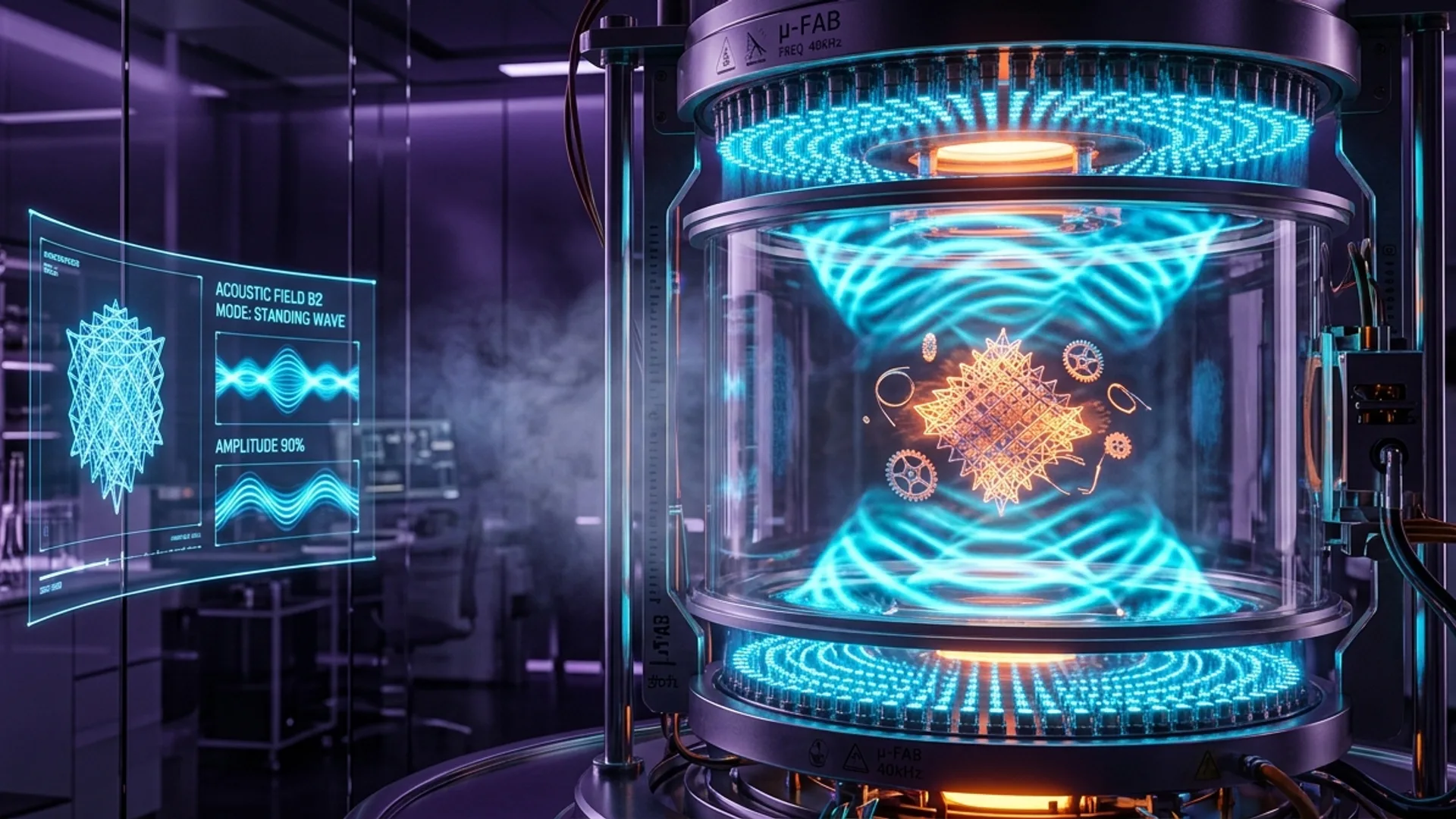
Now, a team of researchers has added a third tool to the arsenal: sound. The technique is called Direct Sound Printing (DSP) and uses focused ultrasonic waves to convert liquid resin into solid objects with micrometer precision, without any physical contact.
🧪 How Sound Printing Works
DSP technology was developed at Concordia University in Canada by Professor Muthukumaran Packirisamy and his team. It works based on a phenomenon known as sonochemical reaction. When focused ultrasonic waves are directed into a liquid polymer, they create microscopic bubbles — a phenomenon known as cavitation. Inside these bubbles, for trillionths of a second (picoseconds), temperatures skyrocket to 15,000 Kelvin and pressure exceeds 1,000 bar — a thousand times the atmospheric pressure at Earth's surface.
These extreme conditions cause localized polymerization: the liquid material becomes solid exactly at the point where the sound is focused. A transducer directs the ultrasonic waves through the material's shell, solidifying the resin pixel by pixel according to a predetermined path. The reaction is so brief that the surrounding material is not affected at all.
"Ultrasonic frequencies are already used in destructive processes, such as tissue and tumor removal. We wanted to use them to create something."
— Muthukumaran Packirisamy, Concordia University
📖 Read more: Nanopigment Sensor: Changes Color Based on pH in Seconds
🏗️ From DSP to Holographic Sound Printing
The original DSP technique, published in Nature Communications in 2022, built objects pixel by pixel — a relatively slow process. In 2024, the same team took a massive step forward: they developed Holographic Direct Sound Printing (HDSP). The new method incorporates acoustic holograms — plates designed to encode specific sound fields — to create entire sections of objects simultaneously, rather than point by point.
This means faster printing — up to 20 times faster according to the researchers — with lower energy consumption. Acoustic holograms can even store information for multiple images simultaneously, allowing the printing of multiple objects at different points within the same print space.
Meanwhile, at the Max Planck Institute for Medical Research and the University of Heidelberg, a separate team achieved something even more impressive: assembling microparticles into three-dimensional shapes “in a single shot.” Researcher Kai Melde and his colleagues used multiple acoustic holograms to create pressure fields capable of trapping particles, gel beads, and even living biological cells in three-dimensional structures — within seconds.
🏥 Why Sound Changes Everything in Biomedicine
The real revolution of acoustic printing lies in biomedical applications. Unlike lasers and heat, ultrasonic waves are gentle on biological cells — they don't destroy them during the process. This makes them ideal for bioprinting, meaning the fabrication of living biological structures.
The capabilities are impressive: creating complex tissues, localized delivery of drugs and cells to specific points, advanced tissue engineering, and even new forms of skin grafts that can accelerate healing. Cells can be placed in precise three-dimensional positions without mechanical stress — something that traditional 3D printing nozzles cannot guarantee.
⚡ Impressive Numbers
- 15,000 K — temperature inside cavitation microbubbles
- 1,000 bar — pressure, a thousand times atmospheric
- 20x — faster holographic technique compared to traditional methods
- Picoseconds — duration of each reaction (trillionths of a second)
📖 Read more: Alzheimer's Starts 20 Years Early With Declining Blood Flow
✈️ Beyond Biomedicine: Aerospace and Industry
One of the most impressive features of acoustic printing is that sound waves can penetrate opaque surfaces — something impossible for lasers. This means printing can be done behind walls, inside pipes, or even inside the human body, without requiring surgical access.
In aerospace engineering, this opens dramatic possibilities: repairing components deep inside an aircraft fuselage, which today requires disassembly, could be done on-site with sound waves. In the microfluidics industry, where biosensors and medical devices are manufactured, the technique promises to replace expensive lithographic methods and the cleanrooms currently required.
Packirisamy's team has already demonstrated that it can print multiple materials — polymers and ceramics. Their goal is polymer-metal composite materials and, ultimately, printing metals using sound alone. The PDMS polymer (polydimethylsiloxane), used in the first experiments, is already widely used in the biomedical industry.
🔬 The Max Planck Team: Cells in 3D in One Step
While the Concordia team focuses on industrial printing, the researchers at Max Planck took a different direction: they used acoustic holograms — 3D-printed plates designed to encode a specific sound field — to “catch” particles and cells floating freely in water, assembling them into three-dimensional shapes.
"The critical idea was to use multiple acoustic holograms together, creating a combined field capable of trapping the particles," explains Kai Melde. The method works with a variety of materials — glass particles, hydrogel beads, and even living biological cells. The advantage of ultrasound is that it can travel deep into tissues, manipulating cells without damaging them — ideal for future tissue engineering applications.
🌍 The Future of Contactless Manufacturing
Acoustic 3D printing is still in its early stages, but researchers believe it could become a landmark technology. Packirisamy compares it to the transition from stereolithography (where a laser hardens one point of resin at a time) to digital light processing (DLP), which hardens entire layers simultaneously — a leap that dramatically accelerated 3D printing. HDSP promises a similar or even greater leap.
"You can imagine the possibilities," he says. "We can print behind opaque objects, behind a wall, inside a pipe, or inside the body. The techniques and devices we use have already been approved for medical applications." With three publications in Nature Communications within three years, acoustic printing is gaining increasing recognition as a technology that could truly change the way we manufacture — from microchips to living tissues.