📖 Read more: Top 10 Humanoid Robots of 2026: The Complete Ranking
💰 A Price That Changes Everything
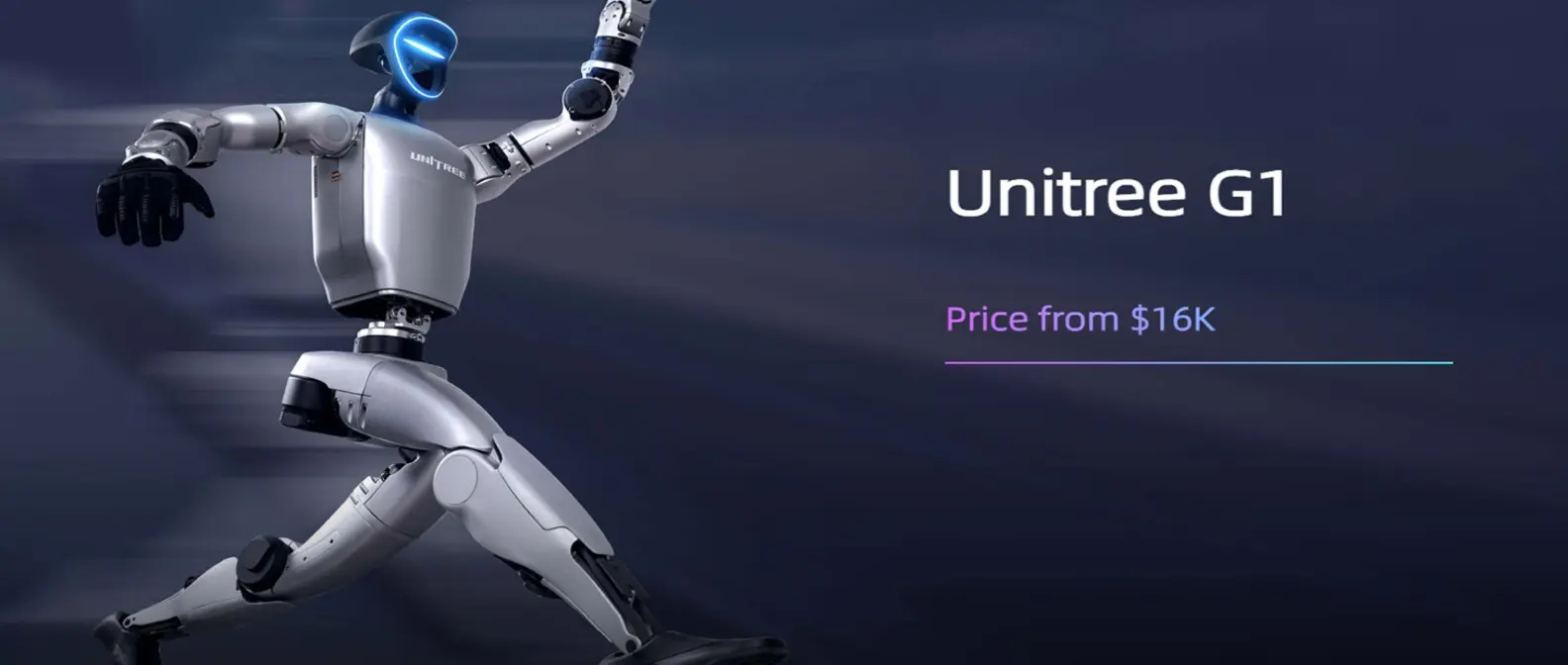
Let's get one thing straight: $13,500 for a humanoid robot isn't just cheap — it's a price breakthrough. For context, Tesla estimates the Optimus will sell for around $30,000, Boston Dynamics prices its robots north of $150,000 (for select customers only), and Figure AI hasn't even announced a price yet.
That figure is for the base G1 model — no dexterous hands, no NVIDIA Jetson Orin. The educational G1 EDU edition (with up to 43 degrees of freedom, force-controlled hands, and secondary development support) costs more, but Unitree doesn't publicly list its price — only “contact sales.”
🤖 What Exactly Is the G1?
The Unitree G1 is a compact humanoid robot designed for general-purpose use in service and industrial applications. Unlike the taller humanoids (Tesla Optimus at 173cm, Figure 03 at 173cm), the G1 stands just 132cm — roughly the size of a child. The compact size brings clear benefits: lighter weight, better stability, and improved safety.
The key difference? It folds. The G1 can collapse down to 69×45×30cm — smaller than a medium suitcase. That means easy transport, storage, and even shipping.
Base Model vs G1 EDU
Unitree offers two versions with significant differences between them:
📊 G1 vs G1 EDU — Full Comparison
⚙️ Technology & Features
Despite the low price, the G1 is far from “cheap” in terms of engineering. It uses industrial-grade crossed roller bearings in every joint, low-inertia PMSM motors (permanent magnet synchronous motors) for rapid response, and a depth camera paired with 3D LiDAR for navigation.
Beyond-Human Flexibility
Knee range of 0°-165°, hip ±154°, waist ±155°. Joint angles that exceed even human anatomical limits.
AI & Machine Learning
Imitation learning + reinforcement learning. Learns by mimicking human movements and improves through trial and error. Over-the-air updates.
Dex3-1 Dexterous Hand (EDU)
Three-finger design with force control. The thumb has 3 DOF, index finger 2, middle finger 2. Optional tactile sensor arrays.
Sensors & Connectivity
Depth Camera + 3D LiDAR, 4-channel microphone array, 5W speaker, WiFi 6 & Bluetooth 5.2. Full spatial awareness.
🏢 Who Is Unitree?
Unitree Robotics (official name: YuShu Technology Co., Ltd) was founded in 2016 in Hangzhou, China by Xingxing Wang. It was the first company in the world to begin mass retail sales of high-performance quadruped robots — the wildly popular Go1 and Go2 robot dogs.
The company didn't stop at four legs. Today Unitree manufactures a full lineup of robots: quadrupeds (Go2, B2), humanoids (G1, H1, H2, R1), robotic arms (Z1), and even fitness equipment (PUMP). The company holds over 200 patent applications, with 180+ already approved.
📖 Read more: Chinese Robots: Why China Dominates Humanoid Robotics 2026
Key 2025 Milestones
- January 2025: 16 H1 robots performed at China's Spring Festival Gala — directed by Zhang Yimou
- May 2025: World's first humanoid robot combat competition (G1-based)
- August 2025: World Humanoid Robot Games — 4 gold medals. H1 clocked 5+ m/s
- October 2025: H2 unveiled — 180cm, 70kg, bionic face, bionic eye cameras
💡 Who Is the G1 For?
At $13,500, who exactly buys a humanoid robot? The truth is, this price point isn't targeting the average consumer — at least not yet. The primary buyers are:
- Universities & research labs: The EDU version with NVIDIA Jetson Orin and secondary development capabilities is ideal for robotics researchers
- Startups & robotics companies: Instead of designing their own hardware, they can use the G1 as a platform
- Industry & logistics: For service applications, pick-and-place, warehousing
- Early adopters: Tech enthusiasts who want “their first robot”
Unitree itself is refreshingly upfront on its website: "The global humanoid robot industry is in its early stages of exploration. Individual users are strongly advised to understand the limitations before purchasing." Fair warning.
📊 How Does It Stack Up Against the Competition?
The comparison isn't as straightforward as it might seem — each robot targets a different use case. But it's still useful:
📊 Humanoid Robot Price & Size Comparison
In pure price-to-capability terms, the G1 wins hands-down. In height, payload, and AI sophistication, it trails behind. It's a classic value proposition — it doesn't do everything, but what it does, it does at a record-breaking price.
⚠️ Limitations & Reality Check
Let's not get carried away. The G1 at $13,500 is NOT Iron Man. Here's what you need to know:
- Battery life of just ~2 hours: Fine for demos and testing, not for all-day operation
- Max payload of 2-3 kg: It can hold a water bottle, not a cinder block
- Short stature (132cm): Can't reach high shelves or operate at human height
- Base model has no hands: Without the Dex3-1 upgrade, it can't grasp objects
- Only 8 months warranty: For a $13,500 system, that's minimal (18 months on EDU)
- Software still evolving: Unitree acknowledges that some advertised features are “still being developed”
"Technology drives world progress. Robots won't replace humans — they'll help us live better lives."
🔮 Is the G1 Worth $13,500?
The answer depends entirely on your purpose. If you're a robotics researcher at a university, the EDU version with NVIDIA Jetson Orin is unmatched in price-to-capability. If you want a home assistant robot for everyday tasks, we're not there yet.
Unitree's achievement lies in making humanoids affordable. Five years ago, a humanoid robot was a multi-million-dollar luxury. Now one costs less than a used car. Unitree already holds 4 gold medals from the first-ever humanoid athletic games in history — proof that the technology works.
The humanoid robot era has entered the age of mass production. And Unitree, with a robot that costs less than a car, is unlocking the door for thousands of researchers, companies, and enthusiasts around the world. That alone makes it something special.